


The Accounting Equation and the Logic of Debits and Credits

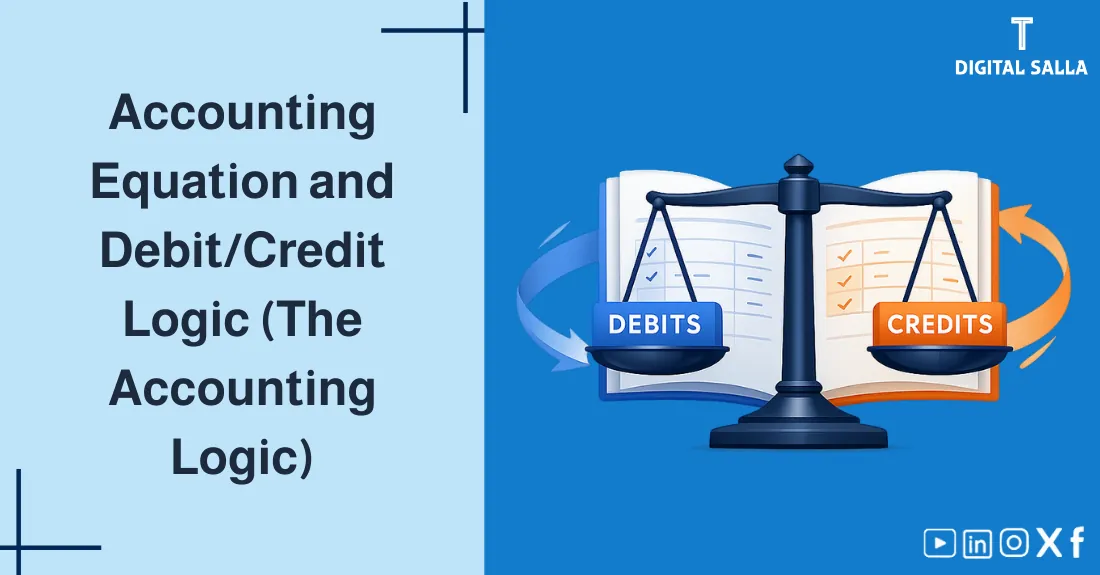
The Accounting Equation and the Logic of Debit and Credit (The Accounting Logic)
The accounting equation is the “DNA” of the financial world. It explains how every resource a company owns (Assets) is balanced against the source of its funding (Liabilities and Equity). By understanding the logic of Debit and Credit through this equation, you will move from just memorizing entries to understanding the flow of value in any business—Digital Salla.
- The primary formula: Assets = Liabilities + Equity.
- The logic of “Value Direction” (Source vs. Destination).
- Why Assets are naturally Debit and Liabilities are naturally Credit.
- How the equation expands to include Revenue and Expenses.
- SVG diagram illustrating the balance of the accounting scale.
- Interactive assessment to test your logic of financial balance.
1) The Basic Accounting Equation: The Foundation
Every accounting entry is built on a simple mathematical truth: everything the company has (Assets) must have come from somewhere.
Assets = Liabilities + Equity
This means the Total Use of Funds (what we bought) must equal the Total Source of Funds (how we paid for it).
2) The Logic of Debit and Credit (Value Flow)
Instead of thinking “left and right,” think of Value Direction:
- Debit (Dr): The receiver of value (The destination of the money).
- Credit (Cr): The giver of value (The source of the money).
In a cash purchase of equipment, Equipment receives value (Debit) and Cash gives value (Credit).

Finance Glossary - PDF File
3) The Accounting Scale: Visualizing Balance (SVG)
This diagram shows how every transaction maintains the perfect equilibrium of the ledger.
4) Why is the Nature of an Account Debit? (The Logic Rule)
The “Normal Balance” or nature of an account is simply the side of the equation it sits on:
- Assets (Left side): Are naturally Debit. To increase them, you Debit them.
- Liabilities & Equity (Right side): Are naturally Credit. To increase them, you Credit them.
5) The Expanded Equation: Adding Revenue and Expenses
Daily operations are integrated into the equation through Equity:
- Revenue: Increases Equity, so its nature is Credit.
- Expenses: Decrease Equity, so their nature is Debit (the opposite of Equity).
6) Analyzing Transactions Step-by-Step
When any transaction occurs, ask yourself:
- Which accounts are affected?
- What is the nature of these accounts (Asset, Liability, etc.)?
- Did they increase or decrease?
- Apply the rule: Increase = Same side; Decrease = Opposite side.
7) Interactive Assessment: Logic of Balance
8) Frequently Asked Questions
Why must the equation always balance?
Because every dollar a company owns (Asset) has to have come from somewhere (Debt or Capital). It is a mathematical necessity.
What happens if the equation is not balanced?
It means there is a “recording error”—either an amount was entered incorrectly, a side of the entry was missed, or an account was classified wrongly.
Is ‘Debit’ always a good thing?
No. Debit simply means the left side. It’s good when it increases cash, but bad when it increases an expense.
9) Conclusion & Summary
The accounting equation is not just for math; it is for Logic. By mastering the relationship between Assets, Liabilities, and Equity, and understanding how Debit and Credit maintain this balance, you gain the “Internal Vision” needed to analyze any financial statement—Digital Salla.