


Accounting Documents: Invoice, voucher, and notice (Tax Acceptance Conditions)

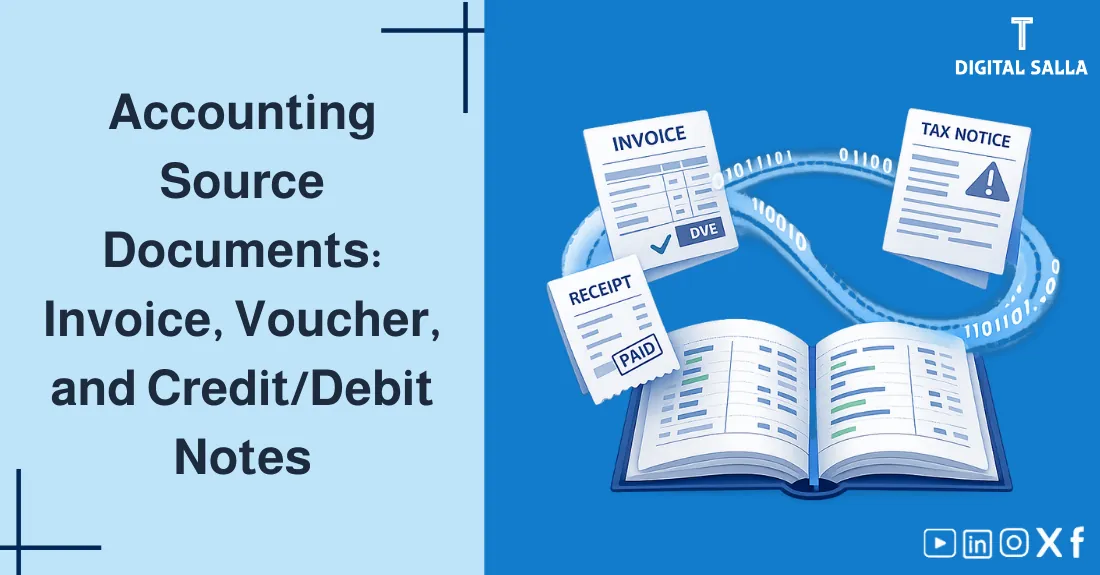
Accounting Documents: Invoice, Voucher, and Notice (Tax Acceptance Conditions)
In accounting, “If it’s not documented, it didn’t happen.” Source Documents are the real physical evidence for any financial transaction. Without a proper invoice or voucher, you cannot record an entry, defend a tax audit, or prove your rights to a third party. In this article, we explain the most important accounting documents, the difference between them, and the essential conditions for Tax Acceptance of your expenses.
- The vital importance of documents in the Accounting Cycle.
- Detailed types: Tax Invoices, Receipt Vouchers, and Payment Vouchers.
- What are Debit and Credit Notes and when are they used?
- Essential conditions for Tax Acceptance of an invoice to avoid fines.
- Legal requirements for Archiving and digital document handling.
- Visual model (SVG) summarizing the data flow from document to report.
1) Importance of Documents in Accounting
Source documents serve three primary purposes:
- Verification: Proving that a transaction actually took place between two parties.
- Authorization: Confirming that the transaction was approved by the responsible person.
- Audit Trail: Allowing internal and external auditors to trace a figure from the report back to reality.
2) Types of Source Documents
| Document Type | When is it used? | Accounting Effect |
|---|---|---|
| Tax Invoice | Selling/Buying goods or services | Recording Revenue or Expense |
| Receipt Voucher | Receiving money (Cash/Check) | Increasing Cash/Bank Balance |
| Payment Voucher | Paying money to others | Decreasing Cash/Bank Balance |
| Credit Note | Reducing a customer’s debt (Returns) | Decreasing Receivables/Revenue |
| Debit Note | Increasing a customer’s debt | Increasing Receivables/Revenue |
3) The Tax Invoice: Core Requirements
For an invoice to be considered “Tax Valid” in most jurisdictions, it must contain:
- Serial Number: Unique and sequential.
- Date: Issuance date and delivery date.
- Seller Data: Legal name, Address, and Tax ID / VAT Number.
- Buyer Data: Name and Tax ID (for B2B transactions).
- Line Items: Description, Quantity, Unit Price, and Total.
- Tax Summary: Net amount, Tax Rate, and Total Amount Due.
4) Receipt and Payment Vouchers
Vouchers are internal control documents used to track liquid cash movements.
Sales Controls Template - Excel Template
- Receipt Voucher: Issued when you receive cash from a customer. It is the basis for increasing the “Cash” account.
- Payment Voucher: Issued when paying salaries, utility bills, or suppliers. It must be signed by the Requestor, Reviewer, and Payer.
5) Debit and Credit Notes
These are used to adjust previously issued invoices without cancelling them.
6) Tax Acceptance Conditions for Expenses
To deduct an expense from your taxable income, the tax authority usually requires:
- Necessity: The expense must be related to generating business income.
- Documentation: Supported by a valid Tax Invoice or equivalent legal document.
- Actual: The transaction must have real economic substance.
7) Archiving and Digital Documents
In the age of E-Invoicing, digital documents have the same legal weight as paper ones if they follow technical standards (Signatures, QR codes).
- Retention Period: Usually 5 to 10 years depending on local laws.
- Safety: Documents must be stored in a way that prevents damage or unauthorized edits.
8) Documentary Cycle Summary (SVG)
9) Frequently Asked Questions
What is a source document simply?
It is the physical or digital evidence (like an invoice or receipt) that proves a financial event happened.
Can I record an entry without an invoice?
Strictly, no. However, in cases like small “out-of-pocket” expenses, an internal payment voucher signed by management might be used.
10) Conclusion
Mastering accounting documents is not a “clerical” task; it is the core of Internal Control and Tax Compliance. By ensuring every invoice is valid and every voucher is approved, you build a reliable system that can withstand any audit and protects your company’s financial rights.