


Balanced Accounting Errors: Errors not revealed by the trial balance and how to catch them?

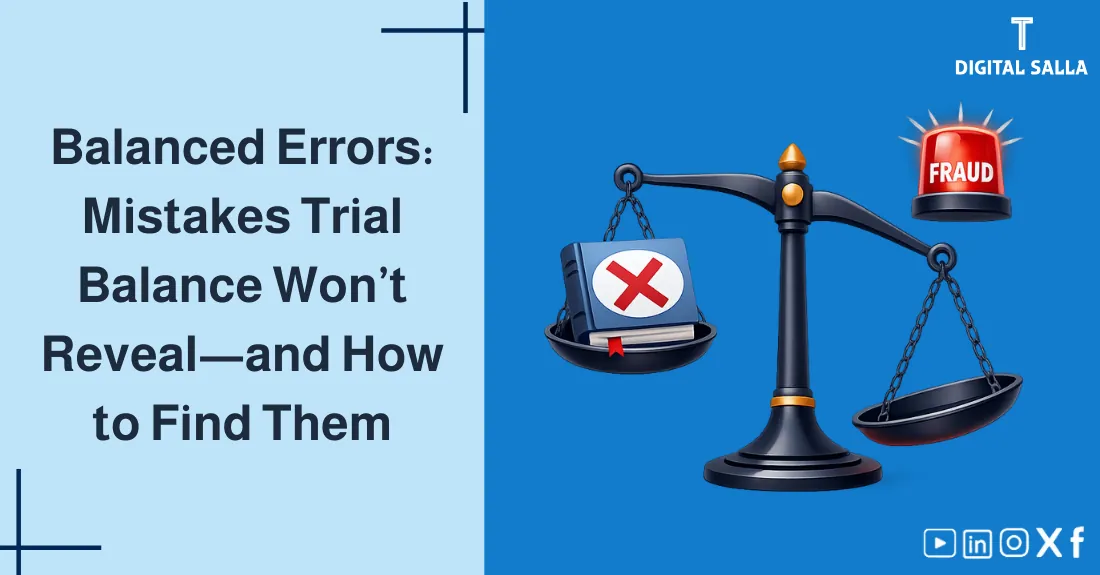
“Balanced” Accounting Errors: What the Trial Balance Misses & How to Catch Them?
In professional accounting, a balanced scale doesn’t always mean the data is clean. Balanced accounting errors are a sophisticated trap: they don’t break the mathematical equilibrium of the Trial Balance, making them invisible to simple checks. Understanding these errors—such as Errors of Omission and Principle—is the difference between a bookkeeper and a professional controller. This guide provides the practical path for detecting and neutralizing these hidden risks—Digital Salla.
- Detailed definition of Balanced Errors and why they bypass the TB.
- The 5 types of hidden errors: Omission, Duplication, Principle, Commission, and Compensating.
- Equilibrium Scale (SVG): Visualizing how errors stay hidden.
- Professional audit techniques for detection: Vouching and Analytical Review.
- Practical Audit Plan (Excel/CSV ready) for monthly reviews.
- Interactive assessment to test your error-hunting skills.
1) What are Balanced Errors? (The Invisible Risk)
A Balanced Error is an accounting mistake where the total debits still equal the total credits. Because the double-entry system remains mathematically consistent, the Trial Balance produces a “Success” message even though the financial reality is distorted.
2) The Equilibrium Limitation (SVG Diagram)
This diagram visualizes why a balanced scale is not a sign of total health.
3) The 5 Types of Hidden Errors: Knowing the Enemy
| Error Type | Example | Why TB misses it? |
|---|---|---|
| Error of Omission | A $5,000 sale happens but is never recorded. | Both Dr and Cr are missing equally. |
| Error of Principle | Buying a computer ($1,000) and recording it as “Repair Expense”. | Correct amount is used on the correct side (Debit), but wrong account category. |
| Error of Duplication | Recording the same invoice twice in the journal. | The double recording maintains the math balance. |
| Error of Commission | Recording a payment to Supplier A in Supplier B’s account. | Total Liabilities remain correct; only the sub-ledger detail is wrong. |
| Compensating Error | Understating Cash by $100 and understating Revenue by $100. | The two separate errors cancel each other out mathematically. |
4) Interactive Tool: Error Hunter Diagnostic
Fraud Risk Assessment - Excel Template
5) Professional Detection Methods (Audit Techniques)
Since the Trial Balance won’t help, you must use these “Manual Detectives”:
- Vouching: Matching journal entries with their original source documents (Invoices, Receipts).
- External Reconciliations: Comparing internal balances with bank statements or supplier statements.
- Analytical Review: Comparing current month expenses with previous months. A sudden drop in a recurring expense often signals an Omission Error.
- Cut-off Testing: Reviewing transactions just before and after year-end to ensure they belong to the correct period.
6) Monthly Internal Audit Checklist
Use this structured plan to catch balanced errors before they reach the board.
Ready-to-use Audit Checklist Template (CSV Format)
7) Frequently Asked Questions
Are balanced errors considered fraud?
Not necessarily. Most are human mistakes. However, they are often used by fraudsters to hide theft (e.g., recording a personal withdrawal as a business expense).
Does software prevent Errors of Principle?
No. Software only checks “Debit = Credit.” If you tell the system that a car purchase is a “Fuel Expense,” the system will accept it as long as the numbers match.
Which is more dangerous: an imbalanced TB or a balanced error?
A balanced error is far more dangerous because it is hidden. An imbalanced TB forces you to find the error before you can close the books.
8) Conclusion & Summary
A Trial Balance is a test of Arithmetic, not Accountancy. By mastering the detection of Errors of Principle and Omission, you provide your company with the highest level of data integrity—Digital Salla. Always audit the logic, not just the totals.