

Customer and Supplier Reconciliations: How to prevent disputes and ensure balance accuracy?

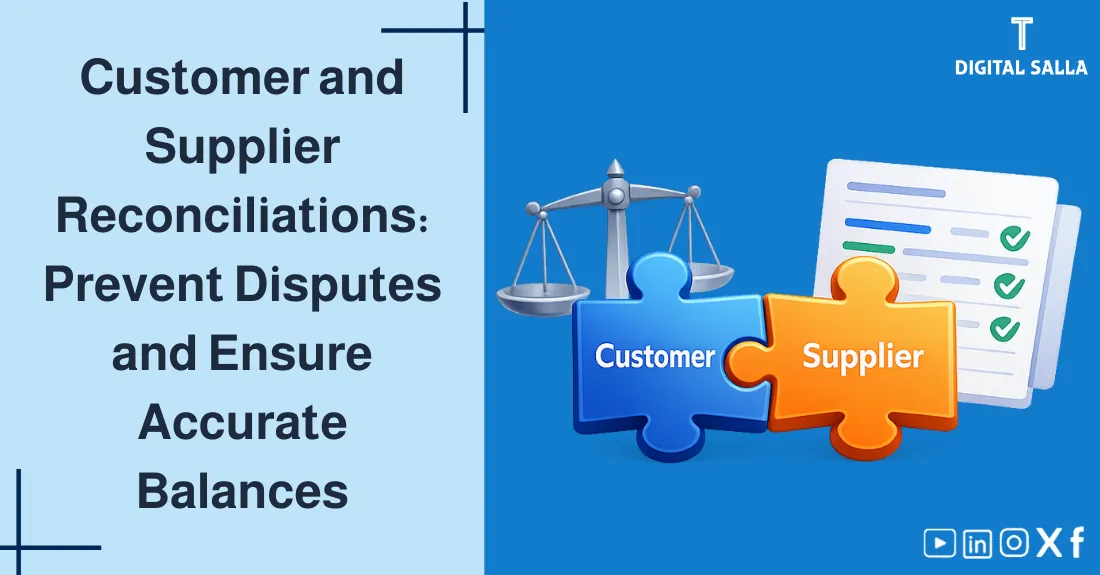
Customer and Supplier Reconciliations: How to Prevent Disputes and Ensure Balance Accuracy?
“Trust but verify” is the golden rule of business relationships. Customer and supplier reconciliations are the primary defense against overpayments, bad debts, and legal disputes. Through the process of matching internal records with external statements and sending Balance Confirmations, you ensure that your assets (AR) and liabilities (AP) are reflected with 100% accuracy. This guide provides the practical path for professional reconciliation—Digital Salla.
- The 3 critical reasons for performing periodic reconciliations.
- Detailed Reconciliation Cycle: From matching to closing.
- Types of Balance Confirmations (Positive vs. Negative).
- Common discrepancy causes: Timing, Returns, and Errors.
- Reconciliation Map (SVG): The path to a zero-discrepancy balance.
- Interactive Tool: Reconciliation Management Plan (CSV Export).
1) Why Reconcile Accounts? (The Protection Goal)
Reconciling Accounts Receivable (AR) and Accounts Payable (AP) protects the company from three major risks:
- Dispute Prevention: Identifying missing invoices or returns before they turn into legal battles.
- Asset Protection: Ensuring customers are paying exactly what they owe and avoiding bad debt surprises.
- Liquidity Accuracy: Providing management with a true picture of upcoming cash inflows and outflows.
2) The Reconciliation Cycle: From Matching to Closing (SVG)
Follow this systematic path to ensure your balances are bulletproof.
3) Reconciliations vs. External Confirmations
While often used together, they serve different professional roles:
Journal Entry Tracker - Excel Template
- Reconciliation: The internal process of listing all transactions on both sides and identifying exactly what is missing or wrong.
- Confirmation (External): A formal request sent to the other party asking them to confirm the total balance as of a specific date. This is a primary tool for auditors.
4) Standard Confirmation Types (Auditing Tools)
| Type | How it works | Risk Level |
|---|---|---|
| Positive Confirmation | The party MUST respond whether they agree or disagree. | Low (High Reliability) |
| Negative Confirmation | The party responds ONLY if they disagree with the balance. | Medium (Assumes agreement) |
| Blank Confirmation | The party is asked to fill in the balance themselves. | Lowest (Highest Reliability) |
5) Common Causes of Discrepancies: The Usual Suspects
- Timing Differences: You sent a payment on the 30th, but the supplier received it on the 2nd of the next month.
- Goods in Transit: You recorded a purchase, but the goods haven’t reached your warehouse yet.
- Unprocessed Returns: You returned goods, but the supplier hasn’t issued a Credit Note yet.
- Recording Errors: Entering $1,200 as $2,100 on one side.
6) Reconciliation Management Plan: Monthly Steps
Use this roadmap to organize your monthly reconciliation tasks.
Reconciliation Procedure Roadmap (Downloadable CSV Template)
7) Interactive Assessment: Choose the Procedure
8) Frequently Asked Questions
How often should AR/AP reconciliations be performed?
Monthly is the standard. However, for high-volume accounts or strategic partners, weekly reconciliation is recommended to keep cash flow data accurate.
What is a ‘Statement of Account’ (SOA)?
It is a report generated from the ledger that lists every invoice, payment, and return for a specific period to share with the partner for matching.
Can reconciliations be automated?
Yes. Modern ERPs can automatically match invoice numbers and amounts, but “Discrepancy Analysis” still requires professional human judgment.
9) Conclusion & Summary
Reconciliation is not just a bookkeeping task; it is an act of Internal Control. By systematically identifying differences and confirming balances with partners, you provide your company with reliable data, prevent financial leakage, and maintain professional relationships—Digital Salla. Always close the loop with required adjusting entries to keep your books synced with reality.