


Matching Principle: The Concept Governing Inventory Adjustments

The Matching Principle: The Concept Governing Adjusting Entries
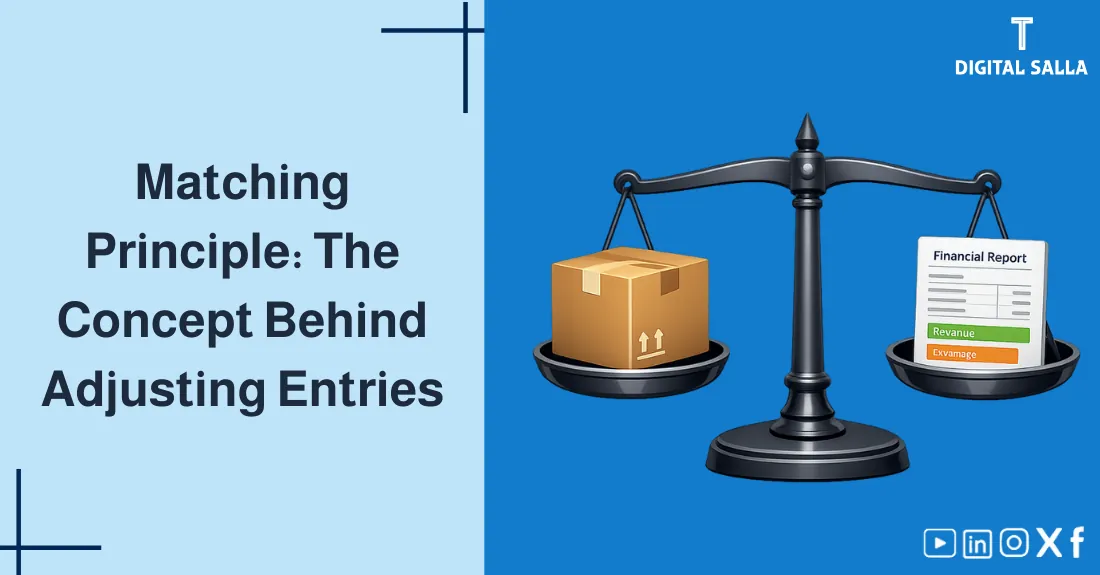
Why do we record “Depreciation” even though no cash leaves the bank? And why do we record “Unpaid Salaries” at year-end? The answer lies in the Matching Principle. This principle is the “Moral Scale” of accounting; it ensures that the expenses you record are the ones responsible for the revenues you earned during the same period. In this article, we explain the matching principle: What is its core logic? How is it linked to Adjusting Entries? And how do you use it to avoid misleading profits that don’t reflect reality?
- A clear definition of the Matching Principle and its practical goal.
- The relationship between “Matching” and the Accrual Basis.
- A visual model (SVG) explaining the Cause and Effect relationship in costs.
- The four main applications: Depreciation, Accruals, Prepayments, and Inventory cost.
- Interactive Tool: Generate an allocation schedule to apply the matching logic to a cost.
- Risks of ignoring matching: Overstated profits and asset valuation errors.
1) What is the Matching Principle?
The Matching Principle requires that a company record expenses in the same period as the revenues they helped generate. It is based on a simple logic: You shouldn’t report the profit from a sale unless you also report the costs incurred to make that sale happen.
2) Why is it the “Heart” of Accounting?
Without this principle, financial statements would be a mess of seasonal cash fluctuations:
- Fair Performance Measurement: It tells you if your business model is actually profitable today.
- Consistency: It allows for realistic comparison between different fiscal years.
- Investor Confidence: Banks and investors need a “Smoothed” view of performance, not a erratic “Cash Tracker.”
3) Matching vs. Accrual Basis
While the Accrual Basis is the “Environment” or the general umbrella, the Matching Principle is the “Mechanism” that works inside it. Accrual focuses on When to record (Timeline), while Matching focuses on What to record alongside it (Correlation).
OH Absorption Model - Excel Template
4) Visual Logic: Cause and Effect
5) Practical Real-World Applications
A) Depreciation (Matching Cost over Time)
When you buy a computer for $1,200, it helps you earn money for 3 years. Under the matching principle, you record $400 expense each year, matching the cost with the benefit period.
B) COGS (Cost of Goods Sold)
You bought 100 items for stock in Nov, but only sold 20 in Dec. The matching principle dictates that Dec’s profit only reflects the cost of the 20 items sold.
6) Interactive Allocation Tool
Enter a multi-period cost to see how the Matching Principle would distribute it:
7) Risks of Violation
- Overstating Profits: If you delay recording a bonus expense to the next year, this year’s profit looks artificially high.
- Audit Failure: External auditors focus heavily on “Cut-off” entries, which are based entirely on matching.
- Bad Decisions: Management might expand based on high profits that didn’t account for upcoming predictable costs.
8) Frequently Asked Questions
Does matching mean cash is not important?
No. Cash is vital for liquidity, but the Matching Principle is for Performance measurement. You need both a P&L (Matching) and a Cash Flow Statement.
What if I can’t determine the exact revenue an expense generated?
In cases like Office Rent, we use “Systematic Allocation” (matching to the time period) as a proxy for matching to revenue.
9) Conclusion
The summary is simple: The Matching Principle is the difference between a professional financial report and a simple receipt book. By mastering the “Cause and Effect” logic, you ensure that your net profit is a reliable indicator that helps you and your investors make sound growth decisions.