


Other Comprehensive Income (OCI): What is it? And Why Do Its Items Not Appear in the Profit and Loss Statement?

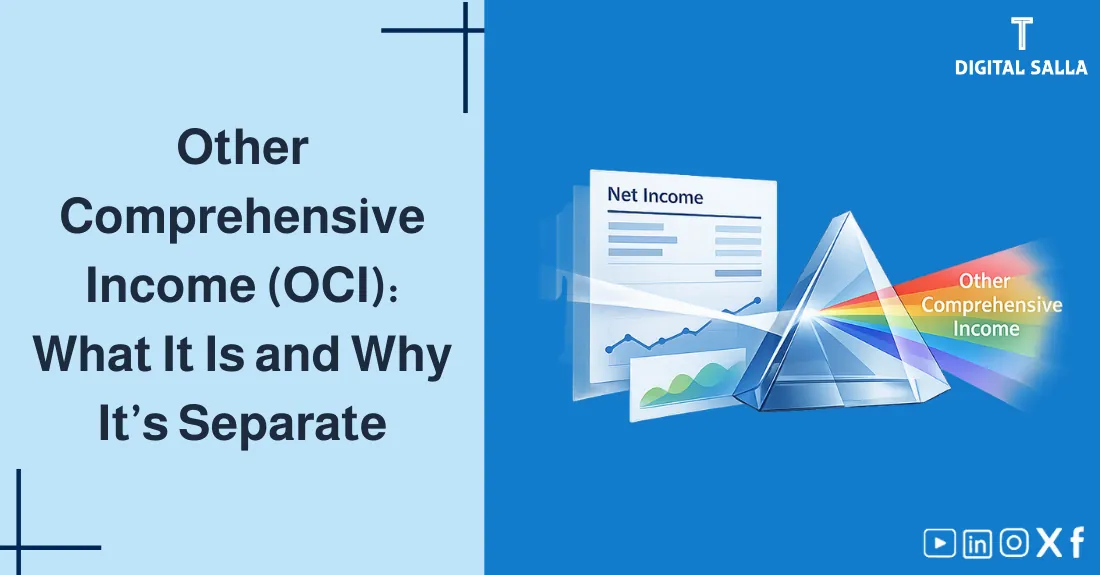
Other Comprehensive Income (OCI): What is it? And why is it excluded from P&L?
Other Comprehensive Income (OCI) is one of the most confusing concepts for readers when analyzing financial statements: “How can there be a profit/loss that doesn’t appear inside the Profit & Loss Statement?” The answer is simply: Standards consider that displaying certain changes (such as currency differences or revaluation) outside of profit or loss provides a fairer view of operational performance, while maintaining their impact within Equity.
- Primary Keyword: Other Comprehensive Income
- Secondary Keywords: OCI, Comprehensive income items, Currency differences, Revaluation
1) What is Other Comprehensive Income (OCI)?
Other Comprehensive Income (OCI) is a section within “Comprehensive Income” that includes items of income or loss not displayed within Profit or Loss (P&L), but displayed separately and then transferred to Equity according to standard requirements.
2) Why doesn’t OCI appear inside the P&L?
The idea isn’t to hide results; but to separate what represents “Operational Performance during the period” from what might be measurement/valuation fluctuations or items with a special nature requiring separate presentation. Therefore, OCI is often used to minimize mixing operational performance with items that may be:
- Unrealized in cash terms during the same period.
- Linked to re-measurement, translation differences, or valuations.
- Realized later when a specific event occurs (such as disposing of an investment/foreign operation).
3) Where does OCI appear? And how is it presented?
Other Comprehensive Income (OCI) usually appears in a separate statement or within a single comprehensive statement, depending on the entity’s presentation method, but the result is the same: presenting Profit or Loss, then OCI, then arriving at Total Comprehensive Income.
| Method | How does it look to the reader? | Practical Advantage |
|---|---|---|
| Single Comprehensive Statement | One list: Profit/Loss then OCI section then Total comprehensive income | Viewing the story on one page |
| Two Separate Statements | Income Statement (P&L) separate + Statement of Other Comprehensive Income | Clearer separation of operational performance from OCI |
4) Most common OCI items
“Comprehensive Income items” vary according to the nature of the company, but these are the most common examples (covering keywords like Currency differences and Revaluation):

FX Revaluation & Translation Toolkit - Excel File
| Item | Simple Concept | What to monitor? |
|---|---|---|
| Foreign currency translation differences | Changes in translating statements for foreign operations/investments due to exchange rate changes | Is currency exposure high? Is the change seasonal or persistent? |
| Asset Revaluation | Increase/decrease in the value of revalued assets according to measurement policy | What is the valuation basis? Is the increase sustainable or temporary? |
| Remeasurement of defined benefit plans (Actuarial gains/losses) | Changes in employee benefit obligations due to assumptions/measurement | Are assumptions (discount/salary/life expectancy) justified? |
| Fair Value changes for certain instruments | Measurement changes presented as OCI depending on instrument classification | Is the change linked to market/credit risk/interest rate? |
| Cash flow hedge reserve | Part of hedging gains/losses treated within OCI then reclassified later | What is the nature of the hedge? When will it reflect on Profit or Loss? |
5) Reclassification: When does OCI return to the P&L?
Some items of Other Comprehensive Income (OCI) are recorded temporarily in OCI and then reclassified later to Profit or Loss when a specific event occurs (such as sale/disposal/hedge effect realization). Thus, you will typically find a common classification:
| Type | Concept | Practical Example |
|---|---|---|
| May be reclassified later | Recorded in OCI now, then moves to P&L upon a condition/event | Cash flow hedge reserve, some currency translation differences upon disposal of foreign operation |
| Will not be reclassified | Remains within Equity and does not transfer later to P&L | Some revaluation items or specific measurement items per Standard/Policy |
6) The impact of OCI on Equity
Practically, OCI items typically accumulate within Equity often in a separate account/reserve (such as “Accumulated Other Comprehensive Income” or specific reserves). Therefore, you might see a company with stable net profit, but Equity moving aggressively due to OCI.
7) Common mistakes when reading OCI
- Considering OCI “unimportant”: While it can be very influential on Equity and leverage ratios.
- Confusing Other income and OCI: The first is inside Profit or Loss, the second is outside it.
- Ignoring Reclassification: Some OCI may return later to the Income Statement and affect future profits.
- Not linking OCI to Notes: Material details are often in the notes (source of change, policy, valuation).
- Neglecting Tax Impact: Many OCI items are presented “net of tax” or “before tax” depending on presentation, which must be understood.
8) Calculator: Total Comprehensive Income
Use this calculator to quickly understand the relationship: Total Comprehensive Income = Net Profit + Total Other Comprehensive Income. (If the OCI value is negative, enter it as a negative).
9) Frequently Asked Questions (FAQ)
What is Other Comprehensive Income (OCI)?
Other Comprehensive Income (OCI) is a group of income or loss items that are not presented within the Profit & Loss statement, but are presented in the “Other Comprehensive Income” section and go directly to Equity according to standard requirements.
Why don’t OCI items appear in the Income Statement (P&L)?
Because standards consider that displaying certain value changes or measurement differences within profit or loss might cause volatility that doesn’t reflect operational performance, so they are displayed in OCI to show their impact without mixing them with the operating result.
Do OCI items affect Equity?
Yes, OCI items typically accumulate within an “Accumulated Other Comprehensive Income” reserve/balance inside Equity, and some items may be reclassified later to Profit or Loss depending on the standard (Reclassification).
What is the difference between “Other income” and OCI?
“Other income/expenses” in the income statement are items within profit or loss, whereas OCI is a separate section presented outside profit or loss and affects equity according to specific requirements.
How do I calculate Total Comprehensive Income?
Total Comprehensive Income = Net Profit (from Income Statement) + Total Other Comprehensive Income (OCI).
10) Conclusion
Other Comprehensive Income (OCI) is an additional “layer” to reading performance: It separates certain changes (such as currency differences and revaluation) from Profit or Loss to avoid distorting the operational picture, while retaining their impact within Equity. When analyzing a company, do not stop at Net Profit—link it with OCI then monitor the impact on Equity and Notes.