


Non-recurring Items: How to isolate them to assess true performance?

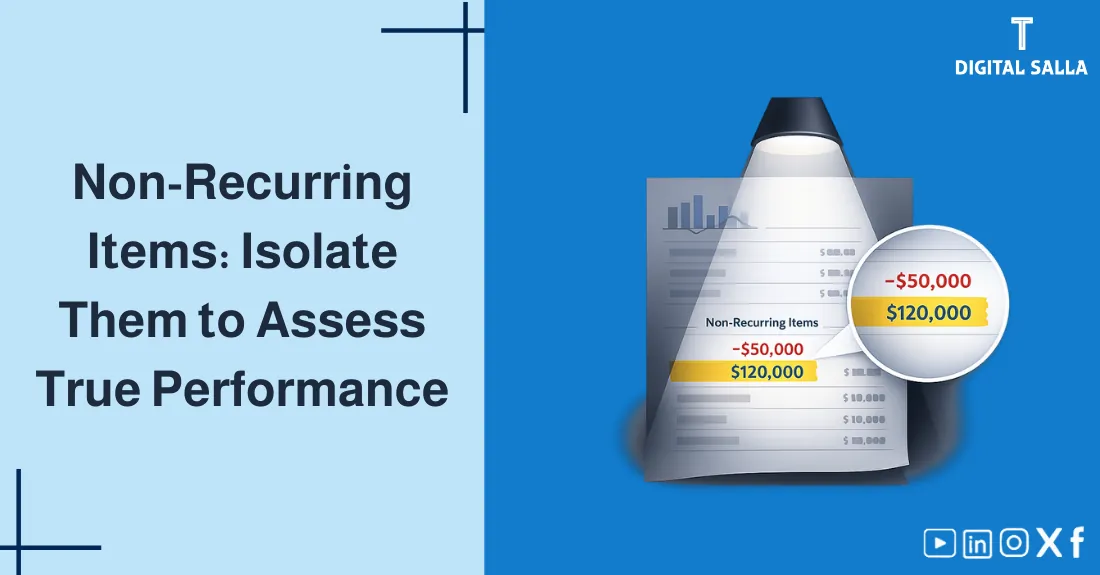
Non-recurring Items: Isolating Exceptional Gains and Losses
Not all profit is created equal. Non-recurring Items are the “Noise” in the financial statements—exceptional gains or losses that are unlikely to happen again. To evaluate a company’s true performance, you must isolate these items to calculate Normalized Earnings. This guide teaches you how to clean the numbers to see the sustainable reality—Digital Salla.
- Precise definition of Non-recurring Items vs. Operating Items.
- Examples: Asset sales, restructuring costs, legal settlements.
- How to calculate Normalized Earnings (Adjusted Net Income).
- Logic Map (SVG): The process of filtering the Income Statement.
- Interactive Tool: Normalization Calculator (Impact of One-offs).
1) What are Non-recurring Items? (The Definition)
They are revenues or expenses recorded in the current period that are not expected to recur in future periods.
Also known as: Exceptional Items, One-off Items, or Extraordinary Items (in some older standards).
2) Common Examples: Gains vs. Losses
One-off Gains (Inflate Profit)
- Gain on sale of Fixed Assets (e.g., selling HQ building).
- Gain from lawsuit settlement in company’s favor.
- One-time tax rebate.
One-off Losses (Deflate Profit)
- Restructuring costs (severance pay, closing branches).
- Loss from natural disasters (fire, flood).
- Asset Impairment charges (write-downs).
3) Normalization Process: Cleaning the Statement (SVG)
Visualizing how to strip out the noise to see the signal.
4) The Tax Effect (Don’t Forget!)
When adjusting for non-recurring items, you must adjust Net of Tax.
Example: If you add back a $100 loss, and tax rate is 20%, you only add back $80 to Net Income (because the loss saved you $20 in taxes).
Rolling Forecast 12-Month Model - Excel File
5) Interactive Tool: Normalization Calculator
Calculate the true sustainable earnings by excluding the noise.
Normalized Net Income: —
Difference (Impact): —
Margin: —
EPS: —
Margin: —
EPS: —
6) How to Interpret Adjusted Earnings?
- Normalized > Reported: The company had unusual losses this year. Underlying performance is better than it looks.
- Normalized < Reported: The company had unusual gains. Be careful not to value the company based on this year’s inflated profit.
7) Frequently Asked Questions
Are non-recurring items illegal?
No, they are real business events. The issue is not legality, but “Comparability” and “Predictability” for investors.
Can a company manipulate via ‘Non-recurring’ labels?
Yes. Some companies label recurring bad costs as “restructuring” every year to inflate their “Adjusted Earnings”. Always check the footnotes.
Does EBITDA exclude non-recurring items?
Standard EBITDA does not automatically exclude them. You usually calculate “Adjusted EBITDA” to remove non-recurring items.
8) Conclusion
Non-recurring Items analysis is the difference between an amateur and a professional analyst. By normalizing earnings, you remove the noise and see the true operational power of the business. Always ask: “Will this happen again next year?” If no, adjust it out—Digital Salla.