


Deductible and Non-Deductible Expenses: How to Adjust Accounting Profit for Tax Purposes?

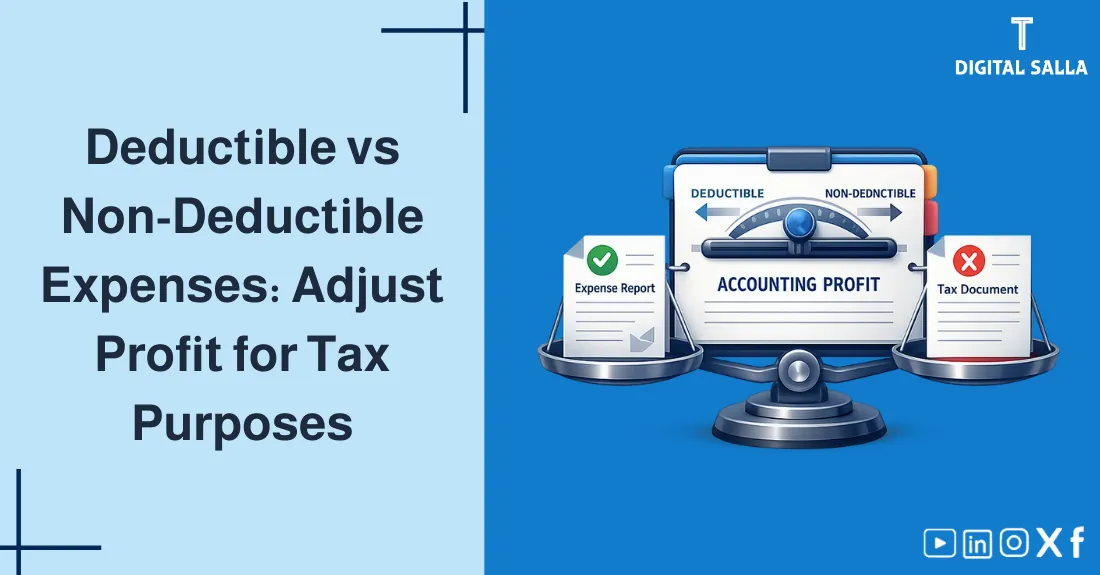
Deductible vs. Non-Deductible Expenses: How to Enhance Acceptance and Reduce Rejection?
Deductible and non-deductible expenses: A practical guide to converting accounting profit into taxable profit, understanding expense acceptance criteria, and building a strong documentation file—Digital Salla.
- Core criteria for an expense to be considered Deductible for tax purposes.
- Examples of Non-Deductible Expenses that are added back to accounting profit.
- How to reconcile accounting profit to Taxable Profit (The Reconciliation Schedule).
- Documentation requirements: How to prove the business nature and legality of an expense.
- A decision map and operational checklist for preparing an audit-ready expense register.
1) The Concept of Tax Deductibility
In Corporate Income Tax (CIT), taxable income is determined by adjusting the net accounting profit. Deductible Expenses are those the authority allows you to subtract from revenue to reach the base, while Non-Deductible Expenses are those that must be “Added Back” to your profit because they don’t meet tax criteria.
2) Criteria for Expense Acceptance (Deductibility)
Before classifying an expense as deductible, it must pass the following “Tax Filters” (based on ZATCA general principles):
| Criteria | Description | Audit Proof |
|---|---|---|
| Business Relation | The expense must be incurred for the purpose of generating taxable income. | Linked to activity, project, or cost center. |
| Actual & Documented | It must be a real transaction supported by a valid tax invoice. | Formal invoice + proof of payment (Bank/Cash). |
| Period Specificity | It must relate to the current tax year (Accrual Principle). | Invoice date vs. service/delivery date. | It should not result in a long-term asset (which should be depreciated instead). | Asset capitalization policy vs. repair/maintenance. |
3) Common Deductible Expenses
Most operational expenses are deductible if they meet the above criteria. Examples include:
- Cost of Goods Sold (COGS): Raw materials, labor, and direct production costs.
- Salaries & Benefits: Paid to employees registered in the payroll system (Social Insurance matched).
- Rent & Utilities: Supported by formal lease contracts and utility bills.
- Marketing & Sales: Documented campaigns and agency fees related to promoting the business.
- Depreciation: Calculated per the Tax Depreciation Rates (which may differ from accounting rates).
4) Common Non-Deductible Expenses (The “Add-Backs”)
These are items found in your Income Statement that the authority will “Reject” and add back to your profit.
Final Review & Sign-off Checklist - Excel File
| Item | Reason for Rejection | Alternative Treatment |
|---|---|---|
| General Provisions | They represent estimated future costs, not actual ones. | Add back to profit; deduct only when actualized/paid. |
| Fines & Penalties | Incurred due to law violations, not for generating income. | Always added back (Non-deductible). |
| Personal Expenses | Not related to the business entity’s taxable activity. | Added back (Non-deductible). |
| Income Tax/Zakat Paid | Tax on profit is not a cost of generating that profit. | Added back (Non-deductible). |
| Unproven Expenses | Missing formal tax invoices or proof of payment. | Added back (Risk of penalties). |
5) Reconciling Accounting Profit to Taxable Income
This is the “Workhorse” of your tax return. You start from the bottom line of your P&L and apply adjustments.
Download the template designed for CIT reconciliation and base calculation: Income Tax (CIT) Calculation and Settlement Template
6) Documentation File: The Audit Defense
An expense is only as “deductible” as the paper trail behind it. For major expenses, prepare a file containing:
- Primary Document: Valid Tax Invoice (Seller data, Registration #, Date, Description).
- Proof of Link: Contract, Purchase Order, or Project Code.
- Proof of Payment: Bank transfer confirmation or receipt.
- Internal Approval: Signature from authorized personnel according to company policy.
7) Operational Controls & Checklist
To ensure deductible expenses are accepted and non-deductible ones are correctly identified:
Expense Quality Gate Checklist
- Does every material expense have a formal tax invoice?
- Is the expense related to a project/activity that generates taxable revenue?
- Have provisions been separated into their own GL account for easy add-back?
- Is there a clear policy for “Entertainment” and “Employee Benefits” per tax rules?
- Have you reconciled accounting depreciation to tax depreciation?
8) Common Errors and How to Prevent Them
- Deducting Estimated Costs: Claiming expenses based on accruals or estimates without an actual invoice.
- Missing Withholding Tax (WHT): Deducting a foreign service expense without proving WHT payment (if applicable).
- Mixing Capital and Revenue: Recording a long-term asset as a repair/maintenance expense.
- Weak Document Retention: Not being able to find the invoice for a major deductible expense during an audit.
9) Frequently Asked Questions
What are Deductible Expenses?
These are the expenses incurred by the entity for the purpose of generating taxable income, provided they are actual, documented, and related to the activity of the period.
Why are provisions non-deductible?
Because they are estimated amounts for future liabilities. Tax authorities only allow deductions for “actual” expenses incurred and proven by documents.
Can I deduct fines paid for traffic violations during business trips?
No. Fines and penalties resulting from law violations are generally non-deductible, regardless of whether they happened during business hours.
What happens if an expense is rejected by ZATCA?
It is added back to your taxable profit, which increases the tax due. You may also be subject to penalties for under-reporting tax if the variance is material.
10) Conclusion
Mastering deductible and non-deductible expenses is the only way to an accurate CIT return. By applying the 4 pillars of deductibility, maintaining a disciplined reconciliation schedule, and keeping a strong documentation file, you will ensure tax compliance, minimize audit rejection risks, and protect the entity’s profitability.
Action Step Now (30 minutes)
- Extract your Expense Ledger for the last quarter.
- Identify the 10 largest items and verify they have formal invoices and business links.
- Locate all “Provisions” and “Fines” accounts and mark them for Add-back in your tax file.