


Contribution Margin: The secret tool for promotion and sales mix decisions

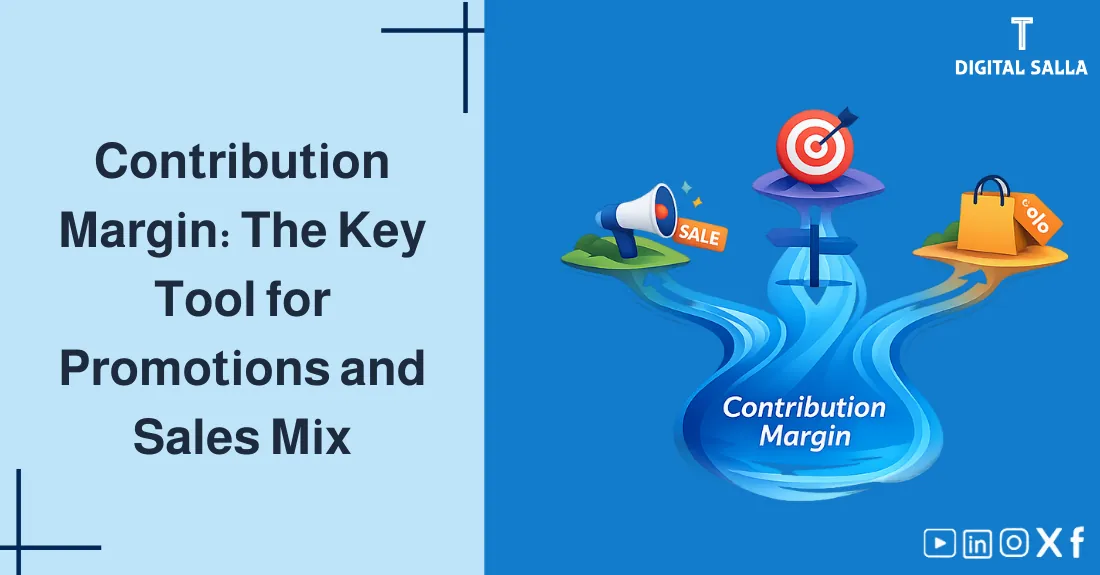
Contribution Margin: The Secret Tool for Promotion and Sales Mix Decisions
Contribution Margin: A practical guide on how to calculate the CM Ratio and use it to cover fixed costs, determine the Break-Even Point, and make strategic pricing and sales mix decisions—Digital Salla.
- Fundamental definition: Contribution Margin (CM) vs. Gross Profit.
- How to calculate CM per Unit and the CM Ratio (%).
- Using CM to analyze Product Profitability.
- Strategic Decisions: Product mix with Constrained Resources.
- Impact of CM on marketing and sales promotion decisions.
1) The Concept of Contribution Margin (CM)
The Contribution Margin is the revenue remaining after all Variable Costs (manufacturing and selling) have been deducted. It is called “Contribution” because this amount is what contributes to covering Fixed Costs and then generating a Net Profit.
2) CM Formulas & Calculation
You must be able to calculate the margin at both the unit and the total level.
2.1 Unit Calculation
CM per Unit = Selling Price − Variable Cost per Unit.
2.2 Percentage Calculation (Ratio)
CM Ratio (%) = (CM per Unit / Selling Price) × 100.
Example: If price is $100 and variable cost is $60, the CM Ratio is 40%.
Pricing & Markdown Tracker - Excel Template
3) CM vs. Gross Profit (The Big Difference)
This is where most traditional accountants get confused.
| Aspect | Gross Profit (Traditional) | Contribution Margin (Strategic) |
|---|---|---|
| Deducts | COGS (Variable + Fixed Mfg) | Total Variable Costs (Mfg + Sales) |
| Ignores | Selling & Admin Expenses | All Fixed Costs |
| Focus | External Reporting (IFRS) | Internal Decision Support |
| Decision Use | Inventory valuation | Pricing, Special Orders, Break-Even |
4) The Contribution Path (Visual Logic)
The flow of dollars through the “Contribution Filter” determines your survival.
5) CM and the Sales Mix Decision
When a company sells multiple products, the Sales Mix is the relative proportion of each product’s sales.
- Strategy: Management should prioritize and promote products with the highest CM Ratio, as they generate more “Contribution Dollars” per sales dollar.
- Promotion Risk: Dropping the price for a sale increases volume but shrinks the CM per Unit. You must ensure the volume increase compensates for the margin loss.
6) Maximizing Profit with Limited Resources
This is the “Pro” application of CM. When you have a Constraint (e.g., only 500 machine hours available), the goal is not the highest CM per unit, but the highest CM per unit of the constrained resource.
| Element | Product A (Premium) | Product B (Standard) |
|---|---|---|
| CM per Unit | $50 | $30 |
| Machine Time needed | 2 Hours | 1 Hour |
| CM per Machine Hour | $25 / hr | $30 / hr |
| Strategic Choice | Rank #2 | Rank #1 (Produce first) |
7) Operational Controls & Readiness Checklist
To ensure your Contribution Analysis leads to correct decisions:
CM Quality Gate Checklist
- Are sales commissions correctly included as a variable cost?
- Is the CM per unit of constraint recalculated whenever machine efficiency changes?
- Is the Sales Mix monitored weekly against the budget plan?
- Do we perform “Sensitivity Analysis” (What if material prices rise by 5%)?
- Are Inventory Valuation methods (FIFO/WAC) consistent with variable costing data?
8) Common Errors and How to Prevent Them
- Confusing CM with Gross Profit: Overlooking variable selling costs or including fixed factory overhead in the margin.
- Ignoring Constraints: Promoting the product with the highest price instead of the most efficient use of machine time.
- Volume over Margin: Chasing sales volume through discounts that result in a negative contribution margin.
- Outdated Variable Costs: Using material prices from 6 months ago while current prices are 20% higher.
9) Frequently Asked Questions
What is a Contribution Margin Ratio?
It is the percentage of each sales dollar that remains after covering all variable costs (CM / Sales).
Can a company have a high CM but a low Net Income?
Yes. If the total fixed costs (rent, salaries, interest) are extremely high, even a strong contribution margin might not be enough to reach the break-even point.
Why is CM important for sales managers?
Because it helps them understand the minimum price they can offer for a special order without hurting the company’s existing cash flow.
10) Conclusion
The Contribution Margin is the “Compass” of management decision-making. By separating Variable and Fixed costs, you provide the clarity needed to optimize your sales mix, set strategic prices, and maximize profit in the face of limited resources. Mastering this metric transforms you from a “Scorekeeper” into a “Strategic Advisor” who can point exactly to where the next dollar of profit will come from.
Action Step Now (30 minutes)
- Rank your products by Sales Volume.
- Now, calculate the CM per Unit for each.
- Compare the two lists—is your team spending most of its time selling your most “Contributive” products?