

Conducting the audit and gathering evidence: Interviews, document examination, and observation

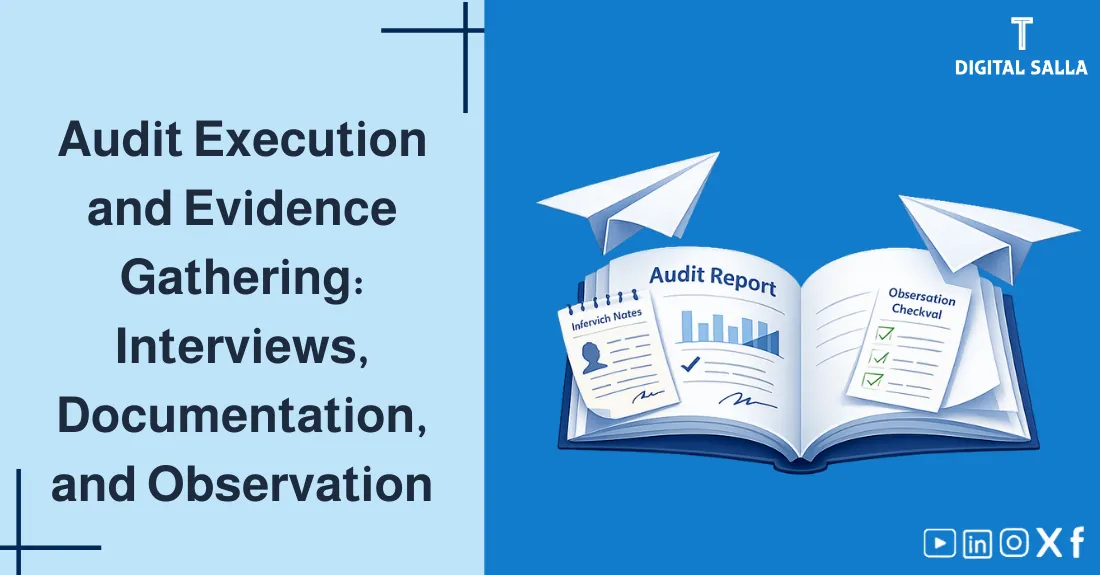
Executing Audit Fieldwork: Gathering Evidence, Interviews, and Document Inspection
Audit Fieldwork: A professional guide on how to execute the audit mission, gather Sufficient and Appropriate Evidence through walkthroughs, document inspections, and substantive testing—Digital Salla.
- Fundamental methodology: Testing Controls vs. Substantive Testing.
- How to perform a Process Walkthrough to verify actual flows.
- Evidence gathering techniques: Inquiry, Inspection, Observation, and Recalculation.
- The Document Cycle check: Ensuring data integrity and valid signatures.
- Documenting Working Papers (WPs): Standards and cross-referencing.
1) The Concept of Fieldwork (Execution)
Fieldwork is the core stage of the audit where the team leaves the office and goes to the “Source” of the data. The objective is to gather evidence to prove whether Internal Controls are working as described in the policies.
2) The Process Walkthrough (Verification)
A Walkthrough involves tracing a single transaction (e.g., one purchase order) from its inception to its final recording in the financial statements.
- Why? To confirm that the process described by management is the one actually followed on the floor.
- Auditor Action: Sit with the employee, observe their screen, and ask: “What do you do if this document is missing?”.
3) Characteristics of Professional Audit Evidence
Not every piece of information is “Evidence.” It must be:
- Sufficient: Quantity (Enough samples to reach a conclusion).
- Reliable: Quality (Originals are better than copies; external evidence is better than internal).
- Relevant: Directly related to the audit objective (e.g., checking a warehouse lock proves physical safety, not asset valuation).
4) The Evidence Gathering Path (Visual Logic)
How we move from “Looking” to “Finding”?
MUS Sampling Model - Excel File
5) Essential Audit Execution Techniques
Auditors use a toolkit of techniques to verify data:
- Inspection: Physically examining an asset or document (e.g., verifying a car’s serial number).
- Observation: Watching a process as it happens (e.g., observing a physical inventory count).
- External Confirmation: Getting a letter directly from a bank or customer confirming a balance.
- Analytical Procedures: Comparing current expenses to the Master Budget to find unusual spikes.
6) Documenting Working Papers (WPs)
Working Papers are the auditor’s property and their primary defense if their findings are challenged.
Standards for a Good Working Paper
- Clear Heading: Engagement name, date, and objective of the test.
- Source of Info: Where did the data come from?
- Tick Marks (✓): Symbols used to show what was checked (e.g., ✓ = Matched to invoice).
- Conclusion: A summary of whether the test passed or failed.
- Cross-Reference: Linking the WP to the final Audit Finding.
7) Operational Controls & Readiness Checklist
To ensure your Fieldwork is high quality:
Execution Quality Gate Checklist
- Are all tests in the Work Program completed and signed by the auditor?
- Is the “Sample” size consistent with the Sampling Policy?
- Were all “Exceptions” (errors found) discussed with the department head immediately?
- Are digital Working Papers stored in a secure, read-only location?
- Did the supervisor review and “Initial” all working papers?
8) Common Errors and How to Prevent Them
- Accepting Verbal Assurance: “Trust me, we do that.” Auditor response: “Show me the documented proof.”
- Ignoring the Root Cause: Documenting the mistake but not finding out Why it happened (e.g., Lack of training vs. Intention to fraud).
- Poor Indexing: Building a pile of papers that no one can navigate. Solution: Use a standardized WPs Indexing System.
- Scope Creep: Spending 3 days on a minor issue while missing a high-risk area. Focus on Materiality.
9) Frequently Asked Questions
What is an Audit Working Paper?
It is the auditor’s record of the procedures performed, the evidence obtained, and the conclusions reached. It serves as the primary support for the audit report.
What is the difference between Control Testing and Substantive Testing?
Control testing checks if the “Process” is working (e.g., did someone sign?). Substantive testing checks if the “Number” is correct (e.g., is the $5,000 balance real?).
Can I use photocopies as audit evidence?
Yes, but you must first “Inspect” the original to ensure the photocopy is authentic and hasn’t been altered.
10) Conclusion
Executing Audit Fieldwork is where professional competence is proven. By utilizing systematic Walkthroughs, gathering reliable Evidence, and documenting everything in high-quality Working Papers, you provide the organization with a credible “Health Check.” This stage ensures that the final report is not just a collection of opinions, but a strategic document backed by indisputable facts that drive operational excellence and institutional trust.
Action Step Now (30 minutes)
- Pick one “Internal Audit Recommendation” from your last report.
- Go to the department and perform a 5-minute Walkthrough to see if the fix is actually being used.
- Document your observation—you have just performed a mini Follow-up fieldwork.