


Financial technologies (FinTech) and automation

Financial Technologies (FinTech) and Automation: How Digital Payments are Changing Accounting?
Financial Technology (FinTech) is no longer just a “trend” but has become a core operational layer: payment gateways, wallets, instant collection, and linking transactions via APIs. The result? More data, faster, and more sensitive—which means greater automation but also a stronger need for governance, reconciliations, and protecting files from errors and manipulation.
- What is Financial Technology and its relationship to accounting automation.
- Main uses of digital payments within the collection and payment cycle.
- How to link FinTech data with ERP/Excel/BI without inflation or duplication.
- Governance and security risks and how to “protect your data” practically.
- A brief implementation roadmap (30/60/90 days).
1) What is Financial Technology (FinTech)? And why it matters to accountants
Financial Technology or FinTech is the application of technology to provide digital financial services—most notably digital payments, instant collection, wallets, and payment gateways. For an accountant, the value is not just in the “payment,” but in transforming every transaction into: a traceable event + linkable data + an audit trail that can be reconciled and analyzed.
2) Financial Technology Ecosystem: Where does accounting fit in?
The following diagram simplifies the FinTech ecosystem from the customer payment point until data reaches the accounting system and reports.
3) Practical Accounting Use Cases: Where does FinTech enter daily work?
3.1 Collection via Digital Payments
Collection becomes instantaneous, but accounting needs to break down the transaction into components: total collection, service provider fees, tax/commission (if any), then link it to the bank settlement notice.
3.2 Refunds and Customer Disputes (Chargeback)
This is a “risk” file, not just a refund. You must track dispute status, documents, deadlines, and its effect on receivables.
3.3 E-Invoicing and Integration
When implementing e-invoicing, linking data (Invoice ← Collection ← Settlement) becomes a mandatory path that reduces reliance on manual files.
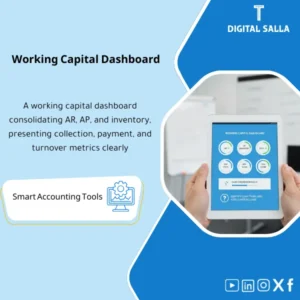
Working Capital Dashboard: AR/AP/Inventory - Excel Dashboard
3.4 Automating Data Entry and Reconciliations
Instead of entering thousands of transactions manually, pulling reports from the payment provider can be automated, followed by automatic reconciliations and linking them to GL accounts.
4) Integration and Reconciliations: From “Transaction” to “Entry” without errors
The success of accounting automation in FinTech depends on three things: a unique key, clear mapping, and reconciliation that links the payment layer to bank settlement and then to the books.
| Element from Payment Provider | What it means Accounting-wise? | Important Governance Control |
|---|---|---|
| Transaction ID | The key that links everything | Must be unique and unchanging |
| Gross Amount | Total collection | Do not mix with net settlement |
| Fees | Service provider expense/commission | Separate fees in an independent account |
| Refund/Chargeback | Reversal/dispute affecting revenue & A/R | Track dispute status and dates |
| Settlement | Amount that actually entered the bank | Bank reconciliation = net after fees/refunds |
5) Protect Your Data: Governance, Security, and Error Reduction (Especially with Excel)
With the expansion of digital payments, transferring data between multiple systems becomes a daily task. The problem is not “the existence of Excel” but “using Excel without governance.” If your reconciliation file or entry model lives in Excel, set rules for it to prevent: human errors, formula modification, or changing inputs without a trace.
- Separate inputs from calculations (Inputs/Calculations/Outputs).
- Mandatory Checks: Total collection = (Net settlements + Fees ± Refunds).
- Backup + Versions: Master + Working + Archive.
6) How to Choose the Right FinTech Solution? (Accountant’s Checklist)
Before signing any contract with a Financial Technology provider, make your decision “financial” and not just “technical.” These practical criteria reduce operational surprises:
- Integration (API): Is there a documented API + Webhooks for real-time updates?
- Audit Trail: Can who did what and when be traced?
- Reconciliations & Settlements: Are there clear Settlement reports and fixed keys?
- Fees and Refunds: Do reports separate Fees/Refunds/Chargebacks?
- Permissions: Clear roles (View/Export/Approve/Manage)?
- Compliance: Invoicing/tax/data protection requirements according to the country of operation.
7) 30/60/90 Day Roadmap for Secure FinTech Implementation (Realistic Automation)
Days 1–30: Establish the Foundation
- Identify digital payment sources and define the “source of truth” for reconciliation.
- Define keys: Transaction ID + Settlement Batch + Invoice ID.
- Build the first simple reconciliation model + Mandatory Checks.
Days 31–60: Automation and Control
- Automate pulling/cleaning reports and linking them to books.
- Reduce manual entry, and stabilize file structure and versioning.
- Enable access permissions and internal review.
Days 61–90: Transition to a Monitoring System
- KPIs: Reconciliation success rate, dispute percentage, collection time, fee costs.
- Dashboards for flows, collections, and accruals.
- Scale to other branches/channels.
8) Frequently Asked Questions
What is meant by Financial Technology (FinTech)?
FinTech is the use of technology to provide digital financial services such as digital payments, e-wallets, payment gateways, embedded finance, and e-invoicing, with a high capacity for integration, measurement, and control.
How does FinTech help in accounting automation?
It helps by reducing manual entry, automating bank reconciliations, tracking collections and payments in real-time, and converting payment events into movements that can be aggregated and analyzed with an audit trail.
Do digital payments reduce or increase errors?
They reduce manual entry errors, but they can increase linking and modeling errors if no governance exists (Correct Mapping, unique keys, reconciliations, security controls, and permissions).
What are the most important FinTech risks to accounting and governance?
Data security and fraud, integration errors, inflation/duplication of transactions due to non-unique keys, and loss of audit trails if operations remain in Excel without governance.
How do I choose the right FinTech solution for my company?
Focus on: compliance, availability of an API and good documentation, support for settlements, audit trails, permission management, fee transparency, and ease of linking with ERP/Excel/BI.
9) Conclusion
Financial Technology (FinTech) gives you higher speed and transparency in collections and payments, but true value appears when this speed turns into traceable accounting automation: clear keys, disciplined reconciliations, and governance that protects data and formulas and prevents errors and manipulation. Start small (Reconciliation + Checks), then automate, then build a monitoring dashboard—and you will quickly see the difference.