


Non-Profit Organization (NPO) Accounting: Restricted donations and administrative expenses

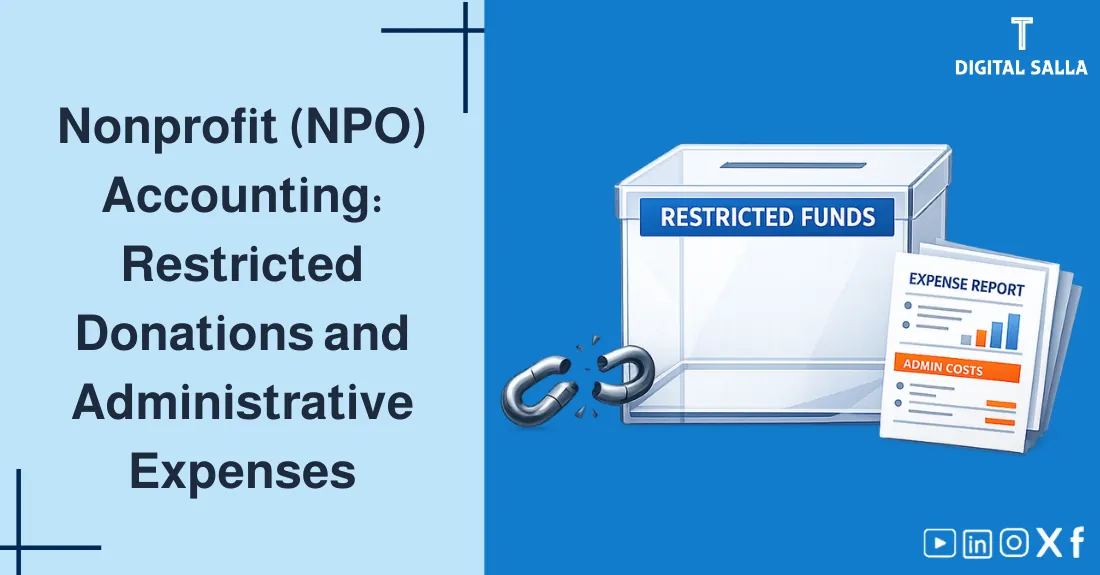
Nonprofit Accounting (NPO): Restricted Funds and Administrative Expenses
In nonprofit accounting, the goal is not “maximizing profit” but maximizing impact while adhering to the conditions of donations and grantors, and building transparent reports that boost donor and regulatory trust. This article provides a practical roadmap: how to process restricted funds, how to categorize administrative and fundraising expenses, and the principles of NPO governance that make your figures “believable”.
- Distinguish between restricted and unrestricted donations and how they are recorded.
- Practical model for tracking restricted funds (Additions/Spending/Releases/Balance).
- Expense categorization rules: Programs/Admin/Fundraising + handling shared costs.
- Core NPO governance principles that protect reports and prevent leakage.
- Interactive calculator for expense ratios and a quick interpretation of results.
1) Why is nonprofit accounting different?
In for-profit companies, efficiency is measured by margin and profit. In nonprofit accounting, the true standard is: Was the money spent on the right purpose? Does the report show this transparently?
- Donor Restrictions: Donations directed to a specific project/segment/time.
- Multi-program Tracking: Measuring the cost and impact of different activities within the same entity.
- Transparency: Donors expect easy-to-understand reports, not just raw numbers.
- Compliance: Adhering to regulator bylaws and grant contracts.
2) Revenue types: Donations, Grants, and Subscriptions
To manage donations correctly, categorize funding sources based on documentation and recognition requirements.
| Source | Examples | Key Accounting Point |
|---|---|---|
| Cash Donations | Bank transfers, Cash, Gateways | Document source + link to program if restricted. |
| In-kind Donations | Food, Medicine, Equipment | Valuation policy + receipt logs + distribution tracking. |
| Grants | Education/Health project grants | Terms drive categorization + progress reporting. |
| Fees/Subscriptions | Memberships, Community services | Recognized as recurring revenue; consistency is key. |
3) Restricted Funds: Tracking and Releases (Restricted Funds)
Restricted funds mean there is a condition limiting the use of the funding. To control them, use a project/cost center to track movement: Opening Balance → Additions → Spending → Release → Closing Balance.
- Quick Comparison: Bank Accounting — Similar focus on transparency and control.
- Quick Comparison: Hotel Accounting — Note the importance of departmental reports over general ones.
4) Common Accounting Entries: Cash/In-kind/Grants
These entries are for educational purposes. Account names vary by your chart of accounts and local regulations.
Excel Accounting Program - Excel File
| Scenario | Entry (Simplified) | Control Point |
|---|---|---|
| Unrestricted Cash Donation | Dr Cash/Bank Cr Donation Revenue (Unrestricted) |
Add campaign code for reporting. |
| Restricted Cash Donation | Dr Cash/Bank Cr Restricted Revenue/Funding |
Use project/fund code; do not mix. |
| Release of Restrictions | Dr Restricted Funding Balance Cr Unrestricted Funding (Transfer) |
Execute after condition (spending/time) is met. |
| In-kind Donation | Dr Inventory/Asset/Expense Cr In-kind Donation Revenue |
Valuation policy + receipt documentation. |
5) Expense Categorization: Programs/Admin/Fundraising
Categorization is the language of donor communication. Program expenses show impact, administrative expenses show infrastructure, and fundraising expenses show the cost of funding.
| Category | Examples | Key Note |
|---|---|---|
| Programs | Medications, services to beneficiaries | Link to project to measure specific cost/impact. |
| Administrative | Accounting, HR, Governance, Rent | Necessary—but must be justified as supporting discipline. |
| Fundraising | Campaigns, ads, donation platforms | Measure cost of funding against collected donations. |
| Shared Costs | Rent, utilities, shared salaries | Allocate based on time/space/beneficiaries. |
6) NPO Governance: Policies and Compliance
NPO governance is the “braking system” that prevents leakage and ensures report reliability.
- Authorizations: Who approves what? To what limit?
- Conflict of Interest: Annual disclosure + mechanism to prevent unfair contracts.
- Audit/Oversight Committee: Periodic review of compliance, contracts, and inventory.
- Written Policies: In-kind donations, distribution, document retention, and travel.
- Impact Measurement: Linking expenses to tangible outputs (beneficiary count/results).
7) Reporting and Transparency: Donor Expectations
Transparency means publishing what matters—clearly.
- Basic Financial Reports: (Position/Activities/Cash Flow) per policy.
- Operational Reports: Program implementation, impact KPIs, budget vs. actual.
- Donor Reports: Restricted funds tracking + impact stories.
8) Practical Internal Controls: Donation and Spending Cycle
Accounting systems fail without controls.
- Collection Cycle: Numbered receipts + segregation of collection/recording.
- In-kind Donations: Receipt logs + written valuation + periodic inventory counts.
- Spending Cycle: Request → Approval → Receipt → Match Invoice → Payment.
9) Expense Ratio Calculator (Program/Admin/Fundraising)
Enter total expenses and their distribution to get quick ratios for a simplified transparency report.
10) Frequently Asked Questions
What is meant by Restricted Funds in nonprofit accounting?
Funding with a usage condition (purpose/time). Tracked separately; not spent outside restriction until met.
How do I distinguish between Admin and Program expenses?
Programs are direct beneficiary-related. Admin is general management/HR/Finance. Shared costs are fairly allocated.
What is the most important transparency report?
Restricted funds movement report (balance/spent) + program usage + ratios with impact stories.
11) Conclusion and 10-Day Plan
The core of nonprofit accounting is: tracking donations by terms, controlling restricted funds, categorizing expenses fairly, and building NPO governance that ensures everything is auditable.
- Day 1: Adopt funding classification policy (restricted/in-kind/grants).
- Day 2: Create project/fund codes for restricted programs.
- Day 3: Activate restricted funds movement log.
- Day 4: Adopt in-kind valuation policy + receipt templates.
- Day 5: Set expense categorization rules and shared cost allocation.
- Day 6: Implement segregation of duties in collection and spending.
- Day 7: Prepare brief program reports: cost vs. impact.
- Day 8: Prepare donor transparency report including restricted funds.
- Day 9: Audit sample docs; ensure link to program/restriction.
- Day 10: Review governance: delegations, oversight, improvement plan.