

Guide to Safe Transition from Simple Accounting Systems to Advanced ERP Systems

A Safe Migration Guide: Moving from Basic Accounting Systems to Advanced ERP (A Practical Roadmap)
Moving to an ERP accounting system is not “installing new software”—it is a reset of your finance operating model: cleaner data, faster processes, more reliable reporting, and stronger, auditable controls. The real challenge appears when you move from Excel/simple tools to an integrated ERP: Are your data ready? Is your chart of accounts designed for growth? Do you have a migration plan, testing, and reconciliations before go-live? This guide walks you through clear, actionable steps—from readiness to go-live to stabilization—plus templates that help you avoid common migration failures.
- How to tell if it’s time to move to ERP (clear readiness signals).
- A practical roadmap: Assess → Select → Design → Migrate data → Test → Go-live.
- A risk + controls view (Governance/ERM/Internal Audit) to reduce project failure.
- A “Requirement → Control → Evidence → KPI” template for fast, practical execution.
1) Why move to ERP now?
Many businesses start with a basic system or Excel because it’s fast and cheap. As operations grow, hidden costs appear: slow month-end close, conflicting numbers across departments, weak audit trails, and difficulty producing a single “source of truth” management report. ERP becomes a practical choice because it connects finance with operations (purchasing/inventory/sales/projects) in one database.
- Faster close: fewer manual reconciliations and repeated entry.
- Unified reporting: the same number shows in finance and operations (no “multiple Excel versions”).
- Governance & controls: roles, approvals, and auditable logs.
- Integrations: APIs and connections with platforms, payment gateways, and HR systems.
2) Readiness assessment: are your data and processes ready?
The best ERP in the world won’t fix “dirty data” or “unclear policies.” A readiness assessment before the project saves costly rework later.
| Dimension | Core question | Practical indicator | Action if weak |
|---|---|---|---|
| Data | Are customers/vendors/items standardized? | Duplicate rate + missing fields | Clean master data before migration |
| Policies | Do you have clear approval and expense policies? | How many exceptions per month? | Document policies + management sign-off |
| Chart of accounts | Does the COA support the reports you need? | Reclassification volume at close | Redesign COA and link to cost centers |
| Resources | Is there a clear process owner? | RACI clarity | Assign responsibilities + steering committee |
| Reporting | Can management numbers be produced easily? | Monthly reporting lead time | Early BI/KPI plan |
3) Define scope: what to migrate (and what to postpone)
A top cause of ERP failure is scope creep. The solution is phased delivery. A practical approach: start with core finance + purchasing + inventory (if critical), then add advanced integrations after stabilization.
- Must-have: GL + posting rules + invoicing + tax/compliance + roles + core reports.
- Should-have: cost centers/projects + document management + essential integrations.
- Nice-to-have: heavy customizations, overly complex reporting, AI—postpone until after stabilization.
If you’re still unsure when ERP is necessary, review: When do you need an ERP system? then continue with ERP implementation stages (BPR → Go-Live).
4) Design the target model (To-Be) & process re-engineering (BPR)
ERP doesn’t “work by itself.” It forces you to define processes correctly: who requests, who approves, what documents are required, and how controls are enforced. BPR ensures you don’t migrate “old chaos” into a new system.
If you want the “AIS” perspective that connects processes, data, and controls across the organization, see: Accounting Information Systems (AIS).
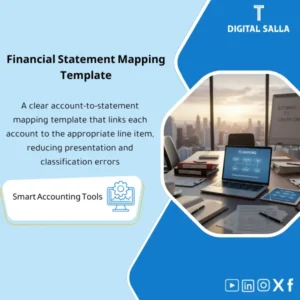
FS Mapping Model - Excel File
5) Data migration: opening balances & chart of accounts mapping
Migration is the project’s heart: if your data are poor, you can still go live fast—but with unreliable numbers. The goal is not to move everything; it’s to move what you need for operations and audit: accurate opening balances + clean master data + transaction history only when required.
5.1 What exactly should you migrate?
- Chart of Accounts: structure, codes, and classifications.
- Customers/Vendors: master data, payment terms, limits.
- Items/Inventory: items, units, costs, locations.
- Opening Balances: GL balances + AR/AP aging if needed.
- Documents (optional): invoices/vouchers depending on audit and compliance needs.
5.2 Migration testing: don’t rely on one trial
Run at least two mock migrations: the first to find issues, and the second after cleanup to confirm results are reconcilable.
| Test | What it validates | Expected output |
|---|---|---|
| Trial Balance Match | TB matches before/after migration | Variance report = zero (or fully explained) |
| Subledger Reconciliation | AR/AP subledgers reconcile to GL | Customer/vendor reconciliation + aging |
| Sample Transactions | Sample invoices/vouchers complete the full cycle | Document → approval → posting → reporting |
| Access & Roles | Permissions prevent data tampering | Roles matrix + audit logs |
6) Integration & security: payment gateways, HR, documents
ERP value grows when you stop daily “export/import” files and build controlled integrations with other systems. But each integration is also a risk point if it’s not governed with proper controls and security.
6.1 HR and payroll integration
Even if payroll is out of phase 1, you’ll still need clear links at least for cost centers and posting rules. (Tip: define ownership, data fields, and reconciliation reports early.)
6.2 Document management and audit trail
Don’t let documents become random folders. Best practice is linking the document to the journal/invoice inside the ERP so retrieval becomes seconds—not hours.
6.3 Cloud vs on-prem: security as a contractual requirement
If you choose cloud, make security a contract requirement: role-based access, MFA, logs, backups, and tested recovery. Compare systematically using: Cloud vs on-prem accounting systems.
7) Governance, risk & audit: how to protect the project
ERP is a governance-heavy project: budget, process change, and sensitive permissions. Link it to a clear risk framework (ERM) and involve internal audit before, during, and after go-live.
| Risk | Impact | Control / mitigation | Evidence |
|---|---|---|---|
| Scope creep | Delays + cost overruns + confusion | Phased scope + formal change requests | Change log with approvals |
| Dirty data | Unreliable numbers | Cleanup + mock migration + reconciliations | TB match + subledger reconciliation reports |
| Weak access controls | Fraud/errors exposure | Role-based access + MFA + logs | Roles matrix + login/audit logs |
| Insufficient training | Operational disruption | Training + UAT + super users | Training records + UAT results |
| Unstable integrations | Data mismatches across systems | SIT + monitoring + retry mechanisms | Integration logs + exception reports |
To strengthen oversight, align the project with: Internal audit (for controls and evidence readiness).
8) Testing & reconciliations before go-live (UAT/Parallel Run)
Testing is not “clicking screens.” Real ERP testing means: an end-to-end process that posts correctly and appears in reports exactly as management expects.
- SIT: integration testing across modules/systems (ERP + gateway + documents…)
- UAT: real business scenarios + exceptions (returns/discounts/cancellations)
- Parallel run: short period running old + new systems with reconciled differences
For common implementation obstacles and how to address them: Common accounting system implementation challenges.
9) Cutover plan, go-live, and post-go-live stabilization
Go-live should never be a “jump into the unknown.” A strong cutover plan defines tasks, owners, and timing—plus a rollback path if a major issue occurs.
| Phase | Task | Owner | Output / evidence |
|---|---|---|---|
| Pre go-live | Final close in legacy system + backup | Finance + IT | Close memo + backup copy |
| Final migration | Load master data + opening balances | Migration team | TB match report |
| Validation | Quick reconciliations + sample transactions | Finance | Validation checklist |
| Go-live | Open transactions in ERP + monitoring | Super users | Logs + exception report |
| Stabilization | Daily support + fixes + additional training | PMO + vendor | Support tickets + improvements |
10) Ready-to-use templates + final checklist
| Requirement | Control | Evidence | Tracking KPI |
|---|---|---|---|
| User access | Role-based access + segregation of duties + MFA | Roles matrix + logs | Manual overrides count |
| Migration | Mock migrations + reconciliations | TB match + explained variances | % variances after load |
| Documents | Link documents to postings | Document link inside ERP | Document retrieval time |
| Compliance | Tax rules + invoice validation | Error report + compliant samples | Compliance notes count |
- Phase 1 scope approved (no changes without a formal request).
- COA + cost centers tested on real reports.
- At least two mock migrations completed + trial balance match report.
- UAT completed including exceptions (returns/discounts/cancellations).
- Roles + MFA + logs + backup/restore enabled and tested.
- Cutover plan written + ownership + rollback plan.
- User training + super users + post-go-live support channels.
Should we migrate full historical transactions?
Not always. Many teams migrate opening balances + master data and keep history in the legacy system as a read-only archive, unless regulatory or audit needs require detailed historical records inside ERP.
What’s the #1 reason ERP migrations fail?
Weak scope governance + dirty data. If scope keeps expanding and master data aren’t cleaned, testing never stabilizes and confidence collapses.
How do we prove the migration is correct?
Trial balance match + subledger reconciliation + end-to-end sample scenarios (document → posting → report). If these are consistent, you can trust the starting point.