

Accounting Data Security in Cloud Systems

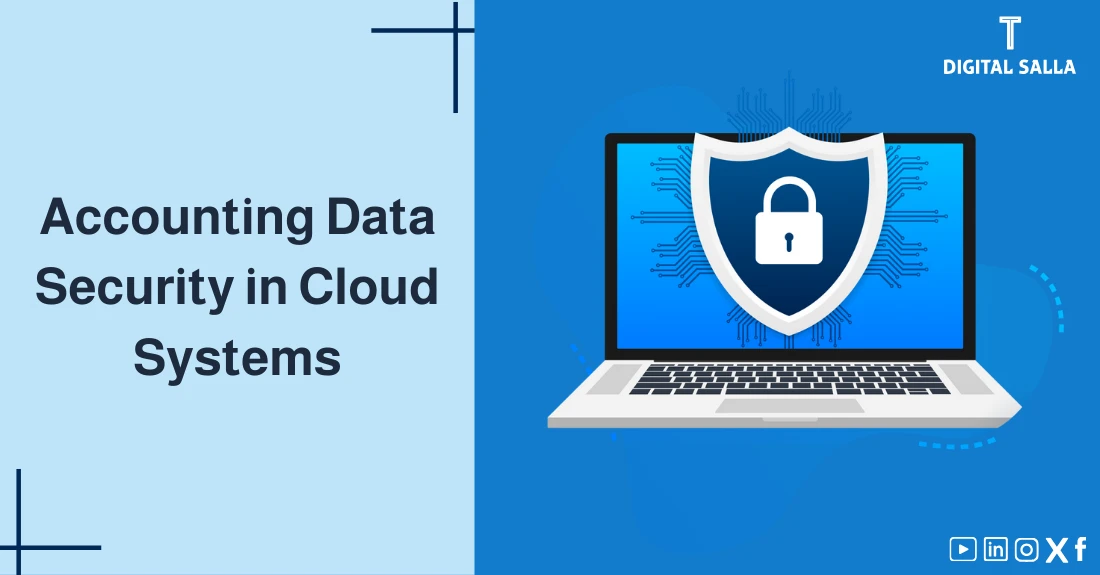
Accounting Data Security in Cloud Systems
Cloud Accounting Data Security explains how to employ technology and governance to improve operations, enhance data quality, reporting, and reduce risks—on Digital Salla. The question isn’t “Is the cloud secure?” but rather: How do you manage security within the shared responsibility model and prove to the auditor that you have controls and an audit trail?
- Understanding the Shared Responsibility Model between the cloud provider and the company (and where errors usually occur).
- Top practical risks for accounting data: Wrong permissions, leaks via sharing/export, uncontrolled API integrations.
- Indispensable controls list: MFA/SSO, Least Privilege, Segregation of Duties, Audit Trail, Tested Backup.
- How to turn security into audit-ready “evidence”: Logs, exception reports, and approved procedures.
- A 30/60/90-day implementation plan + a Checklist before selecting/renewing a service provider.
- Cybersecurity for Accountants: Protecting Financial Data from Hacking and Phishing
- Internal Control and COSO Framework: The Company’s Safety Valve + Designing Control Procedures and Segregation of Duties (SoD)
- Choosing an ERP System: Comparing Cloud vs. On-Premise Solutions
- Data Migration: How to Transfer Opening Balances and Data to the New System?
- Risk-Based Internal Audit: From “Fault Finding” to Added Value
1) Why Cloud Accounting Data Security became a “Financial Risk”?
Accounting data isn’t just numbers—it is a financial asset and the basis for pricing, liquidity, tax, and funding decisions. Therefore, any breach, loss, or manipulation directly reflects on:
- Statement Accuracy: Integrity = Trust in reports.
- Compliance: Fines/Disputes/Business disruption when evidence is lost or sensitive data leaked.
- Liquidity & Reputation: System downtime might stop invoicing, collection, and payment.
3) Most Common Threats in Cloud Accounting Systems
Instead of general talk about “Hacking,” focus on practical scenarios that actually happen in finance:
- Credential Theft (Phishing): Logging in as an accountant then exporting data/modifying vendors.
- Misconfiguration: Sharing reports or files with “Anyone with the link.”
- Excessive Permissions: One user can Create Vendor + Edit IBAN + Approve + Pay.
- Uncontrolled Integrations (API): External app pulling financial data without monitoring.
- Internal Manipulation: Changing entries after closing or deleting evidence attachments.
4) Identity & Access Management: MFA/SSO/Least Privilege/SoD
The strongest control in cloud systems is “Who can do what? When? And with whose approval?” Therefore, make IAM the project’s core:
4.1 Non-Negotiable Controls
- MFA for all accounts (especially Managers and Finance).
- SSO if possible to reduce random passwords and centralize logout.
- Least Privilege: Minimum permission sufficient for work.
- Periodic Permission Review (Quarterly/Semi-annual) + Immediate termination of leaver accounts.
4.2 Segregation of Duties (SoD) in Accounting Terms
Segregation of duties isn’t a theoretical term. Specifically in Finance, prevent the combination of “Initiation + Approval + Disbursement” in one hand. See Control Design Model: Segregation of Duties and Approval Authorities.
Audit-Ready Guide - Word/PDF File
5) Data Protection: Encryption, Keys, Classification, and Retention
Cloud accounting data security isn’t measured by just having “encryption,” but by clarity: What is encrypted? Who holds the keys? Who sees the data?
5.1 Encryption In Transit and At Rest
- In Transit: Ensure all interfaces use TLS/HTTPS.
- At Rest: Ask about database and backup encryption.
- Key Management: Who manages keys? Is there rotation?
5.2 Data Classification
Classify your data at least into: Public / Internal / Confidential / Highly Confidential (Salaries, Bank Accounts, ID Docs). Then link classification to policies:
- Who is allowed to View/Export/Print.
- When to retain and when to securely destroy.
- Are there audit logs for sharing and downloading.
6) Accounting Controls inside the System: Audit Trail, Closing, Exceptions
Big difference between a system that “enters entries” and one that “protects entries.” In the cloud specifically, you need operational controls preventing manipulation and facilitating auditing.
6.1 Dependable Audit Trail
- Track: Who Created/Edited/Approved/Deleted + Time + IP/Device if available.
- Log changes to sensitive data (Vendor IBAN, Customer Credit Limits, Taxes).
- Prevent permanent deletion or restrict it (Soft delete) if possible.
6.2 Monthly Closing Controls
- Define “Open Period” for recording then lock it.
- Any modification after locking needs Reason + Approval + Documentation.
| Threat | Control | Evidence for Auditor |
|---|---|---|
| Changing vendor bank account before payment | Dual approval + Auto notification + Change log | Vendor change log + Approval log + Exception report |
| Exporting sensitive financial data | Restrict Export/Download + Log events | Export logs + Role permissions list |
| Post-closing adjustments | Lock periods + Exception Workflow | List of entries after lock + Reasons and approvals |
| Unused/Old accounts | Periodic review + Auto disable | Users report + Disable/Role change log |
7) Backup and Disaster Recovery: RPO/RTO through CFO Eyes
In Finance, the question isn’t “Is there a Backup?” but: How much data can I lose? (RPO) and How long can I be down? (RTO).
- RPO: Max acceptable data loss (e.g., 15 mins/hour/day).
- RTO: Max acceptable system downtime (e.g., 2 hours/8 hours).
- Restore Test: Backup without testing = Deferred risk.
8) Continuous Monitoring: Early Warning KPIs & Anomaly Detection
Good security doesn’t mean “nothing happens,” but detecting it fast and knowing its impact. These are practical indicators useful for Finance and IT together:
| Indicator | What it Reveals? | Quick Action |
|---|---|---|
| Repeated failed login attempts / From different countries | Password guessing / Phishing | Lock account + MFA reset + Log review |
| Changing Admin/Role permissions | Privilege escalation | Review change + Reason + Approval |
| Large data Export/Download | Potential leak | Identify user + Pause export temporarily + Investigate |
| Vendor data changes before payment | Transfer fraud | Stop payment + Independent verification + Trace trail |
9) Vendor Due Diligence: What to Ask Before Signing?
As a responsible CFO/Accountant, you don’t need to be a security expert… but you need a clear question list closing risk gaps.
- Are there compliance/audit reports (like SOC 2/ISO)? How to get them?
- Where is data stored (Data Residency)? Are there region options?
- Is there an event audit log? Can it be exported?
- Backup policy, retention period, and restore (RPO/RTO)?
- Permissions management: MFA/SSO/Role-based access?
- What happens upon contract termination? (Data export/Secure deletion/Grace period)
10) Data Migration & API Integrations: Preventing Leakage “In Transit”
Biggest cloud risks appear during Migration or Integration, because data moves outside its usual environment. Make migration a controlled project not “file copying”:
10.1 Basic Controls During Migration
- Temporary migration environment with limited access (Don’t send sensitive files via insecure channels).
- File encryption during transfer + Separate passwords + Official sharing channels.
- Sampling review after migration: Balances, Aging, Currencies, Taxes.
- Zeroing/Destroying temporary copies after completion.
10.2 Integrations (API) and Connecting with Payment/Store Platforms
- Use API keys with limited permissions (Read-only when needed).
- Monitor unusual calls (Spike) and set limits (Rate limit) if possible.
- Log all integrations in an internal “Register”: Owner + Purpose + Data Read/Written.
11) 30/60/90 Day Implementation Plan (Brief)
- Activate MFA + Inventory sensitive roles + Remove excessive permissions.
- Define policies: Sharing/Export/Retention/Closing.
- Activate/Review Audit Trail and output initial audit report.
- Apply SoD on Vendors/Payments/Post-Closing Adjustments.
- Create exception reports: Vendor changes/Export/Permissions.
- Review Backup and write RPO/RTO and Restore Test.
- Security KPI Dashboard + Weekly review routine (Finance + IT).
- Update Incident Response procedures and Continuity Plan.
- Risk-based Internal Audit to verify control effectiveness.
12) FAQs + Final Checklist
Is the Cloud safer than On-Premise systems?
It can be safer infrastructure-wise if the provider is strong, but most common errors occur in “Client Settings”: Permissions, Sharing, Integrations, and lack of monitoring. So security depends on Governance and Controls as much as on the Provider.
What are the top 3 quick actions to reduce risk immediately?
(1) MFA + Permission Review, (2) Segregation of Duties on Vendors/Payment, (3) Activate Audit Trail and Exception Reports for sensitive changes. Then comes Tested Backup and Continuous Monitoring.
How do I make security “Audit Ready”?
Collect evidence: Permissions and Role reports, Change Log, Closing Policy, Exception Reports, and Restore Test Log. And link all that to a control framework: COSO.
- Activate MFA + (if possible) SSO for all users.
- Apply Least Privilege + Periodic Permission Review + Immediate Leaver Termination.
- Segregation of Duties (SoD) for: Vendors/Payments/Post-Closing Adj/User Mgmt.
- Activate Audit Trail + Exception Reports for Sensitive Changes (IBAN/Permissions/Export).
- Define RPO/RTO + Backup + Scheduled Restore Test.
- Sharing/Export/Retention/Secure Destruction Policy for Data and Docs.
- API Integration Register (Purpose/Owner/Permissions) + Event Monitoring.
- Provider Check (Compliance/Data Region/Exit Clause/Logs) before signing.