


Governmental Accounting: Organizing and Managing Public Funds


Government Accounting: Organizing and Managing Public Funds
Government Accounting focuses on procedures, practical considerations, and compliance… with tips to reduce risks and improve reporting—on Digital Salla. Practically, accounting in the public sector is not just “journal entries”; it is a system to prove the integrity of public fund usage through budgeting, control, reporting, and auditing. If data is unclassified, undocumented, or uncontrolled—variances appear late, decisions stall, and audit observations increase.
- Work in a government entity/authority/public institution and want to understand the logic of government accounting and budget cycles.
- Need clearer reports for spending, revenue, and variances instead of “aggregated numbers” without explanation.
- Seek to increase compliance and reduce observations through clear controls and procedures.
- Are preparing for digital transformation or implementing a government financial system/ERP and want a practical roadmap.
1) Concept & Objectives of Government Accounting
Government Accounting is the system regulating the recording, classification, and summarization of financial operations for public entities, aiming to provide reliable information on the use of public resources and adherence to the budget and regulations. It serves operational decisions (disbursement/appropriation/procurement), control decisions (compliance/variances), and strategic decisions (resource allocation/programs).
Since public funds relate to public interest, the “Audit Trail” becomes a key requirement: documents, approvals, change logs, and clear authorization paths—intersecting with Internal Controls and COSO Framework.
2) Characteristics of Government Accounting: What Makes it Unique?
What distinguishes the public sector is that the “Goal” is not profit, but executing programs and services within an approved budget and specified service level. Thus, the focus appears on budget items, appropriations, and functional/economic classification, more than profitability indicators.
| Axis | In Government | Impact on Accounting Work |
|---|---|---|
| Starting Point | Budget/Appropriation | Measurement includes commitment/expenditure vs appropriation |
| Control | Regulations + Approvals + Tracking | Document strength and Logs are conditions for data quality |
| Outputs | Compliance Reports + Final Account | Explaining variances is more important than just the “Result” |
| Indicators | Efficiency/Effectiveness/Compliance | Needs linking finance to performance (KPIs) when available |
3) Public Budget Cycle: Preparation, Execution & Control
The budget cycle is the backbone of government accounting, as it defines appropriations, spending paths, and monitoring. From an accounting perspective, cycle success means: (1) Executable budget, (2) Documented commitments, (3) Controlled spending, (4) Variance reports that are read and acted upon.
3.1 Cycle Stages (Practical Brief)
- Preparation: Estimating revenue/needs/priorities and converting to appropriations.
- Approval: Fixing appropriations and issuing spending controls and approval paths.
- Execution: Create commitments → POs/Contracts → Receipt → Invoices → Payment.
- Control & Monitoring: Commitment/Expenditure reports + Variance analysis + Remediation.
- Closing & Final Account: Adjustments, reconciliation, final consolidation, closing reports.
4) Cash Basis vs Accrual Basis in Public Sector
Many public entities start with Cash Basis for ease of tracking, while others move gradually towards Accrual Basis to improve liability/asset visibility and measure true service cost. The decision here isn’t just theoretical; it relates to system tracking capability, and maturity of documents and controls.
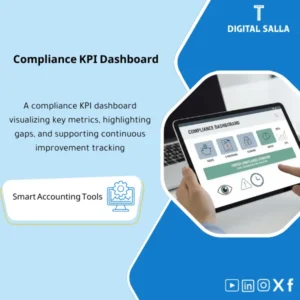
Compliance KPI Dashboard - Excel Dashboard
| Item | Cash Basis | Accrual Basis | Practical Note |
|---|---|---|---|
| Recognition Timing | Upon Payment/Collection | Upon Transaction/Occurrence | Accrual is more accurate for liabilities |
| Liabilities | Less visible | Clearer (Payables/Contracts) | Useful for planning & liquidity |
| Adjustment Complexity | Lower | Higher (Accruals/Prepayments/Depreciation) | Requires documentary discipline |
| Cost Reading | Partial | Closer to Service Cost | Vital for measuring efficiency |
5) Classification of Revenue, Expenditure & Accounts
Government accounting quality rises when classification is clear: What is the nature of the item? Which program/function does it serve? Therefore, many entities use two integrated classifications:
- Economic Classification: Wages, purchases, subsidies, assets… etc.
- Functional/Program Classification: Health, Education, Municipalities… or specific programs within the entity.
5.1 Where do taxes fit in the government picture?
For entities with tax or fee revenues, you need classification enabling performance reading, collection, and arrears, while supporting reporting and compliance. General reference for tax accounting: Value Added Tax (VAT) and Withholding Tax.
6) Internal Control & Compliance: Reducing Risks
The biggest risk to public funds is not just “entry error,” but weak controls: disbursement without docs, overspending appropriation, conflicting permissions, or undocumented adjustments. That’s why internal control is an integral part of government accounting.
- Segregation of Duties: Do not combine (Request + Approve + Pay) in one hand—see Designing Control Procedures.
- Commitment Pre-Disbursement: Recording Commitment at contract/PO stage to avoid end-period surprises.
- Document Rules: No approval without doc, no payment without check (3-way match for purchases).
- Change Logs: Track who edited what and when—vital for audit and accountability.
- Excel Governance if used: To reduce multiple versions—see Excel Governance.
7) Government Reports, Final Account & Variance Reading
Gov reports usually revolve around: (1) Budget (Appropriation/Commitment/Expenditure), (2) Revenue & Collection, (3) Final Account/Financial Statements per framework, (4) Performance reports when operational data exists. To strengthen the “analytical” side of reporting: Financial Data Analysis (Excel & BI).
Enter Approved Budget and Actual Expenditure to get Variance and Execution Rate (Quick Control Indicator).
8) Audit & Accountability: Internal & External Roles
In the public sector, audit is not just a “final stage”; it’s part of the governance ecosystem. Internal Audit focuses on control effectiveness, risk management, and improvement, while External Audit focuses on compliance, standards, and financial impact.
9) Digital Transformation: Gov Finance Systems & ERP Integration
Digital transformation in gov finance succeeds when it translates regulations and controls into System Workflows, reduces manual entry, and produces real-time reports for compliance and variances. Start from a clear “Information Model” then choose the tool.
- Automating chaos: Moving uncontrolled processes to a new system without redesign.
- Migration without cleaning: Errors transfer and grow—see Data Migration.
- Broad permissions: Open risk doors—start with Role-Based & SoD.
- No document management: Evidence gets lost—see Document Management Systems.
10) Checklist & FAQ
- Define clear Economic + Functional classification for budget items.
- Define Commitment & Disbursement cycle (Commitment → Invoice → Payment) with mandatory docs.
- Apply controls: Segregation of Duties + Approval Limits + Change Logs—see Control Procedures.
- Prepare monthly reports: Appropriation/Commitment/Expenditure + Variance report with causes.
- Implement periodic reconciliation for Banks, Payroll, and Liabilities (especially at period-end).
- Digital transformation/ERP plan starting from Processes & Data before Tools.
Is a variance always an “Error”?
Not necessarily. Variance might be justified (price change, emergency, service expansion), but it must be documented, explained, and coupled with action: reallocation, plan adjustment, or estimation improvement.
Difference between “Commitment” and “Disbursement”?
Commitment reflects a contract/PO/pledge that will impact appropriation later, while Disbursement is actual payment. Monitoring Commitment reduces period-end surprises and improves cash planning.
Most important thing to reduce audit observations?
Standardizing documents and approval paths, minimizing exceptions, and having clear Logs and Permissions. See also: Internal Audit.