


Advanced Liquidity Analysis and Cash Management Methods

Advanced Liquidity Analysis and Cash Management Methods
Liquidity management is about transforming cash from a “feeling” into a system of measurement, forecasting, and decision-making. Learn practical tools to analyze performance, optimize working capital, and reduce financial surprises—on Digital Salla.
- The critical difference between Liquidity and Profitability.
- Basic and Advanced Liquidity Ratios (and how to interpret them).
- The Cash Conversion Cycle (CCC) as a practical engine for operations.
- Linking liquidity analysis to 13-Week Cash Flow Forecasting.
- Tactics for Collections, Payments, Inventory, and Financing.
- Interactive Calculator: Calculate your CCC and Liquidity Ratios instantly.
1) Liquidity vs. Profitability (Why Profitable Firms Fail)
Liquidity is a company’s ability to meet its obligations on time without undue stress or high financing costs. Profit, however, is an accounting measurement based on the accrual basis, which often precedes actual cash collection.
A company can be highly “profitable” on paper but face a solvency crisis if accounts receivable are delayed or if cash is tied up in slow-moving inventory.
2) Liquidity Indicators: From Ratios to Operations
Advanced liquidity analysis combines: (A) Balance Sheet Ratios, (B) Operational Metrics (Collection/Inventory/Payment), and (C) Cash Flow Metrics.
| Indicator | Formula | When to use? | Accounting Note |
|---|---|---|---|
| Current Ratio | Current Assets ÷ Current Liabilities | General health check for short-term solvency. | Can be misleading if inventory is slow-moving. |
| Quick Ratio | (Current Assets − Inventory) ÷ Current Liabilities | When inventory is illiquid or seasonal. | More accurate for retail/manufacturing. |
| Cash Ratio | Cash & Equivalents ÷ Current Liabilities | During liquidity stress or high uncertainty. | Useful for defining “Minimum Cash Balance”. |
| Operating Cash Ratio | Operating Cash Flow ÷ Current Liabilities | Testing if operations cover liabilities. | Links the Balance Sheet to the Cash Flow Statement. |
3) Cash Conversion Cycle (CCC): The Real Engine
The CCC measures the “time” it takes for cash to convert into inventory, then sales, and finally back into cash (net of supplier payment terms). The higher the CCC, the more working capital financing the company needs.
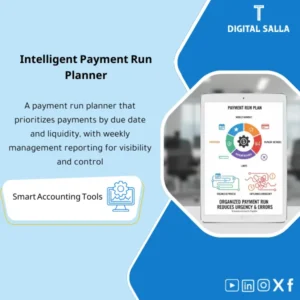
Payment Run Planner - Excel Template
- DSO (Days Sales Outstanding) = AR ÷ Credit Sales × 365
- DIO (Days Inventory Outstanding) = Inventory ÷ COGS × 365
- DPO (Days Payable Outstanding) = AP ÷ COGS × 365
- CCC = DSO + DIO − DPO
4) Reading the Balance Sheet for Liquidity
Good analysis looks beyond total numbers to the quality of liquidity: What percentage is actual cash? Is the inventory obsolete? Are the receivables collectible?
| Question | What to look for? | Red Flag |
|---|---|---|
| Is cash trapped in inventory? | Inventory turnover vs. Sales trends. | Rising DIO and storage costs. |
| Is collection deteriorating? | Aging of Accounts Receivable. | High Sales + Low Cash Inflow. |
| Are liabilities choking operations? | Short-term debt maturity profile. | Payment pressure within 30-60 days. |
5) Linking Analysis to Forecasting: The 13-Week Forecast
Liquidity analysis without “forecasting” is just a diagnosis. The best operational practice is to build a Cash Forecast linked to your analysis outputs: CCC, Ratios, and Payables.
- During liquidity crunches or high seasonality.
- When there are rapid changes in collections or supply chains.
- Preparing for short-term financing or debt rescheduling.
6) Cash Management Tactics
Advanced cash management operates on four levers. Each lever requires specific policies:
6.1 Collections
- Clear credit policy (limits, terms, approvals).
- Early payment discounts (if cost is lower than financing cost).
- Escalation procedures based on aging buckets.
6.2 Payments
- Consolidate payment runs (e.g., pay only on Thursdays).
- Negotiate supplier terms to improve DPO without hurting supply.
- Prevent duplicate payments via 3-way matching.
6.3 Inventory
- Reduce slow-moving and dead stock; it distorts the current ratio.
- Link purchasing strictly to demand forecasts. See Cost Accounting for costing methods.
6.4 Financing
- Use short-term facilities to bridge temporary gaps.
- Plan debt schedules to avoid repayment spikes.
7) Planning & Control: Budget vs. Rolling Forecast
To make liquidity management a habit, integrate it into the planning cycle: Budget → Execution → Variance Analysis → Update Assumptions. This turns liquidity issues into “manageable causes” rather than surprises.
8) Technology: Excel, BI, and ERP
Tools don’t create liquidity, but they accelerate visibility. Excel is great for starting, but scaling requires BI/ERP to automate reports.
9) Liquidity & CCC Calculator
Enter approximate annual figures to get a quick diagnostic. (This does not replace a full forecast model).
10) Checklist & FAQ
- Set a Minimum Cash Balance + Early warning triggers.
- Weekly Monitor: CCC + Cash Balance + Payables (30/60/90 days).
- Collections Report: Top Clients + Overdue Analysis.
- Payments: Aging Schedule + 3-Way Matching.
- Inventory: Reduce slow-moving stock + Demand-driven purchasing.
- Forecast: Monthly update (Rolling) + Variance Analysis.
Does a high Current Ratio mean excellent liquidity?
Not always. High current assets might be due to obsolete inventory or uncollectible receivables. Always check the Quick Ratio and CCC alongside it.
How do I improve liquidity without borrowing?
Focus on the Cash Conversion Cycle (CCC): Speed up collections (lower DSO), optimize inventory levels (lower DIO), and negotiate better payment terms with suppliers (higher DPO).