




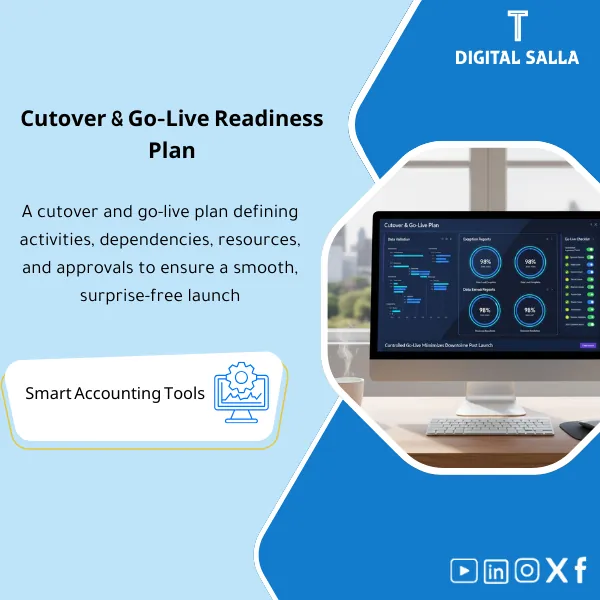
Cutover Plan & Go-Live Readiness – Excel File
63.56 $
Cutover & Go-Live Plan: Defines transaction freeze, load sequence, operational testing, and pre-launch tie-outs. Delivers a readiness checklist and sign-offs that reduce business disruption after go-live.
Cutover Plan and Go-Live
Cutover Plan + Go-Live Readiness Checklist for ERP Launch Led by Finance: Runbook + Ownership + Tie-outs Post-Load + Backout Plan + Go-Live Sign-off Pack
Value Proposition: The Cutover Plan and Go-Live prevents the most costly scenario at launch: “Load completed… but the TB does not match, AR/AP are not closing, and there is no clear decision on whether to Backout or proceed” — this package provides you with a practical transition schedule + Checklists + Tie-out guides + Decision log to exit Day-0 with traceable numbers.
In 20 Seconds: What Will You Get?
- Cutover Plan with a timeline (T-4w to Day+10) + Owners + Gate approvals.
- Go-Live Checklist for readiness with a “Pass/Fail” system + Evidence required for each item.
- Post-Load Tie-out: TB/AR/AP/Inventory/FA linking templates before/after load with a log of variances.
- Cutover JE Log: Migration/Adjustments/Reclass journal entry record with References and Prepared/Reviewed status.
- Backout Plan: Backout plan with clear decision criteria + who signs.
- Hypercare Tracker: Day-1/Day-7 issue log, financial impact, and repair plan linked to numbers.
- Go-Live Sign-off Pack: Delivery index + TB copy + Tie-out evidence + approval signatures.
CTA related to outputs: you will receive Runbook + Readiness Checklist + Tie-out Pack + Cutover JE Log + Backout Decision Pack ready for application.
Suitable For
- Financial Controller / Chief Accountant: Finalizing TB and Subledgers post-load and managing migration entries.
- ERP PMO / Project Manager: Managing Cutover as events and tasks with Owners and Go/No-Go gates.
- Internal Audit / Controls: Documenting load evidence, Tie-outs, and decisions (Traceability) to reduce launch risks.
Not Suitable For
- If your project is still in the system selection/design (Blueprint) phase and you only need UAT and testing scenarios.
- If you are looking for “Data Migration templates” for Master Data/Opening Balances — this is a Cutover/Go-Live package, not Migration templates.
Without the Package / With the Package (Brief Comparison)
| Scenario | Without Cutover Plan | With Cutover and Go-Live Plan |
|---|---|---|
| Day-0 | Load completed… but no owner for each Tie-out and no documented Go/No-Go decision | Runbook + Owners + Readiness checklist + Signed decision gate |
| Variances | TB/AR/AP variances managed through calls and messages | Tie-out templates + Variance log + Reasons + Resolution/Migration decision |
| Backout | Backout as “last resort” without criteria | Backout plan + Decision criteria + Who signs + Clear financial impact |
Before Use: 5 Symptoms That Go-Live is Financially Threatened
- No clear Freeze plan (When do we close the old system? When do we open the new one? What happens to transactions “in between”).
- No Tie-out definition: What needs to match (Total TB? Control accounts? AR/AP subledger totals?).
- Migration entries are done “manually” without JE Log or References, losing Traceability.
- Loading issues are managed as screenshots without financial impact logs, owners, or SLAs.
- No Backout Plan with decision criteria, making the decision emotional on launch day.
How Does the Cutover and Go-Live Plan Work Practically?
The approach here starts from “pre-load” and ends with “first close post-launch”: defining Freeze & data cut → loading Opening balances and Master data → executing Post-Load Tie-out → recording migration entries in JE Log → issuing Go/No-Go sign-off → monitoring Hypercare until numbers stabilize within TB and Subledgers.
Implementation Method (3 Steps)
Step 1: Preparation and Report Gathering
- Define the transition scope: entities/branches, Cutover date, and what will be loaded (GL/AR/AP/Inventory/FA).
- Prepare a “Snapshot baseline” from the old system: TB/GL, AR/AP aging, inventory valuation, asset register, bank balances.
- Prepare Freeze and Delta Plan: how to handle transactions occurring after the snapshot until the final close of the old system.
Step 2: Reconciliations + Matches + JE Log
- Execute loading balances/data then run Tie-out on critical accounts: Control accounts, total AR/AP, inventory, assets, banks.
- Open Cutover JE Log: any variance is treated as a documented migration/reconciliation entry (Reason + Reference + Approved by).
- Close variances through Variance log: “Variance – Reason – Action – Owner – Date” instead of oral follow-ups.
Step 3: Adjusted TB + Reports + Closing Pack
- Issue Adjusted TB after migration entries and link it to subledger reports in the new system (AR/AP/Inventory/FA).
- Prepare “Go-Live Sign-off”: readiness + Tie-out evidence + Go/No-Go or Backout decision.
- Compile Closing Pack for launch: baseline snapshots + tie-out results + JE log + approvals + hypercare tracker for the initial days.
Package Components (Clear Inventory)
-
Cutover Plan (Timeline + Owners + Gates)
- Practical Purpose: Transform Cutover into clear events (Freeze/Extract/Load/Validate/Sign-off) instead of a “general plan”.
- When to Use: From T-4 weeks to Day+10 (Hypercare) with deadlines and owners.
- Resulting Evidence: Signed transition plan + Task completion log (Status/Date/Owner).
-
Go-Live Readiness Checklist (Pass/Fail + Evidence)
- Practical Purpose: Measure readiness for launch as verifiable items: “Completed/Not Completed” with Evidence.
- When to Use: T-7 days → Day-0 before Go/No-Go decision.
- Resulting Evidence: Completed checklist + related evidence (links/files/references).
-
Freeze & Delta Handling Sheet
- Practical Purpose: Manage transactions “between systems”: what stops? What is temporarily recorded? How is it re-entered?
- When to Use: From the moment of Snapshot until the old system is closed and the new one is opened.
- Resulting Evidence: Delta log showing every transaction outside the snapshot and how it was handled.
-
Tie-out Templates (GL/AR/AP/Inventory/FA/Bank)
- Practical Purpose: Execute Post-Load Tie-out uniformly: baseline vs loaded vs adjusted.
- When to Use: Day-0 immediately after loading + repeated on Day+1/Day+3 based on stability.
- Resulting Evidence: Tie-out results + variance analysis + acceptance/rejection decision.
-
Variance Log (Differences Register)
- Practical Purpose: Record every variance: amount, account/module, reason, action, owner, date.
- When to Use: Day-0 until the last variance is closed before Go-Live sign-off.
- Resulting Evidence: Updated variance register demonstrating progress and closure of points.
-
Cutover JE Log (Migration/Adjustments/Reclass)
- Practical Purpose: Document migration entries that make TB “close” (Opening adjustments/Mapping fixes/Reclass).
- When to Use: From Day-0 until the first close post-launch.
- Resulting Evidence: JE log with references + References + list of what was actually migrated in ERP.
-
Backout Plan (Rollback Runbook + Decision Criteria)
- Practical Purpose: Establish a practical Backout Plan: what is rolled back? Who executes? What is the decision criterion?
- When to Use: Prepared before Day-0 and reviewed in the Go/No-Go meeting.
- Resulting Evidence: Backout decision pack + rollback steps list + approval signatures.
-
Hypercare Tracker (Day+1 → Day+10)
- Practical Purpose: Track post-launch issues with financial impact: impact on AR/AP/Inventory/Posting/Reports.
- When to Use: First 10 days (or as per project plan) until reports stabilize.
- Resulting Evidence: Incident log + financial impact + resolution decision + closure date.
-
Go-Live Sign-off Pack (Index + Approvals)
- Practical Purpose: Standardize Day of Launch delivery: what was done? What is the evidence? Who approved?
- When to Use: At the end of Day-0 (or before opening the system to users) + update final version after Hypercare.
- Resulting Evidence: Pack index + approved version (Version/Prepared/Reviewed/Approved).
What Should Be Included in the Delivery?
- 01-Cutover-Plan.xlsx: Timeline + Owners + Gates + Status tracking.
- 02-GoLive-Readiness-Checklist.xlsx: Pass/Fail + Required Evidence + Go-Live Readiness Results.
- 03-Freeze-&-Delta-Log.xlsx: Freeze window + delta transactions and how they were handled.
- 04-TieOut-Pack.xlsx: Tie-out templates for GL/AR/AP/Inventory/FA/Bank + Variance summaries.
- 05-Variance-Register.xlsx: Variance register (Reason/Action/Owner/Date/Closure).
- 06-Cutover-JE-Log.xlsx: Migration entry log + References + Prepared/Reviewed + Posting status.
- 07-Backout-Plan.docx: Backout plan + Decision criteria + Rollback runbook.
- 08-Hypercare-Tracker.xlsx: Incident log + Financial impact + Repair plan + Closure.
- 09-GoLive-Signoff-Pack.docx: Go/No-Go minutes + Signatures + Evidence index.
- 10-Archiving-Map.docx: Naming convention + Copy storage path (Cutover/Day0/Day+X/Final).
After Implementation (Two Points Only)
- Operational Outcome for the Team: The transition becomes “managed by tasks and evidence”: Freeze → Load → Tie-outs → JE log → Sign-off → Hypercare, with an owner for each item instead of open meetings.
- Control/Audit Outcome: Complete Traceability: baseline snapshots ↔ Tie-out results ↔ migration entries ↔ Adjusted TB ↔ Go/No-Go/Backout decision with Version/Sign-off available for archiving.
FAQ — Questions Before Purchase
Is it suitable for any ERP system?
Yes. The package relies on Exports (TB/GL/Load reports) and the Tie-out and JE log approach, not on technical integration with a specific system.
Does it cover the entire ERP transition plan or just the Go-Live part?
It focuses on the ERP transition plan during the Cutover/Go-Live phase and immediately thereafter (Hypercare). It does not cover system design/Blueprint or UAT in detail.
What is the minimum data required to run the Post-Load Tie-out?
Baseline TB/GL from the old system + load reports from the new system + subledger totals (AR/AP/Inventory/FA) and bank balances. The more details, the better the variance interpretation.
Is it suitable for multi-entity/branch companies?
Yes, provided your reports support Entity/Branch. You can run Tie-outs for each entity and then compile the Sign-off Pack at the group level.
Does it include a template for migration entries (Cutover JE)?
Yes, through the Cutover JE Log: it documents the entries required to close variances/reclassify with References and migration status.
Is there an actual Backout Plan or just a title?
There is a Backout Plan as a Runbook + decision criteria + who signs, ensuring the decision is defensible and not improvised.
Does it cover Tie-out for inventory and assets?
Yes, within the Tie-out pack: Inventory valuation totals and FA register totals at the aggregate level, and it can be expanded internally based on your system details.
Is it useful for month-end tests (Month-End) after launch?
It is useful as a transition phase: the first Month-End after Go-Live typically requires the same logic for Tie-outs, JE log, and Closing pack until reports stabilize.
Ready to Go-Live with “Traceable” Numbers Instead of TB Surprises?
Outputs: Cutover Plan + Go-Live Checklist + Tie-out Pack + Cutover JE Log + Backout Plan + Sign-off Pack.
| المسمّى الوظيفي | |
|---|---|
| Duration | |
| المستوى | |
| التحديثات | |
| القطاع | |
| الصيغة |
Related products


DOA Matrix – Excel Template

Expected Credit Losses Assessment Service (IFRS 9)


Reviews
Clear filtersThere are no reviews yet.