




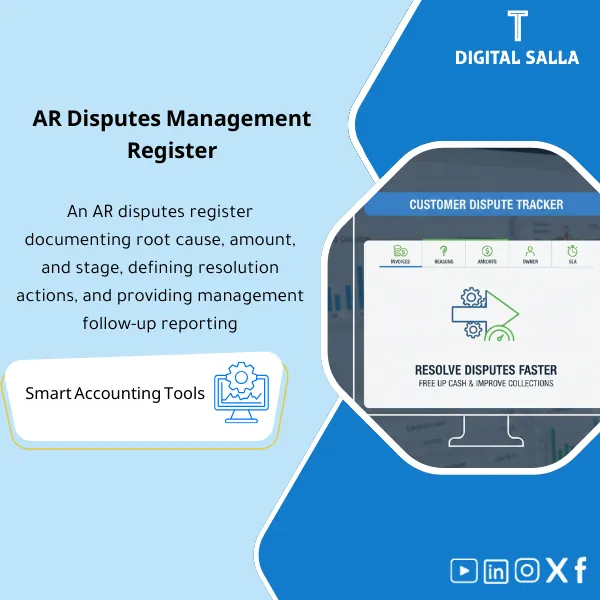
AR Dispute Tracker – Excel Template
34.31 $
AR Dispute Tracker: Logs disputed invoices with reason, amount, owner, and target closure date. Delivers an open-disputes list linked to collections planning—clarifying what can be collected now vs. what awaits dispute resolution.
Accounts Receivable Disputes
AR Dispute Tracker for managing invoice disputes from reporting → investigation → resolution (CN/DN/collection) → deliverable Month-End Dispute Pack
Value Proposition: Accounts Receivable Disputes quickly become a closing issue when managed as “calls and correspondence”: a disputed invoice without a coded reason, without documentation, and without a clear Owner, leading into Month-End without knowing: what can be collected? What needs a Credit Note? What requires resolution/entry? This AR Dispute Tracker turns the dispute into a “case” with a number, reason, evidence, decision path, and final outcome linked to the invoice and the AR Aging and JE Log—thus delivering a dispute file within the Closing Pack instead of a list of complaints.
In 20 Seconds: What Will You Get?
- AR Dispute Tracker: Invoice dispute record with Dispute ID + Invoice# + Amount disputed + Status + Owner.
- Collection Dispute Reasons: Ready reason codes (Pricing/Delivery/PO/Quality/VAT/Short-pay/Service) for unified analysis.
- Customer Dispute Tracking: Action log (What was done? Who is responsible? What is the next step? Next follow-up date).
- Resolution of Disputed Invoices: Clear paths: (Full collection / Partial collection / CN / DN / Write-off proposal) with references.
- Credit Notes Pipeline: List of “CN required” + approval stage + linking to the invoice and dispute.
- Dashboard: Open disputes by reason/customer/age + value of disputed vs collectible amounts.
- Month‑End Dispute Pack: Summary of disputes + evidence + decisions + JE refs (if any) for delivery within the Closing Pack.
CTA related to outputs: you will receive Dispute Register + Reason Codes + Action Log + CN Pipeline + Month‑End Pack ready.
Suitable For
- AR / Collections: Sorting overdue items into: collectible vs disputed, linking each dispute to a clear step.
- Controller / Chief Accountant: Closing AR with a documented dispute file + Reconciliations + CN/JE references instead of “unexplained” disputes.
- Sales Ops / Customer Service Finance: Managing disputes with unified reasons and SLA escalation instead of losing cases.
Not Suitable For
- If you want a complete Ticketing system (Emails/Integration/Automation) — this is a tracking and documentation template, not a platform.
- If your disputes are entirely legal and require contract/legal correspondence management — the product focuses on invoice and collection disputes and their financial documentation.
Without Tracker / With Tracker (Brief Comparison)
| Item | Without AR Dispute Tracker | With AR Dispute Tracker |
|---|---|---|
| Collection | General follow-up: “the customer says there is a problem” | Coded reason + Owner + Next action + SLA for each invoice |
| CN/DN | Credit Notes appear late and enter Month-End as discrepancies | CN pipeline + approvals + linking to the dispute and invoice |
| Month‑End | Closing Pack without a dispute file → many audit requests | Month‑End dispute pack + Evidence index + tie‑out notes |
Before Use: 5 Symptoms That Invoice Disputes Are Managed Unclosably
- Disputed invoices appear in AR Aging as overdue, but there is no clear distinction between “Overdue” and “Disputed”.
- No unified Collection Dispute Reasons; each team writes a different reason, leading to lost analyses.
- Disputes recur monthly without an Owner or SLA, turning into chronic overdue accounts.
- Credit Notes/resolutions are executed without linking to the original dispute or without approval evidence.
- At Month-End, discrepancies appear between AR subledger and GL or between revenue and CN, with no file explaining “why” and “what action”.
How Are Accounts Receivable Disputes Managed Practically from the Moment of Objection to Month-End?
The approach begins by logging the dispute at the invoice level (or part of it) and identifying the coded reason, then gathering evidence (PO/Delivery/Service proof/Email approval) and determining the path: full collection, partial collection, issuing CN/DN, or accounting resolution when necessary. Each step is recorded in the Action log. Before closing, the Month‑End Dispute Pack is generated, detailing: what remains disputed, what has been resolved, and what requires an entry/memo within the Closing Pack and Adjusted TB.
Implementation Method (3 Steps)
Step 1: Preparation and Report Gathering
- Extract the list of AR open items or the list of uncollected invoices from the ERP (Invoice#, Customer, Amount, Invoice date, Due date, Terms).
- Establish a dictionary of dispute reasons (Reason codes) and identify who owns each reason (Sales/Warehouse/Tax/AR/Service).
- Identify the required linking references to be gathered: PO#, Delivery note, Contract/SOW, Quality/Receipt attachments, and CN/DN references later.
Step 2: Resolutions + Matches + JE Log
- Log the dispute in AR Dispute Tracker: disputed amount, reason for dispute, Owner, and next follow-up date.
- Manage Customer Dispute Tracking through the Action log: investigation, document request, escalation, discount approval, etc.
- Upon reaching a resolution: execute Resolution of Disputed Invoices through one of the paths:
- Collection: Update status to Resolved‑Collected and link receipt number (if available).
- Credit Note: Enter CN# in the pipeline then in the CN register after issuance, with approval reference.
- Debit Note: If the customer is required to pay a difference (DN) and record its reference.
- Write‑off proposal: Set it as a proposal needing approval and policy (with JE ref upon execution).
- Any accounting resolution is recorded with references in the JE Log within the file (JE ref + date + brief reason) to facilitate Reconciliations.
Step 3: Adjusted TB + Statements + Closing Pack
- Generate a Month‑End summary: total disputed, what has been resolved, what needs CN pending, and what requires escalation/provision/decision.
- Perform a simple Tie‑out: AR open items (after updating) ↔ AR control account in TB, clarifying the impact of CN/JE on Adjusted TB.
- Compile the Month‑End Dispute Pack: dispute register + aging by reason + evidence index + approvals + JE refs as part of the Closing Pack.
Template Components (Clear Inventory)
-
AR Dispute Register
- Practical Purpose: Transform each dispute into a case (Dispute ID) linked to an invoice/customer and disputed amount and status.
- When to Use: As soon as invoice disputes arise or a customer objects to collection.
- Resulting Evidence: A dated dispute register that can be referenced at Month‑End/Year‑End.
-
Reason Codes & Ownership Matrix
- Practical Purpose: Standardize reasons and link each reason to an owner/responsible team (Sales/Logistics/Tax/AR).
- When to Use: When logging the dispute and analyzing recurrence and corrective actions.
- Resulting Evidence: A dictionary of reasons + responsibilities that can be easily tested for compliance.
-
Action Log
- Practical Purpose: Record every step: document request, customer response, escalation, settlement agreement… with Next action date.
- When to Use: Weekly/Daily depending on the volume of disputes.
- Resulting Evidence: A trail that proves “what happened” for each dispute (important during audits or recurring disputes).
-
SLA Aging & Escalation
- Practical Purpose: Calculate the age of disputes and filter cases exceeding SLA with clear escalation.
- When to Use: Weekly AR/Collections meeting + before closing (Week‑4).
- Resulting Evidence: List of SLA breaches + escalation decisions.
-
Settlement Path
- Practical Purpose: Determine the resolution path for the dispute: Collect / Partial collect / CN / DN / Write‑off proposal with references.
- When to Use: When reaching an agreement or internal decision regarding the settlement.
- Resulting Evidence: A documented settlement decision linking the dispute to the settlement document.
-
CN/DN Pipeline & Approvals
- Practical Purpose: Manage requests before issuing CN/DN: reason, amount, approvals, then record the document number after issuance.
- When to Use: For any discount/price correction/return leading to CN or DN.
- Resulting Evidence: Approval log + record of CN/DN documents linked to disputes.
-
JE Log
- Practical Purpose: Document any settlement/reclassification entries related to disputes (Reclass/Write‑off) via JE ref.
- When to Use: Month‑End/Year‑End when there is an impact on Adjusted TB.
- Resulting Evidence: JE references linked to each dispute affecting the statements or settlements.
-
Evidence Index
- Practical Purpose: Link the dispute to its documents (PO/Delivery/Emails/Approvals/CN copy) with a clear path/link.
- When to Use: During investigation + when preparing the closing file.
- Resulting Evidence: A deliverable evidence index that reduces requests for “provide the document”.
-
Month‑End Dispute Closing Pack
- Practical Purpose: Generate a closing file: open/closed disputes, CN pending, impact on AR aging, and any Reconciliations/JE refs.
- When to Use: Week‑4/Month‑End and Year‑End.
- Resulting Evidence: Closing pack section ready for delivery to the Chief Accountant/auditor.
What Should Be Included in the Delivery?
- 01-AR-Dispute-Tracker.xlsx: AR Dispute register + status + disputed amount + owners.
- 02-Dispute-Reason-Codes.xlsx: Collection dispute reasons + reason definition + Owner matrix.
- 03-Action-Log-Followup.xlsx: Customer dispute tracking (Actions/Next steps/Promise dates/Notes).
- 04-SLA-Aging-Escalation.xlsx: Age of dispute + SLA breaches + escalation and closure.
- 05-Settlement-Paths.xlsx: Resolution of disputed invoices (Collect/CN/DN/Write‑off) + references.
- 06-CN-DN-Pipeline.xlsx: CN/DN requests before issuance + approvals + document number after issuance.
- 07-Approval-Workflow.xlsx: Prepared/Reviewed/Approved for any settlement/discount/closure of a substantial dispute.
- 08-JE-Refs-Log.xlsx: JE Log for references of entries related to disputes (if any) + reason + date.
- 09-Evidence-Index.xlsx: Evidence index (PO/Delivery/Emails/CN copies) + paths/links.
- 10-MonthEnd-Dispute-Closing-Pack.xlsx: Closing summary: open/closed disputes + CN pending + tie‑out notes.
- 11-Signoff-Pack.docx: Prepared/Reviewed signature for the month + approval of dispute summary.
- 12-Runbook.pdf: Practical run (Intake → classify → investigate → settle → month-end pack).
- 13-Archiving-Map.docx: Archiving tree (Year/Month/AR/Disputes/Evidence/CN-JE) + Naming convention.
After Implementation (Two Points Only)
- Operational Outcome for the Team: Any dispute becomes a clear path: reason + Owner + SLA + Next action, and immediately shows a list of what can be collected and what needs resolution, instead of leaving the dispute “hanging” within AR Aging.
- Compliance/Audit Outcome: Month‑End/Year‑End receives a reviewable dispute file: Dispute register + evidence + approvals + CN/JE refs + tie‑out notes within the Closing Pack, supporting Traceability instead of verbal explanations.
FAQ — Questions Before Purchase
Is the template suitable for any ERP system?
Yes. It is sufficient to extract the list of invoices/AR open items. The template adds a layer of dispute management and documentation and tracking on top of the system data.
Does it support multi-branch or entity companies?
Yes, by adding Entity/Branch as a field, and Dashboards and Month-End packs can be extracted for each entity or group.
Does it handle partial disputes (only part of the invoice)?
Yes, through the “Disputed amount” and “Undisputed/Collectible amount” fields with a collection path for the non-disputed part.
Does it include Credit Notes for discounts or DN settlements?
It includes a Pipeline and record linking CN/DN to the dispute and invoice and closure approvals. Document issuance occurs within the ERP, then their numbers and application status are recorded.
What is the minimum data required to get started?
Invoice# + Customer + Amount + Invoice date + Due date/Terms + brief reason note (even if abbreviated) + initial Owner for the dispute.
Can it be linked with the AR Aging template and collection plan?
Yes. Practically, Overdue is separated into (Disputed vs Non-disputed), making the collection plan and DSO calculations more interpretable and reducing “unclassified” disputes.
Does it support Month-End and Year-End?
Yes. The primary outputs are the Month‑End Dispute pack with Evidence index and Approvals and JE refs, and an annual Snapshot can be saved within the Closing Pack and Adjusted TB.
Is it an alternative to a ticketing system or CRM?
No. It is an accounting/compliance template for documenting and managing disputes from a collection and closing perspective, not a messaging system or technical Workflow.
Ready to Enter Month-End with a Deliverable Dispute File Instead of a List of Objections?
Outputs: AR Dispute Tracker + Reason Codes + SLA + CN/JE Refs + Month‑End Dispute Closing Pack.
| المسمّى الوظيفي | |
|---|---|
| Duration | |
| المستوى | |
| التحديثات | |
| القطاع | |
| الصيغة |
Related products

3-Way Match Toolkit – Excel File





Reviews
Clear filtersThere are no reviews yet.