



IFRS 15 Revenue Recognition Pack – Excel Files
111.44 $
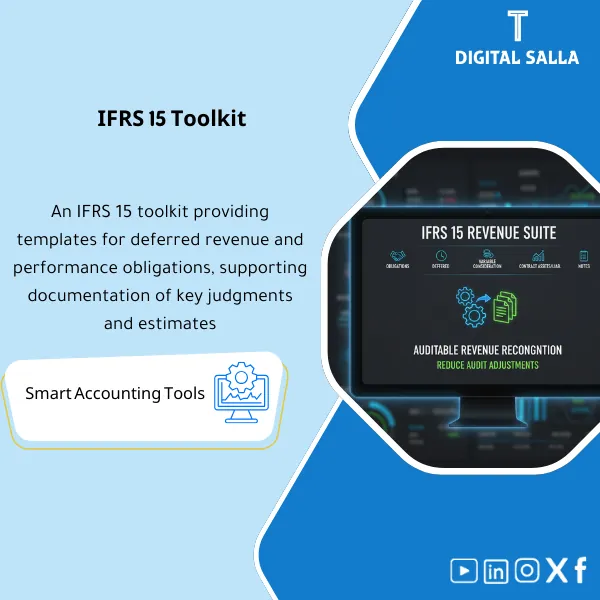
IFRS 15 Revenue Recognition Pack: Breaks contracts into performance obligations and manages deferred revenue and variable consideration with supporting schedules. Delivers monthly journals and disclosure-ready reports for IFRS and reporting teams.
IFRS 15 Package
Subtitle: IFRS 15 Revenue Recognition for Contracts: Revenue Recognition + Deferred Revenue + Performance Obligations + Variable Consideration + Disclosure Pack
Value Proposition: IFRS 15 Revenue Recognition becomes a “closing crisis” when revenues are recorded on an invoice or collection basis while the contract contains multiple elements, discounts/incentives, or phased delivery. The usual outcome: unadjusted deferred revenue, undocumented performance obligations, and endless review requests about (why did you recognize the revenue? And when? And on what basis?). This package transforms the file from “verbal explanation” to Workpapers that are reviewable: performance obligations matrix, transaction price calculation including Variable Consideration, price allocation (SSP Allocation), recognition schedules, and a ready-to-deliver IFRS 15 disclosure file.
In 20 Seconds: What Will You Get?
- Contract Intake Pack: Input contract items (Duration/Price/Deliverables/Terms) in an aggregable format.
- Performance Obligations Matrix: Matrix of Performance Obligations + method of measuring progress (Over time/Point in time).
- Transaction Price & Variable Consideration: Calculate the price including Variable Consideration and its constraints (Constraint) and monthly impact.
- SSP Allocation: Price allocation to contract elements (Standalone Selling Price) with reviewable outputs.
- Revenue Recognition Schedule: Revenue recognition schedule by period/stage with clear references for each contract.
- Deferred Revenue Rollforward: Movement of Deferred Revenue (Opening + billings + revenue recognized + adjustments = closing).
- IFRS 15 Disclosure Pack: IFRS 15 Disclosures + Contract balances schedule + explanatory memos + Evidence index.
CTA related to outputs: Receive Recognition Schedules + Deferred Revenue Rollforward + JE Log + Disclosure Pack ready for delivery.
Suitable For
- SaaS/Subscriptions: Subscription contracts + Setup fees + Accompanying services + Deferred revenue requiring a recognition schedule.
- Projects/Services: Implementation/service contracts with milestones and progress measurement (Over-time) with evidence.
- Controller / External Audit readiness: Preparing Workpapers and Traceability for revenue and disclosure review.
Not Suitable For
- If all your sales are “one item delivered immediately” without discounts/programs/multiple elements—you will need it less as the complexity is limited.
- If you are looking for an automated system to apply IFRS 15 within ERP (Rule engine/Automation)—this is a package of operational templates and documentation, not a technical module.
Without the Package / With the Package (Short Comparison)
| Item | Without IFRS 15 Workpapers | With IFRS 15 Revenue Recognition Pack |
|---|---|---|
| Basis of Recognition | Revenue on an invoice/collection basis → discrepancies with the contract | Documented 5-Step model + schedule for each contract |
| Deferred Revenue | “Hanging” deferred revenue balance at month-end | Rollforward + aging + tie-out with GL |
| Discounts/Variable Consideration | Discounts recorded late or as unexpected CN | Calculator + constraint + monthly impact + JE refs |
| Disclosures | Disclosures prepared at the last moment and without a single source | IFRS 15 disclosure pack + Contract balances schedules ready |
Before Use: 5 Symptoms That Revenue Does Not Track the Contract
- Revenue is recorded “upon invoicing” while services are provided over a period or in phases.
- No Performance Obligations matrix exists, thus no fixed basis for timing recognition.
- Deferred Revenue changes without a clear rollforward (you do not know: billings, recognized, or adjustments).
- Discounts/incentives/rebates appear as late Credit Notes and pressure Month-End and Year-End.
- During review, Contract Revenue Recognition is requested (Contract → revenue schedule → JE) and no ready Audit trail exists.
How to Apply IFRS 15 Revenue Recognition Practically to Your Contracts?
The goal of the package is not to explain the standard theoretically, but to transform it into operational files: input contracts, identify performance obligations, calculate the transaction price including variable discounts, allocate the price (SSP), then a monthly recognition schedule that outputs settlement entries (JE refs) and produces a rollforward for deferred revenue/contract obligations, and finally an IFRS 15 disclosure file supported by numbers and references.
Application Method (3 Steps)
Step 1: Preparation and Report Gathering
- Gather contracts/service agreements (MSA/SOW/PO) and billing and collection terms and appendices for discounts or incentives.
- Extract operational data: Deliverables/Delivery/Acceptance (if any) + billing reports + AR/open items.
- Define the “unit of analysis” within the package: Contract ID + Customer + Product/Service line + start/end dates + currency.
Step 2: Settlements + Matches + JE Log
- Prepare Performance Obligations Matrix: Identify each performance obligation and method of recognition (Over time/Point in time) and measurement method (Milestones/Output/Input).
- Calculate Transaction price with Variable Consideration (discounts, rebates, penalties) and apply constraint and document assumptions.
- Allocate the price to obligations (SSP allocation) and then build a Revenue Recognition IFRS 15 schedule monthly.
- Output JE Log: recognition/deferred revenue/contract adjustments + references that can be posted within ERP.
Step 3: Adjusted TB + Financial Statements + Closing Pack
- Output Rollforward for Deferred Revenue and Contract assets/liabilities and tie them to GL accounts (tie-out notes).
- Produce a monthly Snapshot: recognized revenue, deferred closing, CN/discount impact, and cases of contract modifications.
- Compile Closing Pack: schedules + rollforwards + JE refs + disclosure pack + evidence index + sign-off (Prepared/Reviewed).
Package Components (Clear Inventory)
-
Contract Intake Sheet
- Practical Purpose: Aggregate contract items into aggregable fields (Duration/Price/Deliverables/Periods/Terms).
- When to Use: When signing a new contract or updating an existing contract.
- Resulting Evidence: Unified contract register with Contract IDs.
-
Performance Obligations Matrix
- Practical Purpose: Document Performance Obligations and method of recognition and measuring progress.
- When to Use: Once for each contract + update when modifying scope/obligations.
- Resulting Evidence: Signed/reviewed performance obligations matrix (Workpaper).
-
Transaction Price + Variable Consideration Calculator
- Practical Purpose: Calculate the transaction price including discounts/incentives and apply constraint and document assumptions.
- When to Use: Monthly when updating forecasts or for claims/rebates/discount changes.
- Resulting Evidence: Calculator + change log explaining why values changed.
-
SSP Allocation Workpaper
- Practical Purpose: Allocate price to contract elements (Standalone selling price) and output reviewable ratios and allocations.
- When to Use: For multi-element contracts (Bundles) or when there are “free” elements within the contract.
- Resulting Evidence: Allocation schedule linking each obligation to its revenue impact.
-
Revenue Recognition Schedule (Monthly)
- Practical Purpose: Monthly recognition schedule (Recognized vs Deferred) for each contract/obligation with references.
- When to Use: Month-End and Quarter-End.
- Resulting Evidence: Recognition schedule + monthly snapshot of figures.
-
Deferred Revenue Rollforward
- Practical Purpose: Explain the movement of Deferred Revenue and link it to billings/recognition/adjustments.
- When to Use: Month-End and Year-End.
- Resulting Evidence: Rollforward + aging showing outstanding items.
-
Contract Assets/Liabilities Tracker
- Practical Purpose: Track contract balances (Contract assets/liabilities) resulting from timing between performance and billing.
- When to Use: Monthly, especially in contracts billed in advance or billed in phases.
- Resulting Evidence: Contract balance schedule that can tie to GL.
-
Contract Modifications Log
- Practical Purpose: Document contract modifications (Scope/Price/Term) and how they affected allocation and recognition.
- When to Use: For any change order or renewal or price change.
- Resulting Evidence: Modifications log with “before/after” and decision references.
-
JE Log (Revenue/Deferred/Adjustments)
- Practical Purpose: Aggregate settlement entries resulting from schedules (Recognize/Defer/Reclass) with JE refs.
- When to Use: Month-End and Year-End.
- Resulting Evidence: JE list that can be posted + brief explanation for each entry.
-
IFRS 15 Disclosure Pack
- Practical Purpose: Prepare IFRS 15 Disclosures (contract balances, disaggregation, significant judgments) with sources of figures.
- When to Use: Quarter-End and Year-End (and sometimes monthly for disclosure readiness).
- Resulting Evidence: Disclosure checklist + tables + mapping of sources of figures.
-
Audit-Ready Revenue Memo + Evidence Index
- Practical Purpose: Short methodological memo: what did we apply? Why? And what are the data sources? + Evidence index linking the contract to the schedules.
- When to Use: During internal/external audits and during closing delivery.
- Resulting Evidence: Memo + Evidence index + Sign-off.
What Should Be Included in the Delivery?
- 01-Contract-Register.xlsx: Contract intake + IDs + terms.
- 02-Performance-Obligations-Matrix.xlsx: Performance obligations + recognition (Over/Point) + measuring progress.
- 03-Transaction-Price-Variable-Consideration.xlsx: Discounts/incentives calculator + constraint + change log.
- 04-SSP-Allocation-Workpaper.xlsx: SSP allocation + outputs for each obligation.
- 05-Revenue-Recognition-Schedule.xlsx: Monthly recognition schedule (Recognized/Deferred) + snapshots.
- 06-Deferred-Revenue-Rollforward.xlsx: Deferred revenue rollforward + aging + reasons for discrepancies.
- 07-Contract-Balances-Tracker.xlsx: Contract assets/liabilities + tie-out fields.
- 08-Contract-Modifications-Log.xlsx: Contract modifications log + before/after + impact on schedules.
- 09-JE-Log.xlsx: IFRS 15 entries (Revenue/Deferred/Reclass) + JE refs + brief explanation.
- 10-IFRS15-Disclosure-Pack.xlsx: Disclosure tables + disaggregation + judgments + mapping.
- 11-Revenue-Memo.docx: Accounting memo explaining methodology, assumptions, and scope.
- 12-Evidence-Index.xlsx: Evidence index (Contracts/SOW/Delivery proof/Invoices) + links/trails.
- 13-Runbook.pdf: Practical operation (Monthly close + Year-End disclosure workflow).
- 14-Archiving-Map.docx: Archiving tree (Year/Month/Revenue/IFRS15/Contracts/Workpapers) + Naming convention.
After Implementation (Two Points Only)
- Operational Outcome for the Team: Month-End revenue becomes a repeatable process: stable schedules + JE log + rollforwards, instead of late adjustments to “close the revenue number.”
- Control/Audit Outcome: You have complete Traceability: Contract → Performance obligations → Allocation → Recognition → Deferred rollforward → JE refs → Disclosures, reducing review requests and preventing the need to rebuild the file every year.
FAQ — Questions Before Purchase
Is the package suitable for any ERP system?
Yes. The package builds Workpapers outside the system based on Exports (Invoices/AR/Contracts), then produces JE refs and Tie-out for recording within ERP according to your account structure.
Is it suitable for SaaS and subscriptions (Deferred revenue)?
Yes. You will specifically benefit from the Deferred revenue rollforward and Monthly recognition schedule linking to billing and collections.
Does it cover multi-element contracts (Bundle: Subscription + Setup + Support)?
Yes, through the Performance obligations matrix and SSP allocation workpaper to allocate the price to contract elements and output the impact of each element on revenue.
How do you handle variable consideration (Variable consideration)?
There is a calculator for discounts/incentives with documented methodology and applied constraints, and a change log explaining why estimates changed over the months.
Does it include contract modifications (Contract modifications) and Change Orders?
Yes, through the Contract modifications log that documents the modification and its impact on allocation, recognition, and deferred revenue.
What is the minimum data required to get started?
A copy of the contract/SOW + billing terms + start/end dates + billing/AR report + delivery/acceptance evidence (if delivery is a condition for recognition).
Are there templates for IFRS 15 disclosures?
Yes: The disclosure pack focuses on contract balances, disaggregation, and significant judgments, with mapping of sources of figures to facilitate review.
Is it suitable for monthly use or only annual use?
For both. It is best to run it monthly for stable recognition and rollforwards, then at Year-End it directly converts into a disclosure file and ready memos.
Is this package a substitute for an IFRS technical opinion or consultant?
No. It is operational and documentation templates. Technical judgments remain the company’s responsibility, but the package provides the right framework to document them and link them to figures and evidence.
Ready to Receive the IFRS 15 Revenue File as Reviewable Workpapers?
Outputs: Recognition schedules + Deferred rollforward + JE log + Disclosure pack + Evidence index.
| المسمّى الوظيفي | |
|---|---|
| Duration | |
| المستوى | |
| التحديثات | |
| القطاع | |
| الصيغة |
Related products
EOSB Calculator – Excel Template

Projects Finance & WIP – Excel File
Sales Controls Template – Excel Template
Sales Control Template is an effective Excel tool to manage and monitor sales invoices and revenue contracts with automated workflows, analytical reports, and charts to help you understand sales performance. Highly flexible and editable to fit your needs—strengthening sales controls and improving performance.
Reviews
Clear filtersThere are no reviews yet.