


Inventory & Warehouse SOPs – Editable Word File
84.84 $
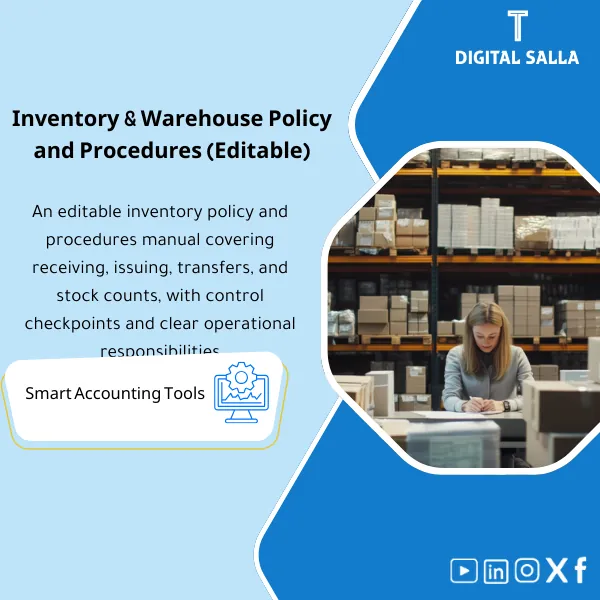
Inventory Policies & Procedures: Documents warehouse operations (receipts, issues, transfers, counts, and costing methods such as FIFO/Weighted Average), including required documents and control points. Delivers an operating reference that reduces count variances and negative inventory at month-end close.
Inventory Policies and Procedures
An operational guide for warehouses covering receiving/issuing/transferring/inventory/counting (FIFO) with templates, logs, accounting reconciliations, and linking inventory to GL within Month-End
Value Proposition: Inventory Policies and Procedures transform warehouse movement from “operations performed” to “operations that can be substantiated and reconciled.” The typical accounting scenario: inventory balance in the system does not match reality, annual inventory ends with significant unexplained discrepancies, transfers between warehouses without documentation, and month-end cut-off impacting COGS and Inventory Valuation. This package provides Warehouse Procedures step-by-step + templates and logs (GRN/Issue/Transfer/Adjustments/Counts) + clear rules for FIFO Inventory Pricing Policy and Inventory Policy, then links that to auditable outputs: documented inventory movement, inventory discrepancy reports, and proposed adjustment entries (JE Log) with a guide integrated into the Closing Pack.
In 20 Seconds: What Will You Get?
- Inventory Receiving and Issuing Policy: GRN/Issue steps + mandatory documentation + approval points.
- Warehouse Transfer Controls: Transfer Order/Transfer Note + Responsibilities + Receiving discrepancy reconciliation.
- Inventory Policy: Cycle count + Physical count + Handling inventory discrepancies + reason codes.
- FIFO Inventory Pricing Policy: Cost rules and FIFO layers + exceptions (adjustments/returns).
- Operational Logs: GRN log / Issue log / Transfer log / Stock adjustment log.
- Monthly Reconciliations: Inventory subledger vs GL + discrepancy report and explanation.
- Warehouse Management Excel: Ready templates for generating movement, inventory, and discrepancy reports in the absence of WMS.
CTA linked to outputs: receive Policy + SOPs + Logs + Count pack + FIFO guide + Reconciliation templates + Month-End pack outline.
Suitable For
- Warehouse/Operations: Operating receiving, issuing, and transferring with fixed templates preventing “movement without documentation.”
- Financial Controller / Costing: Establishing Valuation (FIFO) and linking inventory to GL and COGS during Month-End.
- Internal Audit: Ensuring Traceability: Movement → Document → Log → Inventory → Reconciliation → JE Log.
Not Suitable For
- If your primary need is a “Warehouse Management System” (WMS) and not policies, templates, and operations — this package does not sell a system.
- If your activity relies on manufacturing with BOM and conversion costs (WIP/Standard cost) and you need a complete production policy — this package focuses on inventory/warehousing (receiving/issuing/transferring/inventory/pricing).
Without the Package / With the Package (Brief Comparison)
| Item | Without Inventory Policies and Procedures | With Inventory Policies and Procedures |
|---|---|---|
| Warehouse Movement | Receiving/Issuing/Transferring without fixed templates | GRN/Issue/Transfer with mandatory requirements + logs |
| Inventory | Annual inventory ends with significant discrepancies without reasons | Inventory policy + variance report + reason codes + follow-up |
| Month-End | Inventory-to-GL without explanation + delayed adjustment entries | Reconciliations + proposed JE Log + attachments within Closing Pack |
Before Use: 5 Symptoms That Inventory Will Not Match GL or Inventory
- Receipts are made without a clear GRN or without linking to PO/invoice (GR/IR opens for months).
- Issuing/shipping occurs without an Issue Note or without specifying a reason (sale/damaged/samples/internal use).
- Transfers between warehouses are done “verbally” without a Transfer Order and without reconciling receiving discrepancies.
- Inventory is done only once a year, with no Cycle count or follow-up on discrepancies and their causes.
- Pricing (FIFO) is undocumented: cost changes/adjustments/returns affect valuation and COGS without a file explaining them.
How to Implement Inventory Policies and Procedures Practically from Daily Movement to Month-End?
The implementation is built as a series of guides rather than a “document.” It starts with establishing daily Warehouse Procedures: Receiving with a GRN document and verifying quantity/quality and storage location (Put-away), then Issuing with an Issue document and linking to the reason, followed by Transfers with a Transfer Order and receipt in the receiving warehouse with any discrepancies reconciled. Next comes the layer of Inventory Policy: periodic Cycle count + annual Physical count + inventory discrepancy report and approval steps. Finally, the pricing and reporting layer: FIFO Inventory Pricing Policy to explain valuation/COGS, then monthly Reconciliations linking the inventory subledger to GL, producing clear accounting outputs (JE Log/Adjusted TB support) within the Closing Pack.
Implementation Method (3 Steps)
Step 1: Preparation and Gathering Reports
- Item master: items, units of measure, item groups, and pricing methods (FIFO).
- Warehouse structure: Warehouses/Bins/Locations + access rights (who receives/who issues/who approves).
- Movement sources: PO/Receiving, Sales/Dispatch, Transfers, Returns, Adjustments.
- System reports: Inventory movement, on-hand, valuation + GL/TB for calculating inventory and COGS and GR/IR.
Step 2: Operations (Receiving/Issuing/Transferring) + Logs and Controls
- Implementing Inventory Receiving and Issuing Policy: GRN/Issue requirements, mandatory documents, and clear approval steps.
- Implementing Warehouse Transfer Controls: Transfer Order → Dispatch → Receipt → Exception handling for discrepancies.
- Implementing the exceptions log: Negative stock, backdated postings, missing documents, linking each case to an action.
Step 3: Month-End (Inventory/Pricing/Reconciliations) + Accounting Outputs
- Applying Inventory Policy: Cycle count/Physical count + Count variance report + approvals.
- Applying FIFO Inventory Pricing Policy: Reviewing cost layers and the impact of returns/adjustments on valuation and COGS.
- Producing Reconciliations: Inventory subledger vs GL + GR/IR aging + discrepancies and explanations.
- Producing proposed adjustment entries (JE Log) for inventory discrepancies/damaged/obsolete/reclassifications as needed, compiling them in the Closing Pack.
Product Components (Clear Inventory)
-
Inventory & Warehouse Policy (DOCX/PDF)
- Practical Purpose: Document of inventory policies and procedures: defining processes, responsibilities, approvals, and the required guide for each step.
- When Used: During establishment + whenever there is any change in processes/warehouses/pricing method.
- Resulting Guide: Approved policy with issuance and date (Signed Policy).
-
SOP Warehouse Procedures (Receiving/Put-away/Issue/Transfer)
- Practical Purpose: Clear daily operational steps for receiving/issuing/transferring inventory with document requirements.
- When Used: Daily for each warehouse movement.
- Resulting Guide: GRN/Issue/Transfer documents + auditable logs.
-
Inventory Receiving and Issuing Policy + Templates
- Practical Purpose: Defining what makes receiving “acceptable” and what makes issuing “authorized.”
- When Used: When receiving from suppliers/returns + when issuing for sale/internal use/damaged.
- Resulting Guide: GRN + Issue Note + Movement Log (Receiving/Issue Log).
-
Warehouse Transfer Controls + Transfer Log
- Practical Purpose: Preventing “untraceable transfers” and establishing reconciliation of discrepancies between sender/receiver.
- When Used: When transferring between warehouses/branches/locations.
- Resulting Guide: Transfer Order/Note + Proof of receipt + Transfer exceptions log.
-
Inventory Policy (Cycle Count + Physical Count)
- Practical Purpose: Planning inventory, separating tasks, documenting counts, and interpreting and approving inventory discrepancies.
- When Used: Periodically (Cycle count) + Annually (Physical count) + during any investigation of discrepancies.
- Resulting Guide: Count sheets + Variance report + Adjustment approvals.
-
FIFO Inventory Pricing Policy (Valuation Guide)
- Practical Purpose: Standardizing handling of FIFO layers and the impact of returns/adjustments on cost and COGS.
- When Used: Monthly at Month-End + during cost changes or significant adjustments.
- Resulting Guide: FIFO review sheet + explanation of valuation/COGS discrepancies.
-
Stock Adjustments Policy + Adjustment Request Form
- Practical Purpose: Organizing when and why Stock Adjustments (Shrinkage/Damage/Obsolete) are made and who approves.
- When Used: During inventory discrepancies or damage/obsolete or correcting input errors.
- Resulting Guide: Adjustment request + reason code + approvals + adjustment log.
-
Inventory-to-GL Reconciliations (Month-End)
- Practical Purpose: Matching sub-inventory (subledger/valuation) with GL and GR/IR accounts and COGS.
- When Used: Monthly within Month-End and Year-End.
- Resulting Guide: Reconciliation schedule + differences log + JE proposals.
-
Warehouse Management Excel (Logs + Dashboards)
- Practical Purpose: Operating movement and inventory logs and tracking in Excel when there is no WMS or as a control layer over the system.
- When Used: Daily/Weekly + before closing.
- Resulting Guide: Deliverable Excel logs + operational KPIs (optional).
What Should Be Included in the Delivery?
- 01-Inventory-Warehouse-Policy.pdf + .docx: Inventory Policies and Procedures (Approved version + Customizable version).
- 02-Warehouse-SOPs-Receiving-Issue-Transfer.pdf: Step-by-step warehouse procedures.
- 03-GRN-Template.xlsx: Receiving template (GRN) + mandatory fields (PO/Item/Qty/Batch/Expiry/Location).
- 04-Issue-Note-Template.xlsx: Issuing/shipping template + reason for issuance + approval.
- 05-Transfer-Order-Template.xlsx: Transfer order between warehouses + proof of sending/receiving.
- 06-Receiving-Issue-Transfer-Logs.xlsx: Movement logs (GRN log / Issue log / Transfer log).
- 07-Inventory-Count-Pack.xlsx: Cycle count plan + Physical count sheets + counting instructions.
- 08-Count-Variance-Report.xlsx: Inventory discrepancy report + reason codes + closing follow-up.
- 09-Stock-Adjustment-Request.xlsx: Stock adjustment request form + approvals + justification.
- 10-Stock-Adjustments-Log.xlsx: Adjustments log (Shrinkage/Damage/Obsolete/Reclass) with references.
- 11-FIFO-Valuation-Guide.xlsx: FIFO Inventory Pricing Policy guide + cost layer review.
- 12-Month-End-Cutoff-Checklist.pdf: Inventory cut-off checklist (last receipt/last shipment/movement closure).
- 13-Inventory-to-GL-Reconciliation.xlsx: Matching valuation/subledger with GL + differences log.
- 14-GRIR-Aging-Template.xlsx: GR/IR aging report (receipts without invoice/invoice without receipt).
- 15-JE-Proposals-Inventory.xlsx: Proposed JE Log for inventory adjustments/damaged/obsolete (for posting within ERP).
- 16-RACI-Warehouse-Process.xlsx: Responsibility distribution (Receiving/Issuing/Transferring/Inventory/Pricing).
- 17-Exception-Log.xlsx: Exceptions log (negative stock/backdated postings/missing docs) + owner + closure.
- 18-Runbook.pdf: Comprehensive operation from daily movement to Month-End + archiving guides (Closing Pack Index).
- 19-Archiving-Map.docx: Folder tree for archiving inventory and warehouse guides + Naming convention.
- 20-Signoff-Page.docx: Prepared/Reviewed/Approved for inventory files and monthly reconciliations.
After Implementation (Only Two Points)
- Operational Outcome for the Team: Every movement (receiving/issuing/transferring) has a document and log; inventory shifts from an “annual event” to a plan (Cycle count + Variance follow-up).
- Control/Audit Outcome: You can link Inventory Valuation and COGS with evidence: Logs → Count variance → Adjustments → Reconciliations → JE Log within the Closing Pack.
FAQ — Questions Before Purchase
Is it suitable for any ERP/WMS?
Yes. The package includes policies, templates, and logs; applicable to any system as the documents (GRN/Issue/Transfer/Counts) are the fixed control source.
Does it cover multiple warehouses/multiple branches?
Yes. It includes transfer controls between warehouses and transfer logs and tracking receiving discrepancies between locations.
Does it only include FIFO pricing policy?
It mentions FIFO Inventory Pricing Policy as an operational model. If your company uses Weighted Average, the pricing part can be adjusted, but the control structure (movement/count/recon) remains the same.
Is there a practical inventory policy (Cycle count + Annual Inventory)?
Yes: The inventory policy includes a Cycle count plan, counting templates, inventory discrepancy report, and approval and reconciliation path.
What is the minimum data required to start?
Item list + warehouse structure + movement/on-hand reports + valuation or cost + TB for calculating inventory/COGS/GRIR.
Does it include matching inventory with GL?
Yes, through the Inventory-to-GL reconciliation template + differences log + linking it to JE proposals within Month-End.
Does it cover warehouse management in Excel if there is no system?
Yes: There are Logs/Trackers files for tracking in Excel as an operational/control layer, usable even if you have ERP (as a verification layer).
Does it deal with damaged/obsolete items?
Yes, through the Stock adjustments policy + adjustment request form + adjustments log with reason codes and approvals.
Ready to Establish Warehouse Movement and Obtain Auditable Monthly Reconciliations?
Outputs: Warehouse Procedures + Inventory Policy + FIFO guide + Logs + Reconciliations + JE Log + Closing Pack Index.
| المسمّى الوظيفي | |
|---|---|
| Duration | |
| المستوى | |
| التحديثات | |
| القطاع | |
| الصيغة |


Reviews
Clear filtersThere are no reviews yet.