




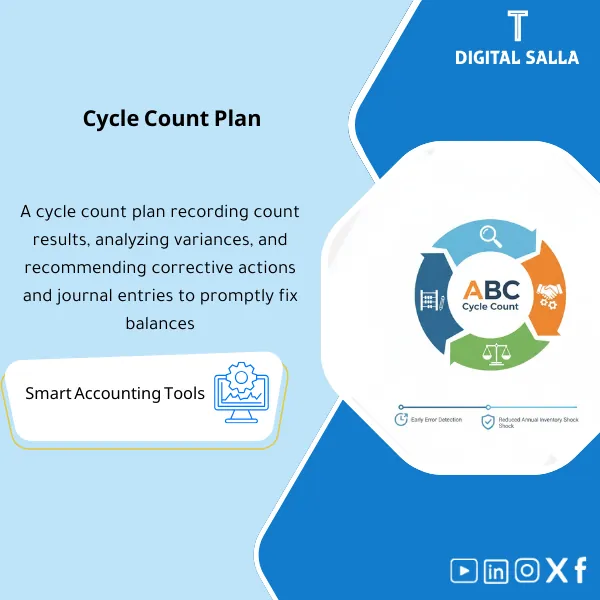
Cycle Count Plan & Variances – Excel Template
42.29 $
Cycle Count Template: Builds an ABC cycle count plan and records count results, variances, root causes, and adjustment minutes. Delivers inventory accuracy reporting and operational improvement insights beyond annual stocktakes.
Cycle Count Template
Periodic Inventory Count Plan (ABC) + Count Results + Periodic Count Variances + Inventory Variance Handling Process (Excel)
Value Proposition: Cycle Count Template transforms inventory counting from an “annual event” to continuous operational oversight. The real-world scenario: inventory accuracy gradually declines due to undocumented disbursements, receiving errors, unclosed transfers, or uncontrolled locations. Then, at the end of the period, significant variances appear, addressed with general adjusting entries without explanation. This product provides you with a Periodic Inventory Count Plan based on ABC Inventory, along with a record of count results and a clear system for documenting Periodic Count Variances and converting them into actions: investigation, processing decision, and approval. The outcome is not just “overall improvement” — the result is a traceable list of variances, accuracy reports by item/location, and a Inventory Variance Handling Process that links each variance to its cause and action for approval.
In 20 Seconds: What Will You Get?
- Periodic Inventory Count Plan with a clear calendar based on ABC (A counted more frequently than B and C).
- Cycle Count Template for “Blind count” to reduce bias.
- Count Results Log: system vs actual count with signature of the counter and reviewer.
- Periodic Count Variances converted into Variance log with cause classification.
- Inventory Variance Handling: clear decision (Adjust / Recount / Investigate / Hold).
- Accuracy Reports: Accuracy % by warehouse/location/item + high-risk items.
- Approved Adjustments List instead of general adjustments.
CTA related to outputs: you will receive Plan + Count sheets + Variance log + Approved adjustments + Accuracy KPIs.
Suitable For
- Inventory Controller: Building a periodic count plan and tracking and closing variances.
- Warehouse Operations: Organizing counts without disrupting operations with a calculated movement lock window.
- Finance / Internal Audit: Obtaining evidence of variances and justifications and approvals instead of “Bulk” adjustments.
Not Suitable For
- If your WMS implements Cycle Count internally with workflows and approvals and ready accuracy reports — this template will be merely an additional documentation tool.
- If the root issue is the lack of movement documentation/authorizations (disbursements and receipts without entries) — you first need inventory policies and procedures to control the source.
Without Periodic Counting / With Periodic Counting (Brief Comparison)
| Item | Without Cycle Count | With Cycle Count Template |
|---|---|---|
| Variance Detection | Once a year (or late) | Early detection based on ABC category and count calendar |
| Variance Explanation | General adjusting entries | Variance log + cause + action + approval |
| Accuracy Control | No measurable KPIs | Accuracy KPIs by item/location/warehouse |
Before Use: 5 Symptoms That Inventory Variances Will Increase
- Inventory occurs only once a year, and there is no Periodic Inventory Count Plan.
- No ABC Inventory classification; the same counting frequency for all items.
- Variances recur for the same items without closing the root cause.
- No unified record for Periodic Count Variances and no follow-up for closing them.
- Adjustments are entered into the system without evidence (From count? From reviewer? Why?).
How Does the Cycle Count Template Work Practically from Planning to Approving Variance Handling?
The application begins by classifying items according to ABC Inventory (by value/movement/importance). Then, a Periodic Inventory Count Plan is built with a clear calendar: A items are counted more, B less, and C the least. During the count execution, a “Blind count” is used (without showing the system balance to the counter) to reduce bias, and then the results are compared to the system balance, revealing the count variance. Any variance automatically moves to the Periodic Count Variances (Variance log) with mandatory fields: potential cause, does it need a Recount? Is there movement during the count? Is the variance related to a specific location? After investigation, an approved Inventory Variance Handling list is issued with signatures for Prepared/Reviewed/Approved, then the count cycle is closed, and accuracy indicators are updated.
Implementation Method (3 Steps)
Step 1: Preparation and Report Gathering
- Export system balance (On‑Hand) by warehouse/location/bin.
- Set count window rules (Lock movement window) or document movement during the count.
- Identify the counting team (Counter), reviewer (Reviewer), and approver (Approver).
- Establish ABC rules (value/movement) and choose counting frequency for each category.
Step 2: Execute Count + Record Results
- Issue Cycle Count sheets for targeted items/locations.
- Perform Blind count and document date/time/location/counter.
- Record results and compare system vs actual and output count variance.
Step 3: Investigation + Inventory Variance Handling + Closing
- Convert the variance into Variance log and determine: Recount or Adjustment or Investigation.
- Document the cause (Reason codes) and corrective action (Corrective action).
- Issue the Approved adjustments list and sign off for approval and close the count cycle.
Product Components (Clear Inventory)
-
ABC Classification Sheet
- Practical Purpose: Classifying items into A/B/C to determine counting frequency.
- When to Use: During establishment and then quarterly/biannual reviews.
- Resulting Evidence: Approved ABC list.
-
Cycle Count Plan
- Practical Purpose: Count calendar and distribution of items over weeks/days of counting.
- When to Use: Monthly/Quarterly based on inventory size.
- Resulting Evidence: Deliverable and trackable Plan.
-
Cycle Count Sheets (Blind Count)
- Practical Purpose: Count sheets without system balance to reduce bias.
- When to Use: During physical counting.
- Resulting Evidence: Signed Count sheets.
-
Count Results Register
- Practical Purpose: Recording count results (Counted qty) and linking them to location/bin and date.
- When to Use: After each counting session.
- Resulting Evidence: Reviewable results register.
-
Variance Log
- Practical Purpose: Compiling variances and documenting cause and action (Recount/Investigate/Adjust).
- When to Use: When a difference appears between the system and the count.
- Resulting Evidence: Variance list + status for each variance.
-
Root Cause & Corrective Actions
- Practical Purpose: Converting recurring variances into actions (controlling receipts/disbursements/transfers/locations).
- When to Use: Weekly/Monthly based on variance size.
- Resulting Evidence: Action tracker linked to variances.
-
Approved Adjustments List
- Practical Purpose: List of variances approved for adjustment within the system.
- When to Use: After investigation and decision approval.
- Resulting Evidence: Approved adjustments with signatures.
-
Accuracy Dashboard
- Practical Purpose: Measuring Accuracy % by item/warehouse/location + accuracy trend over time.
- When to Use: Monthly in management/closing reports.
- Resulting Evidence: Reviewable KPIs.
What Should Be Included in the Delivery?
- 01-Cycle-Count-Pack.xlsx: Main file (Plan + Results + Variance + KPIs).
- 02-ABC-Classification.xlsx: ABC Inventory (classification rules + results).
- 03-Cycle-Count-Plan.xlsx: Periodic Inventory Count Plan (calendar + item distribution).
- 04-Blind-Count-Sheets.xlsx: Cycle Count Template for counting (without system balance).
- 05-Count-Results-Register.xlsx: Count results register (system vs counted).
- 06-Variance-Log.xlsx: Periodic count variances + Status + Reason codes.
- 07-Recount-Tracker.xlsx: Recount tracking (if needed) and its results.
- 08-Root-Cause-Actions.xlsx: Inventory variance handling (corrective actions + owner + date).
- 09-Approved-Adjustments.xlsx: List of approved adjustments for system upload.
- 10-Accuracy-Dashboard.xlsx: Improving inventory accuracy (KPIs + trend).
- 11-Movement-Lock-Checklist.pdf: Movement lock checklist/documentation during counting.
- 12-Controls-Checklist.pdf: Counting controls (Blind count/Segregation/Approvals).
- 13-Signoff-Page.docx: Prepared/Reviewed/Approved for each counting cycle.
- 14-Runbook.pdf: Step-by-step operation (Plan → Count → Variance → Close).
- 15-Archiving-Map.docx: Tree for archiving count evidence, variances, and adjustments.
After Implementation (Only Two Points)
- Operational Outcome for the Team: Counting becomes scheduled (ABC) and variances are closed continuously instead of accumulating for the annual inventory.
- Control/Audit Outcome: Each variance has a record: count result + cause + action + approval + list of reviewable approved adjustments.
FAQ — Questions Before Purchase
Is it necessary to stop inventory movement during counting?
It is preferable to have a Lock window or document any movement during counting within the template to avoid mixing results.
Does it support ABC Inventory?
Yes: there is a sheet for classifying items A/B/C and determining counting frequency for each category.
Does it provide Blind count?
Yes: count sheets without showing system balance to reduce bias.
How are inventory variances handled?
Through the Variance log: Recount/Investigate/Adjust + reason codes + corrective actions and approvals.
Is it suitable for multi-warehouse companies?
Yes: the plan, results, and variances operate by warehouse/location/bin.
Is there a ready delivery for reviewers?
Yes: sign-off + list of approved adjustments + archiving map + accuracy reports.
What is the minimum data required to get started?
Item master + system balance by warehouse/location + last count date (if any). Movement data helps explain variances.
Does it help improve inventory accuracy?
Yes, by measuring Accuracy% periodically and linking recurring variances to actionable corrective measures.
Ready to Reduce Inventory Variances Before They Turn into General Adjustments at Closing?
Outputs: Periodic Inventory Count Plan (ABC) + Results + Variances + Approved adjustments + KPIs.
| المسمّى الوظيفي | |
|---|---|
| Duration | |
| المستوى | |
| التحديثات | |
| القطاع | |
| الصيغة |






Reviews
Clear filtersThere are no reviews yet.