




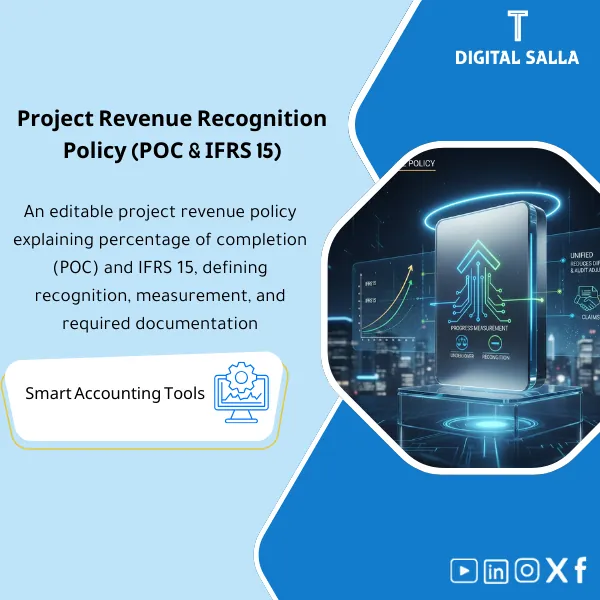
POC & IFRS 15 Policy – Editable Word File
84.84 $
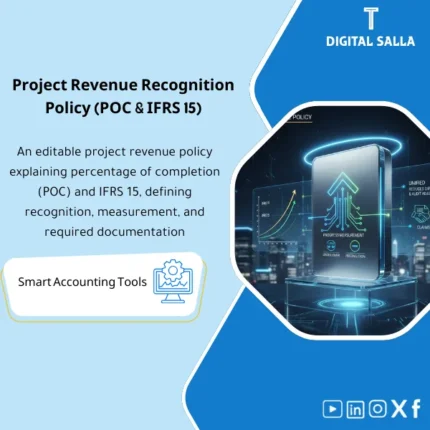
Percentage of Completion (POC) Methodology: Documents progress measurement policy, EAC updates, and linkage to accrued revenue under IFRS 15—including claims and under/over billing treatment. Delivers consistent month-end project close rules for reporting and audit teams.
Revenue Recognition Policy for Projects (POC / IFRS 15)
A written policy and practical methodology for applying Percentage of Completion (POC) in accordance with IFRS 15 for construction and service projects, including the Cost-to-Cost method, handling Under/Over Billing, and proper accounting treatment of Claims & Variations as Variable Consideration.
Value Proposition:
This is not a “theoretical policy paper,” but an operational guide that connects
contract → costs → percentage of completion → recognized revenue → financial statements.
The goal: to recognize revenue that is auditable, consistent with IFRS 15, and prevents revenue inflation or unjustified deferral.
In 20 seconds: What will you get?
- Revenue Recognition Policy written for projects.
- Application of POC (Percentage of Completion) in accordance with IFRS 15.
- Practical explanation of the Cost-to-Cost Method.
- Mechanism for calculating recognized revenue monthly.
- Accounting treatment of Under / Over Billing.
- Policy for handling Claims & Variations as Variable Consideration.
- Linking the policy with WIP and the Trial Balance.
- Practical examples + typical Journal Entries.
Suitable for
- Construction and project companies.
- Long-term service companies.
- Financial managers and heads of accounts.
- Entities subject to external audit.
Not Suitable for
- Activities with immediate sale (Point-in-Time).
- Companies that do not track project costs.
Before Implementing the Policy
- Revenue recognized only upon invoicing.
- Unjustified inflation or deferral of revenue.
- Continuous discrepancies with the external auditor.
- Lack of a clear methodology for calculating WIP.
- Random handling of claims and changes.
After Implementing the Policy
- Accounting Consistency: The same methodology every month and for every project.
- Auditability: Revenue supported by costs and percentage of completion.
How does the Revenue Recognition Policy work in practice?
1) Determine if the contract is subject to POC
- The contract is executed over a period of time.
- The customer has gradual control over the benefit.
- Costs and revenue can be measured reliably.
2) Determine the method for measuring the percentage of completion
The policy is based on the Cost-to-Cost Method:
- Percentage of completion = costs incurred ÷ total estimated costs.
- Regular updates to total costs (EAC).
3) Calculate recognized revenue
- Recognized revenue = contract value × percentage of completion.
- Revenue for the period = cumulative revenue − previously recognized revenue.
4) Handling Under / Over Billing
- Under Billing: Recognized revenue > issued invoices → Current asset (WIP).
- Over Billing: Issued invoices > recognized revenue → liability.
5) Claims & Variations as Variable Consideration
- Not recognized unless collection is highly probable.
- Included at the weighted or most likely value.
- Exclude high-risk claims from revenue.
Accounting Output from Implementing the Policy
- Project revenue compliant with IFRS 15.
- Clear and explained WIP balance.
- Traceable Under / Over Billing.
- Standard monthly closing entries.
- File ready for external audit.
Delivery Contents
- Revenue Recognition Policy: A formal written policy.
- POC Methodology: Explanation of Cost-to-Cost.
- Variable Consideration Guidance: Claims & Variations.
- Journal Entries: Typical accounting entries.
- Examples: Practical numerical examples.
If you want a revenue policy that won’t be rejected by the auditor and won’t distort the financial statements
| المسمّى الوظيفي | |
|---|---|
| Duration | |
| المستوى | |
| التحديثات | |
| القطاع | |
| الصيغة |
Related products


DOA Matrix – Excel Template
Reviews
Clear filtersThere are no reviews yet.