


Deferred Tax Model – Excel File
84.84 $
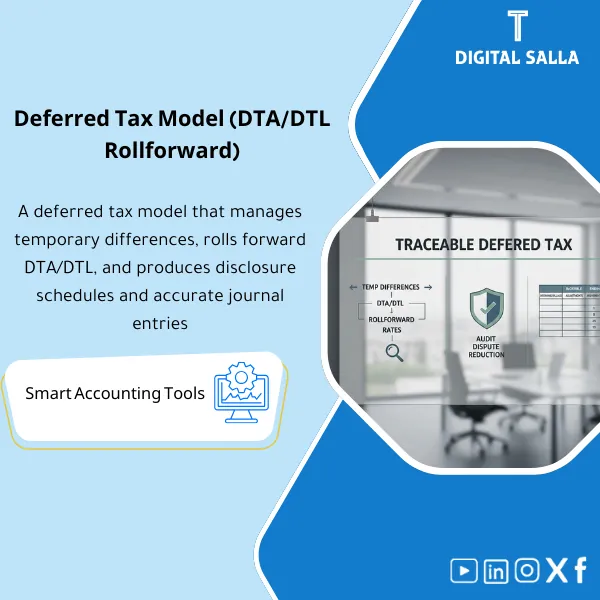
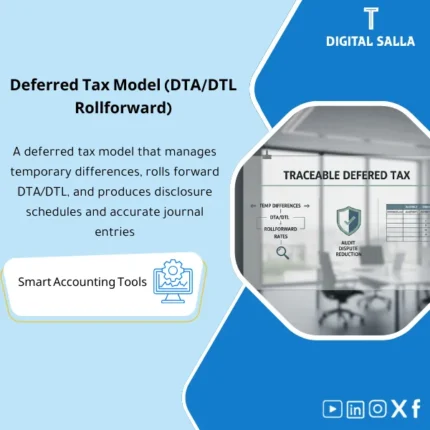
Deferred Tax Template: Tracks temporary differences and calculates DTA/DTL with rollforwards and linkage to P&L/OCI. Delivers an auditable deferred tax schedule for IFRS reporting teams.
Deferred Tax Model
Subtitle: Temporary Differences Register + DTA/DTL Rollforward + TB Tie-out + Deferred Tax JE Templates + Tax Note Pack
Value Proposition: The Deferred Tax Model transforms the differences between “Carrying amount vs Tax base” into an auditable movement in DTA/DTL and Deferred tax expense: Temporary Differences → DTA/DTL Calculation → Rollforward → TB Tie-out → JE Templates → Note Pack instead of showing DTA/DTL balance in the TB without a movement schedule or explanation at closing.
In 20 Seconds: What Will You Get?
- Temporary Differences Register: A register of temporary differences by item (FA/Provisions/Accruals/Leases… as applicable).
- Tax Base vs Carrying Amount: Clear measurement columns for each item: Carrying amount, Tax base, Difference.
- DTA/DTL Calculation: Calculation of DTA or DTL for each item + aggregation by type/account.
- DTA/DTL Rollforward: Opening + Movement (P&L/OCI/Equity if necessary) ± Reclass = Closing.
- Deferred Tax Expense Bridge: Linking DTA/DTL movement to deferred tax expense/income for the period.
- TB Tie-out: Matching Closing DTA/DTL with TB accounts and showing differences and their explanations.
- Deferred Tax JE Templates + Note Pack: Journal entries for recording/reversing deferred tax + ready schedules for clarifying deferred tax.
CTA related to deliverables: Receive Temporary differences register + DTA/DTL rollforward + TB tie-out with JE templates to establish the deferred tax balance and produce a ready Note.
Suitable For
- Reporting / Consolidation needs traceable DTA/DTL movements within Year-End and Note disclosures.
- Financial Controller wants a clear tie-out before approving the financial statements and before signing off on the closing.
- Tax Accountant wants a temporary differences schedule that feeds into the Tax provision and supports Deferred tax accounting.
Not Suitable For
- Those who do not recognize Deferred tax in their financial statements or do not have a measurement policy/definition of Tax base for core items.
- Those who want a “ready differences list” without inputting Carrying/Tax base from their records (the value here is in data linkage).
Without the Model / With the Model (Quick Comparison)
| Item | Without Deferred Tax Model | With Deferred Tax Model |
|---|---|---|
| Identifying Differences | Scattered items + difficult to track annually | Temporary differences register with repeatable and auditable items |
| DTA/DTL Movement | Opening/Closing without explanation of movement | Rollforward explains movement by reason and links it to differences |
| Journal Entries | Deferred entry aggregated without reference | JE templates + bridge linking movement to deferred tax expense |
| Notes | Manual Note aggregation at year-end | Ready Note pack: movement schedules + classification + tie-out |
Before Use: 5 Symptoms Indicating Deferred Tax Issues
- DTA/DTL balance in TB lacks a Rollforward explaining the increase/decrease throughout the year.
- Temporary differences are not managed as a register, causing the list of items to change from year to year without explanation.
- Deferred tax expense is not linked to DTA/DTL movement (no clear bridge).
- Deferred tax entries are recorded as a single entry without reference to items/differences.
- When preparing the deferred tax Note: there are no ready schedules for preparing disclosures or linking to the TB.
Deferred Tax: Implementation Method (3 Steps Without Gaps)
Step 1: Preparation and Report Gathering
- Extract TB for DTA/DTL accounts + calculate Deferred tax expense/income if applicable.
- Gather sources of temporary differences: FA schedule, provision schedules, accruals/prepaids, leases (as per your scope).
- Establish Tax rate and measurement definitions: what you consider the Tax base for each item (according to your policy/regulations).
Step 2: Record Differences + Calculate DTA/DTL + JE Log
- Fill in the Temporary differences register: Carrying amount versus Tax base and specify the type of difference.
- Calculate DTA/DTL for each item and aggregate by account/category.
- Extract movement for the period and prepare JE templates and update the JE log with references.
Step 3: Rollforward + TB Tie-out + Note Pack
- Update DTA/DTL rollforward (Opening/Movement/Closing) and specify where the impact went (P&L/OCI/Equity if necessary).
- Perform TB tie-out between Closing in the model and TB balances and close or document differences.
- Compile Deferred tax note pack + evidence index + sign-off as a final version for the period.
Product Components (Clear Inventory)
-
Temporary Differences Register
- Practical Purpose: Document each temporary difference as a separate item with its source (FA/GL schedule) and classification.
- When Used: Year-End + interim updates when items change.
- Resulting Evidence: Register linking Carrying/Tax base and the source of the figure for each item.
-
Tax Base vs Carrying Amount Worksheet
- Practical Purpose: Establish measurement methodology: Carrying amount, Tax base, Difference, Type.
- When Used: When entering data for the first time and when updating items.
- Resulting Evidence: Worksheet clarifying the measurement method and standardizing it within the team.
-
DTA/DTL Calculation
- Practical Purpose: Calculate DTA/DTL for each item according to the approved tax rate and aggregate by accounts.
- When Used: After updating the register and before closing the period.
- Resulting Evidence: DTA/DTL table showing the value by item/category rather than just a total figure.
-
DTA/DTL Rollforward
- Practical Purpose: Explain the final balance with movement (Opening + movement ± reclass = closing).
- When Used: With every period closing, especially Year-End.
- Resulting Evidence: Rollforward supports Note disclosure and closes the tie-out.
-
Deferred Tax Expense Bridge
- Practical Purpose: Link DTA/DTL movement to deferred tax expense/income in P&L (or OCI/Equity as applicable).
- When Used: When approving tax expense in the financial statements.
- Resulting Evidence: Bridge explaining the deferred tax expense figure instead of an unlinked number.
-
TB Tie-out Sheet
- Practical Purpose: Ensure that Closing DTA/DTL in the model = TB balances for DTA/DTL accounts.
- When Used: Before approving the financial statements and during sign-off.
- Resulting Evidence: Tie-out with documentation of differences and closure or explanation.
-
Deferred Tax JE Templates
- Practical Purpose: Produce entries for recording/reversing deferred based on movement (Increase/Decrease DTA/DTL).
- When Used: At the end of the period and after confirming the rollforward.
- Resulting Evidence: JE templates + JE log with references to register/bridge.
-
Deferred Tax Note Pack + Evidence Index + Sign-off
- Practical Purpose: Prepare deferred tax disclosure schedules and confirm the final version for approval.
- When Used: Year-End + when preparing periodic statements if required.
- Resulting Evidence: Note-ready pack (jumps straight into FS notes) + index + sign-off.
CTA related to deliverables: DTA/DTL rollforward + TB tie-out + JE templates + Note pack to establish deferred tax as a deliverable closing file.
What Should Be Included in the Delivery?
- 01 – TB Extract: TB for DTA/DTL accounts and Deferred tax expense for the period.
- 02 – Temporary Differences Register: Register of items with Carrying amount and Tax base and the source of each figure.
- 03 – DTA/DTL Calculation: Calculation of DTA/DTL by item/category + aggregation by account.
- 04 – DTA/DTL Rollforward: Movement Opening/Movement/Closing with classification of impact (P&L/OCI/Equity if necessary).
- 05 – Deferred Tax Expense Bridge: Bridge linking movement to deferred tax expense.
- 06 – JE Templates & JE Log: Entries for recording/reversing deferred + movement status + supporting reference.
- 07 – TB Tie-out: Matching Closing DTA/DTL with TB + explanation/closure of differences.
- 08 – Supporting Schedules: FA schedule, provision/accrual schedules… as per listed items.
- 09 – Note Pack: Deferred tax disclosure schedules + comparative figures + presentation method.
- 10 – Evidence Index & Sign-off: Evidence index + reference version + who reviewed/approved.
After Implementation (Two Key Points)
- Operational Outcome for the Team: Updating deferred tax becomes a measurement and documentation process: register → calculation → rollforward → JE, instead of directly adjusting DTA/DTL balance in the TB without explanation.
- Audit/Control Outcome (Evidence & Traceability): Each DTA/DTL balance has movement and source (temporary differences) and tie-out with TB and a ready Note pack, with sign-off confirming the final version.
FAQ — Questions Before Purchase
Is the model suitable for IFRS?
It is suitable as a working template for Temporary differences, rollforward, and note readiness. The final recognition/measurement application (such as recognition criteria for DTA) depends on your company’s policy and reporting framework.
Does it support DTA and DTL separately?
Yes, DTA and DTL can be tracked separately or as a net amount, with rollforward and movement explanation linking to TB.
Does it require a Fixed Assets Schedule?
In most cases, yes, as depreciation/assets differences are among the largest sources of temporary differences. If there is no FA schedule, other items can be entered, but it may not cover all deferred sources typically.
Can it be used during the year (Quarter/Month-end)?
Yes, when preparing provision if your company updates deferred tax periodically. You will need to update the register for items that changed during the period.
Does it automatically produce deferred tax entries?
It produces JE templates based on calculated DTA/DTL movement. The actual posting occurs in your system after review and approval.
What is the minimum data required?
TB for DTA/DTL accounts + list of items generating temporary differences + Carrying amount + definition of Tax base/measurement bases + tax rate.
Can it be linked within Tax provision and Tax note?
Yes. Its outputs feed into Tax provision (deferred part) and support Tax note through rollforward and ready schedules.
Does it cover all deferred cases (OCI/Equity)?
It provides columns for classifying impact (P&L/OCI/Equity) if needed. The application of detailed cases depends on your presentation method and reporting policy.
Ready to Establish DTA/DTL with Auditable Movement?
You will receive: Temporary differences register + DTA/DTL rollforward + TB tie-out + JE templates + note pack + sign-off as a deliverable closing file for deferred tax.
| المسمّى الوظيفي | |
|---|---|
| Duration | |
| المستوى | |
| التحديثات | |
| القطاع | |
| الصيغة |
Reviews
Clear filtersThere are no reviews yet.