


Fraud Risk Assessment – Excel Template
84.84 $
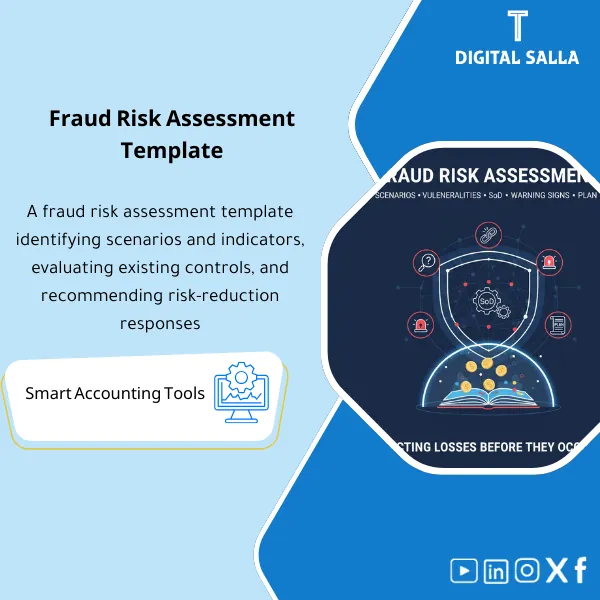
Fraud Risk Assessment: Lists fraud scenarios by cycle, assesses impact and likelihood, identifies control gaps, and defines required controls and KRIs. Delivers a fraud risk register with mitigation and testing plan.
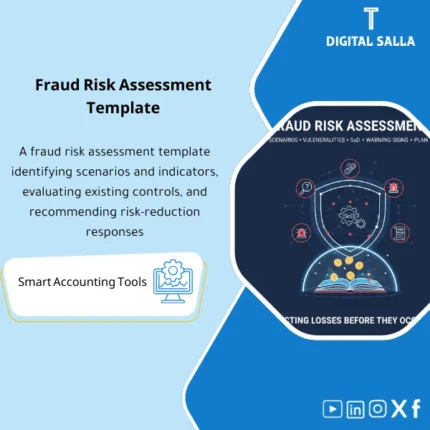
Fraud Risk Assessment
Fraud Risk Assessment + Fraud Scenarios + Likelihood/Impact Assessment + Existing/Required Controls + Red Flags + Testing Plan
Value Proposition: The Fraud Risk Assessment template transforms “general concerns” into an actionable record: Fraud Scenarios → Likelihood/Impact → Existing Controls → Control Gaps → Red Flags → Action Plan → Test & Monitoring instead of an anti-fraud policy without scenarios or testable controls.
In 20 Seconds: What Will You Get?
- Fraud Scenarios Library: Ready-made scenarios by cycles (Sales/Purchases/Payroll/Inventory/Treasury).
- Risk Scoring: Assessment (Likelihood/Impact) + Risk level before and after controls (Inherent/Residual).
- Controls Mapping: Linking each scenario to existing controls (Prevent/Detect) and their expected evidence.
- Control Gaps: Identifying control gaps and the type of action required (Policy/System/SoD/Monitoring).
- Red Flags: Observable indicators + their source (Reports/Logs/Exception reports).
- Action Plan: Action + Owner + Due Date + Verifiable Output (Evidence) + Status.
- Testing & Monitoring Plan: Periodic testing/monitoring plan for sensitive controls.
CTA related to deliverables: Receive Risk register + controls mapping + red flags + action plan to reduce fraud risks through testable and follow-up controls.
Suitable For
- Internal Audit to update the fraud risk assessment and link it to the testing plan.
- Risk/Compliance to build a risk register and report to management on high risks and remediation plans.
- CFO/Controller to identify weaknesses in authorizations/delegations/operational controls.
Not Suitable For
- Those seeking “methods to commit fraud” or circumvent controls (this is not permitted).
- A company that does not wish to document controls or cannot extract reports/evidence—will remain theoretical.
Without Assessment / With Assessment (Quick Comparison)
| Item | Without Fraud Risk Assessment | With Fraud Risk Assessment |
|---|---|---|
| Scenarios | General risks without describing how the risk occurs | Scenario + Vulnerability + Impact + Corresponding Controls |
| Controls | Policies without testing/evidence | Controls mapping + evidence + test plan |
| Follow-up | No remediation plan or owner | Action plan + owners + due dates + status |
Before Use: 5 Symptoms
- Frequent exceptions (manual overrides) without root cause analysis and compensating control.
- Overlapping authorizations (SoD) in purchases/payments or payroll.
- Repeated modifications to vendor/customer data without a review log.
- Inventory counts/adjustments without trend analysis or exception reports.
- Audit findings or comments recurring without a prevention plan.
Fraud Risk Assessment: Implementation Method (3 Steps)
Step 1: Gather Context and Identify Cycles
- Identify key cycles and sensitivity points (Purchasing/Sales/Inventory/Payroll/Treasury).
- Review current authorizations, powers, and exception reports.
- Define the scope of “fraud” to be covered: Financial/Corruption/Reporting Manipulation/Assets.
Step 2: Assess Scenarios and Link Controls
- Document relevant scenarios and assess (Likelihood/Impact) to determine Inherent risk.
- Link existing controls and assess their effectiveness and Residual risk.
- Identify gaps and build an Action plan with verifiable outputs.
Step 3: Red Flags + Monitoring + Testing
- Identify observable Red Flags and their sources (Reports/Logs/Exception reports).
- Establish a periodic monitoring plan (Monthly/Quarterly) for the highest scenarios.
- Define a testing plan for Key anti-fraud controls and close it with evidence.
Product Components
- Fraud Scenarios Register — Scenario/Cycle/Vulnerability/Impact.
- Risk Scoring — likelihood/impact + inherent/residual.
- Controls Mapping — Controls + Evidence + Owner + Frequency.
- Red Flags Library — Red flags + Data source.
- Action Plan — Actions + Owner + Due Date + Status + Evidence.
- Testing & Monitoring — Testing and monitoring plan.
- Sign-off — Reference copy and approval.
Delivery Contents
- Risk register + Heatmap.
- Controls mapping + Evidence index.
- Red flags + Monitoring plan.
- Action plan + Follow-up.
After Implementation
- Operationally: Fraud risks are transformed into actionable controls and monitoring.
- Regulatory: Clear reports to management on high risks, remediation plans, and progress.
FAQ
Is the template suitable for anti-corruption and conflict of interest?
Yes. Corruption/conflict of interest scenarios can be included and linked to controls such as disclosures, approvals, and gift logs.
Does it include measurable Red Flags?
It provides observable indicators linked to data sources (exception reports/Logs). Detailed measurement depends on your system reports.
Can it be linked to RCM?
Yes. The RCM covers operational/reporting risks, and this template focuses on fraud scenarios. Key controls can be linked between them.
Does it explain how to commit fraud?
No. The template focuses on prevention, detection, and documentation, and does not provide any guidance on executing violations.
Ready to Transform Fraud Risks into Testable Controls?
| المسمّى الوظيفي | |
|---|---|
| Duration | |
| المستوى | |
| التحديثات | |
| القطاع | |
| الصيغة |
Related products
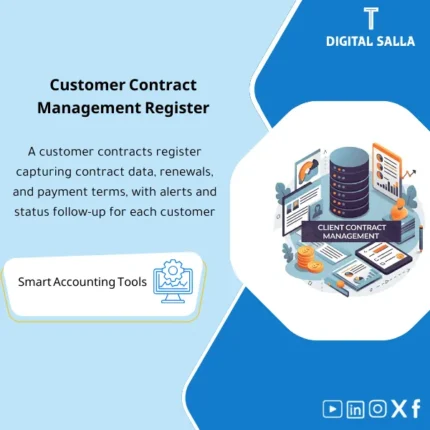
Customer Contracts Register – Excel Template
Customer Contract Management Template is a comprehensive Excel-based program to manage customer contracts effectively, including contract data, payments tracking, completion percentages, delivery dates, and project profitability—supported by automated reports that improve contract oversight and customer relationships.

Reviews
Clear filtersThere are no reviews yet.