
Account Classification and Journal Entry Directing Guide: Assets, Liabilities, and Equity
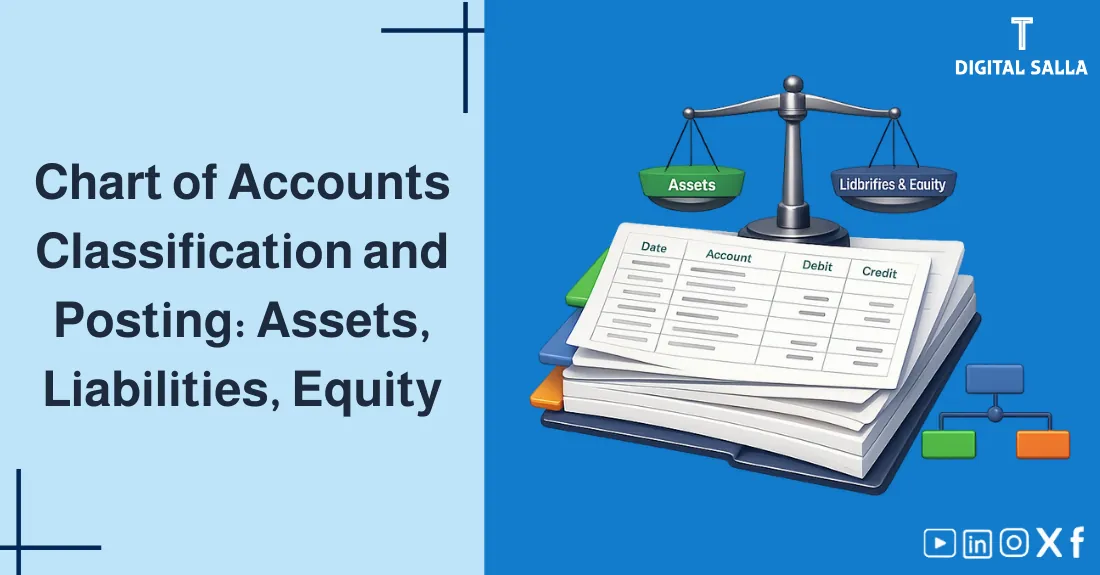
The first question every accountant faces when holding a document is: "What is the type of this account?" In this guide, we provide a comprehensive manual for account classification: How to distinguish between assets, liabilities, and equity? How does classification affect the direction of the journal entry (Debit/Credit)? And how do you build a sound financial structure that ensures accurate and reliable financial statements.
What will you gain from this guide?
- A clear definition of an Account and its role in the accounting system.
- Detailed classification of the 5 main groups: Assets, Liabilities, Equity, Revenues, and Expenses.
- Mastering Entry Directing based on the "Nature of Accounts" rule.
- A visual model (SVG) explaining the hierarchy of groups and subgroups.
- A practical table to help you select the correct account for any transaction.
- A checklist for avoiding common classification mistakes.
To build the big picture: Also read Accounting Equation Explained to see how these groups balance.
Table of Contents Auto-highlights on scroll
1) What is an Accounting Account? 2) The 5 Main Account Groups (SVG) 3) Asset Classification: Current vs. Non-Current 4) Liability Classification 5) Equity Components 6) Revenue and Expense Classification 7) Directing Entries (The Nature Rule) 8) Practical Table for Account Selection 9) Common Classification Mistakes 10) Frequently Asked Questions 11) Conclusion
1) What is an Accounting Account?
An Account is a summary record used to track increases and decreases in a specific financial item. Think of it as a "labeled folder": when you buy a machine, you record the event in the "Equipment" folder; when you pay a supplier, you record it in the "Accounts Payable" folder.
The Goal: To be able to answer the question: "What is the balance of this item right now?"
2) The 5 Main Account Groups
Every account in any company—from a small grocery to a global corporation—must belong to one of these five groups:
Accounting Groups Map Assets What you OWN Cash • Equip • Stock Liabilities What you OWE Loans • Payables Equity Owners' Share Capital • Profits Revenues Earnings Sales • Services Expenses Costs Rent • Salaries
The 5 main groups are the foundation of any accounting structure (Chart of Accounts).
3) Asset Classification: Current vs. Non-Current
Assets are resources the company owns to generate income. They are divided by liquidity:
Smart Journal Entries System - Excel File
- Current Assets: Expected to turn into cash within one year (Cash, Inventory, Receivables).
- Non-Current Assets: Long-term investments (Buildings, Machines, Intellectual Property).
4) Liability Classification: What you owe
Liabilities are obligations to external parties:
- Current Liabilities: Due within a year (Suppliers, Short-term loans, Accrued expenses).
- Non-Current Liabilities: Long-term obligations (Bank loans, Mortgages).
5) Equity Components: The Owners' Share
This group represents the "residual value" of the business for the owners:
- Capital: Money invested by owners.
- Retained Earnings: Accumulated profits not yet distributed.
- Drawings: Money taken by the owner for personal use.
7) Directing Entries (The Nature Rule)
Classification determines which side—Debit (Dr.) or Credit (Cr.)—increases the account balance:
| Account Group | Natural Balance | To Increase (+) | To Decrease (-) |
|---|---|---|---|
| Assets | Debit | Debit | Credit |
| Expenses | Debit | Debit | Credit |
| Liabilities | Credit | Credit | Debit |
| Equity | Credit | Credit | Debit |
| Revenues | Credit | Credit | Debit |
8) Practical Table for Account Selection
Use this table as a quick guide for common transactions:
| If the transaction is... | Impacted Account | Classification | Direction (Increase) |
|---|---|---|---|
| Buying stock for cash | Inventory | Asset (Current) | Debit |
| Borrowing from bank | Bank Loan | Liability (Non-Current) | Credit |
| Paying monthly rent | Rent Expense | Expense | Debit |
| Selling goods on credit | Accounts Receivable | Asset (Current) | Debit |
9) Common Classification Mistakes
- Confusing Assets with Expenses: Buying a laptop is an Asset (it lasts years), not an immediate Expense.
- Confusing Revenue with Collection: Recording revenue only when cash is received is a mistake under the Accrual Basis.
- Ignoring "Accrued" Liabilities: Forgetting to record utility bills just because they haven't been paid yet.
10) Frequently Asked Questions
Why is classification important?
Without correct classification, your Profit & Loss will be wrong and your Balance Sheet won't balance. It is the basis for all financial reporting.
Is "Drawings" an expense?
No. Drawings are a reduction of Equity, not a business expense used to generate revenue.
11) Conclusion
Mastering account classification is the difference between a "data entry clerk" and a "professional accountant." By understanding the nature of each group and how it impacts the financial statements, you build a foundation that can handle the most complex financial transactions with confidence.
Your Next Step: Look at your company's Chart of Accounts. Can you identify which accounts are Current Assets vs. Non-Current Assets?
© Digital Salla Articles — General educational content. For professional system design or audit services, consult a certified public accountant.