


Accounting Estimate vs Accounting Policy: Fundamental Difference and How to Address

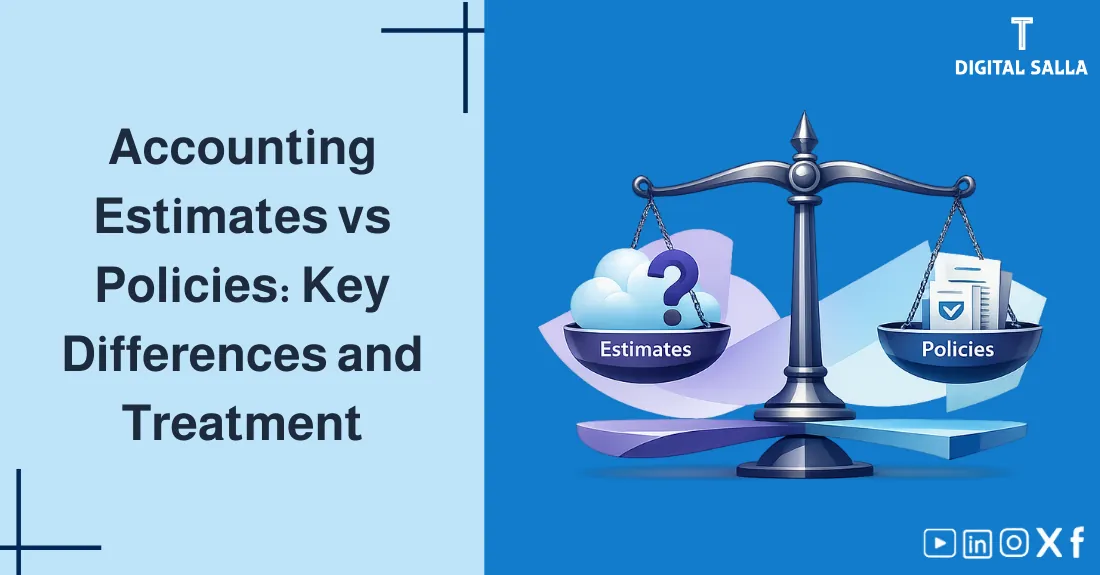
Accounting Estimate vs. Accounting Policy: The Core Difference and Treatment
“Is this a change in policy or a change in estimate?” This question confuses many accountants. The answer determines whether you restate previous years (Retrospective) or just adjust the current year (Prospective). In this guide, we simplify the difference according to IAS 8 with practical examples like depreciation, inventory, and provisions.
- The fundamental difference: “The Rule” (Policy) vs. “Judgment” (Estimate).
- Decision Map: When to apply Retrospectively vs. Prospectively?
- Practical Examples: Depreciation, Inventory, Provisions, and Valuation Models.
- How to treat the “Change in Depreciation Method” specifically (Common confusion).
- Required disclosures to ensure compliance with IAS 8.
If the change is due to a mistake in the past rather than new info, that’s an Error: Related Topic: Accounting Error Correction
1) Concept: Policy vs. Estimate (Simply)
To distinguish easily, think of it this way:
- Accounting Policy is “The Rule of the Game”. It is the basis, convention, or principle selected (e.g., using Cost Model vs. Fair Value Model). Changing it means changing the rule itself.
- Accounting Estimate is “The Judgment within the Game”. It is the number derived based on current information (e.g., useful life is 5 years, bad debt is 2%). Changing it means new info appeared.
2) The Core Difference Table
This table summarizes the main differences regarding definition, treatment, and impact.
| Aspect | Accounting Policy | Accounting Estimate |
|---|---|---|
| Definition | Principles, bases, conventions, rules applied in preparing statements. | Adjustment of carrying amount due to assessment of status/benefits/obligations. |
| Treatment | Retrospective Application (Restate prior periods). | Prospective Application (Current and future only). |
| Why Change? | Required by Standard OR results in more reliable/relevant information. | New information, new developments, or more experience. |
| Typical Example | Inventory valuation (FIFO to Weighted Average), Investment Property (Cost to Fair Value). | Useful life, Residual value, Warranty provision, Bad debt %. |
3) Decision Map: Retrospective or Prospective?
Why does the distinction matter? Because Retrospective Application (for Policy) is complex and requires changing old numbers, while Prospective Application (for Estimate) is easy and affects only now/future.
4) Practical Examples (The Confusion Area)
Inventory Valuation (FIFO vs Weighted Average)
Changing from FIFO to Weighted Average is a change in Accounting Policy.
Action: Restate prior year comparatives as if the new policy had always been applied (Retrospective).
Provision for Bad Debts (Percentage Change)
Changing the provision from 2% to 5% due to market conditions is a change in Accounting Estimate.
Action: Record the extra expense in the current year. Do not touch the past (Prospective).
Practical IFRS Applications - PDF File
Investment Property (Cost vs Fair Value)
Changing from Cost Model to Fair Value Model is a change in Accounting Policy.
Action: Retrospective application (unless the specific standard IFRS 40 says otherwise, usually adjustment to opening Retained Earnings).
5) Special Case: Change in Depreciation Method
“We changed from Straight-Line to Units of Production because machines wear out by usage, not time.” Is this a policy or estimate?
Although it looks like a “method” change, IAS 16 clarifies that the depreciation method reflects the “pattern of consumption” of future economic benefits. Since this pattern is an estimate, the change is treated prospectively.
6) Disclosure Requirements
Whether it’s a policy or estimate change, you must disclose.
For Policy Change:
- Title of the standard (if mandatory) or reason for better reliability (if voluntary).
- Nature of the change.
- Amount of adjustment for each prior period presented (Effect on EPS, Equity, etc.).
For Estimate Change:
- Nature and amount of change that has an effect in the current period.
- Effect on future periods (if applicable).
7) Closing Checklist
- Identify the change source: New Standard? Better Policy? Or New Info (Estimate)?
- If Policy: Are prior year data available for Restatement?
- If Estimate: Is the calculation documented for the current period?
- Check Materiality: Is the impact worth the disclosure?
- Draft Note: Explain the “Why” and “How much”.
8) Frequently Asked Questions (FAQ)
What is an Accounting Policy?
Accounting policies are the specific principles, bases, conventions, rules, and practices applied by an entity in preparing and presenting financial statements.
What is an Accounting Estimate?
An accounting estimate is an adjustment of the carrying amount of an asset or liability resulting from new information or developments (e.g., useful life, provisions).
How is a Change in Policy treated?
It is treated Retrospectively (Restatement), meaning prior period financials are adjusted as if the new policy had always been applied.
How is a Change in Estimate treated?
It is treated Prospectively, meaning the effect is recognized in the current and future periods only.
Is changing the depreciation method a policy or estimate?
It is considered a change in Accounting Estimate because it reflects a change in the expected consumption pattern of benefits.
9) Conclusion
Distinguishing between Accounting Policy and Accounting Estimate saves you the effort of Restatement when it’s not needed. Remember: Policy = Principles (Restate Past). Estimate = New Info (Adjust Future). Always document the “Reason for Change” to justify your treatment to the auditor.