
Statement of Financial Position (Balance Sheet): Structure, Order of Liquidity, and Classification
If the Income Statement is a "Video" showing a company's performance over a year, the Statement of Financial Position (or Balance Sheet) is a "Photo" of its health at a specific moment. It answers the most critical question for any stakeholder: "What does the company own, and who owns it?" In this guide, we provide a professional breakdown of the Balance Sheet: How are assets and liabilities classified? What is the "Order of Liquidity"? And how do you use Working Capital to assess whether the company can survive the next 12 months?
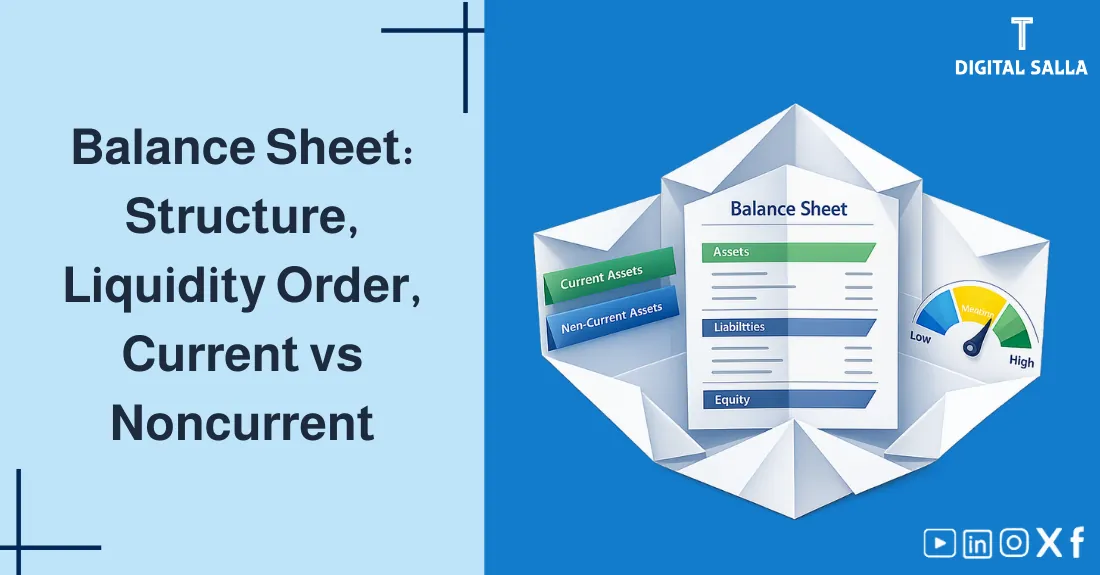
The Balance Sheet: A snapshot of the accounting equation Assets = Liabilities + Equity.
What will you learn in this guide?
- Simplified definition of the Statement of Financial Position.
- Detailed classification of Current Assets vs. Non-Current Assets.
- Understanding Liabilities and their settlement timing.
- Visual model (SVG) explaining the Order of Liquidity logic.
- Equity components: Capital, Reserves, and Retained Earnings.
- Interactive Tool: Calculate Working Capital and the Current Ratio.
- A checklist for reviewing the quality of balance sheet items.
Contextual Link: To understand the rules for correcting errors in this statement, read Correcting Accounting Errors (IAS 8).
Table of Contents Auto-highlights on scroll
1) Defining the Statement of Financial Position 2) Asset Classification: Current vs. Non-Current 3) Liability Classification 4) Equity: The Residual Interest 5) Visual Logic: Order of Liquidity (SVG) 6) Liquidity Ranking Logic 7) Interactive Liquidity Analyzer 8) Key Ratios from the Balance Sheet 9) Frequently Asked Questions 10) Conclusion
1) What is the Statement of Financial Position?
It is a formal financial report that provides a snapshot of a company's economic resources (Assets) and the sources of funding for those resources (Liabilities and Equity) at a specific point in time.
The Golden Equation: Assets = Liabilities + Owner's Equity. Both sides must always balance perfectly.
2) Asset Classification: What we own
Assets are classified based on the Operating Cycle (usually one year):
- Current Assets: Expected to be converted to cash or consumed within 12 months (e.g., Cash, Bank, Inventory, Accounts Receivable).
- Non-Current (Fixed) Assets: Long-term investments and physical assets held for use, not for resale (e.g., Land, Buildings, Equipment, Patents).
3) Liability Classification: What we owe
Liabilities follow the same timeline logic:
Customer Credit Limits & Policy - Word & Excel Files
- Current Liabilities: Debts due for payment within one year (e.g., Accounts Payable, Short-term Loans, Accrued Salaries).
- Non-Current Liabilities: Long-term obligations due after one year (e.g., Bank Mortgages, Long-term Bonds).
4) Equity: The Residual Interest
This section represents the owners' net investment in the company. It includes:
- Paid-in Capital: The amount investors originally paid for shares.
- Retained Earnings: Accumulated profits not yet distributed as dividends.
- Reserves: Statutory or voluntary amounts set aside for strengthening the company.
5) Visual Logic: The Liquidity Ladder
The Order of Liquidity Logic Highest Liquidity (Current) Cash • Bank • Marketable Securities Medium Liquidity Receivables • Inventory Lowest Liquidity (Non-Current) Equipment • Buildings • Goodwill
The ranking of assets from most liquid (top) to least liquid (bottom) is standard practice under IFRS.
6) Liquidity Ranking Logic
Why do we rank items by liquidity? To help analysts quickly determine the company's ability to settle its obligations. If the company has $1M in assets but $900k is tied up in "Land," it might still struggle to pay $50k in "Monthly Salaries." This is the difference between Solvency and Liquidity.
7) Interactive Liquidity Analyzer
Enter your balance sheet totals to evaluate your short-term health:
Total Current Assets ($)
Total Current Liabilities ($)
Working Capital: —
Current Ratio: —
Liquidity Signal: —
8) Key Ratios from the Balance Sheet
- Working Capital (Current Assets - Current Liabilities): Measures the cushion available for operations.
- Current Ratio (Current Assets / Current Liabilities): Ideally should be above 1.0 (indicating Assets cover debts).
- Debt-to-Equity: Measures how much the company relies on debt vs. owners' money.
9) Frequently Asked Questions
Can the Balance Sheet be for a full year?
No. It is always "As of" a specific date. The Income Statement is for a period (e.g., Year 2024), but the Balance Sheet is for a point (e.g., Dec 31, 2024).
Is "Inventory" always a current asset?
Yes, for most commercial companies, because it is held specifically for sale within the normal operating cycle.
10) Conclusion
The summary is simple: The Statement of Financial Position is the ultimate report of Financial Stability. By mastering the classification of items and understanding the order of liquidity, you move beyond just "Matching Numbers" to Managing Survival and planning for sustainable long-term growth.
Your Next Step: Use the analyzer above to check your latest company figures. Is your "Current Ratio" healthy, or are you operating under liquidity pressure?
© Digital Salla Articles — General educational reference. For professional credit analysis or formal external reporting, consult a certified public accountant.