


Break-Even Analysis: How do you determine the sales volume needed to cover costs?

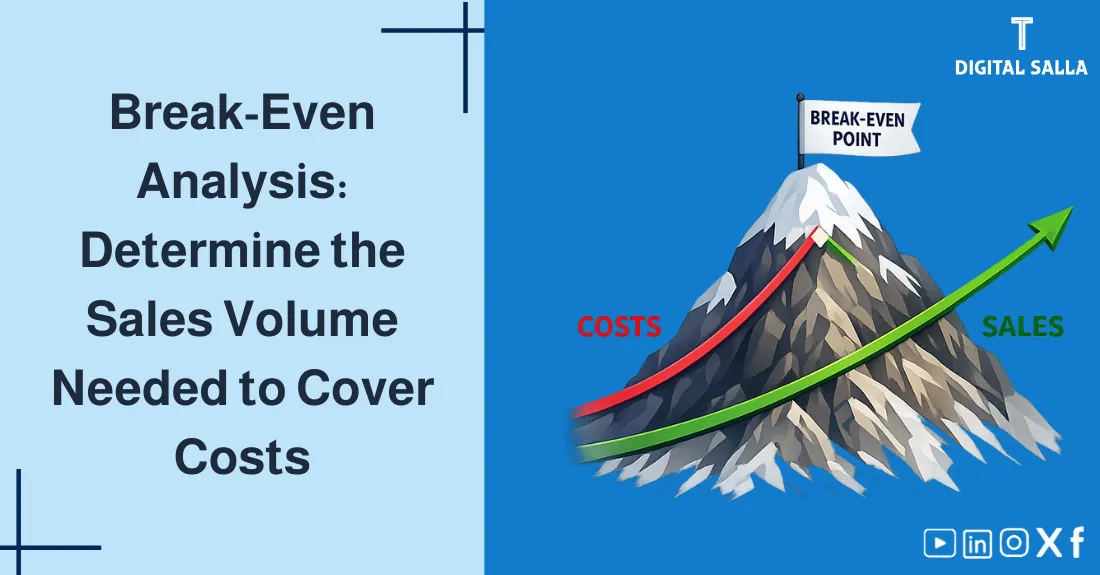
Break-Even Analysis (BEP): How to Determine the Sales Volume Needed to Cover Costs?
Break-Even Analysis: A professional guide on how to calculate the sales volume needed to cover costs, learn Cost-Volume-Profit (CVP) analysis, and interpret results to make realistic pricing and sales targeting decisions—Digital Salla.
- The fundamental definition of Break-Even Point (BEP).
- How to calculate Contribution Margin (The engine of BEP).
- BEP Equations: Calculating in Units and in Revenue ($).
- Margin of Safety: Measuring the “Cushion” before incurring losses.
- Target Profit Analysis: How much must we sell to earn $X in profit?
1) What is the Break-Even Point (BEP)?
The Break-Even Point is the level of sales where Total Revenue exactly equals Total Costs. At this point, the company earns zero profit but incurs zero loss. It is the “Survival Minimum” for any product or project.
2) Contribution Margin: The Key Driver
Before calculating BEP, you must understand Contribution Margin. It is the amount of revenue left over after covering Variable Costs to “Contribute” toward covering Fixed Costs.
2.1 The Equations
- CM per Unit = Selling Price − Variable Cost per Unit.
- CM Ratio (%) = (CM per Unit / Selling Price) × 100.
3) The Break-Even Formulas
There are two main ways to express the break-even point depending on management needs:
| Method | Formula | Use Case |
|---|---|---|
| BEP in Units | Total Fixed Costs / CM per Unit | For production planning and sales targets. |
| BEP in Revenue ($) | Total Fixed Costs / CM Ratio (%) | For overall financial planning and multi-product companies. |
4) The CVP Chart (Visual Analysis)
Visualizing the Cost-Volume-Profit relationship helps management understand risk.
Costing & Cost-Plus Pricing - Excel Template
5) Calculating for Target Profit
Management usually wants to do more than just “Break-even.” They want a specific profit.
Units to Sell = (Total Fixed Costs + Target Profit) / CM per Unit
This formula helps set Sales Quotas that are mathematically linked to the company’s net income goals.
6) Margin of Safety: The Risk Metric
The Margin of Safety tells you how far sales can drop before the company starts losing money.
- Formula ($) = Actual (or Budgeted) Sales − Break-Even Sales.
- Formula (%) = (Margin of Safety in $ / Actual Sales) × 100.
7) Operational Controls & Readiness Checklist
To ensure your BEP analysis remains a reliable tool:
BEP Quality Gate Checklist
- Are Step-Fixed costs (like hiring a second shift supervisor) identified?
- Is the analysis updated whenever a supplier increases Variable material prices?
- In multi-product companies, is the Sales Mix weighted correctly?
- Does the analysis account for Inventory Valuation impacts (FIFO vs. WAC)?
- Is the Operating Leverage understood (High fixed costs = High risk/High reward)?
8) Common Errors and How to Prevent Them
- Treating All Labor as Variable: Most salaries are fixed. Treating them as variable will underestimate your break-even sales volume.
- Ignoring Capacity Limits: Calculating a break-even point that requires 120% of your factory’s physical capacity.
- Ignoring the Sales Mix: Assuming you will sell an equal amount of high-margin and low-margin products.
- Static Analysis: Failing to update the BEP when rent increases or tax laws change.
9) Frequently Asked Questions
What is the Break-Even Point?
It is the volume of sales where total revenue equals total costs, resulting in zero net income.
How can I lower my Break-Even Point?
You can lower the BEP by: (1) Increasing the selling price, (2) Reducing variable costs per unit, or (3) Reducing total fixed costs.
Does BEP include non-cash expenses like depreciation?
Accounting BEP includes all costs (including depreciation). However, a Cash Break-Even excludes non-cash items to show the sales needed to stay cash-flow positive.
10) Conclusion
Break-Even Analysis is the ultimate sanity check for any business plan. By mastering Contribution Margin logic and monitoring your Margin of Safety, you provide the entity with a clear roadmap for profitability. This analysis ensures that sales targets are not just arbitrary numbers, but are mathematically derived to cover costs and achieve the strategic profit objectives of the organization.
Action Step Now (30 minutes)
- Take your P&L for the last month.
- Separate Total Fixed from Total Variable costs.
- Calculate your current Contribution Margin Ratio.
- Divide Fixed Costs by that Ratio. How close were your actual sales to that Break-Even number?