


Common Challenges of Implementing Accounting Systems and How to Overcome Them

Common Accounting System Implementation Challenges—and How to Overcome Them
Accounting system implementation challenges explains how to use technology and governance to improve workflows, raise data and reporting quality, and reduce risk—Digital Basket style. Put simply: most system projects don’t fail because of the “software” itself, but because of data, scope, people, and controls. In accounting, even a small issue in migration, permissions, or approval flow can turn into month-end variances, unreliable reports, and audit observations.
- Start by defining “what will we measure?” (close speed, data quality, number of exceptions)—then execute around it.
- Don’t go live before testing migration and reconciliations (trial balance, AR/AP, and transaction samples).
- Design security and roles from day one: see Accounting data security in cloud systems.
- If this is an ERP project or a major expansion: begin with ERP implementation phases, then Data migration.
1) What does “successful accounting system implementation” mean?
Success is not “entering an invoice on the screen.” Real financial success shows up at month end: a faster close, fewer variances, clearer traceability, and reports you can defend to management or auditors. To get there, connect the implementation to the concept of Accounting Information Systems: one source of truth, well-structured data, and consistent operating policies.
2) Requirements & scope (Scope): how to manage it
The most repeated problem in system projects: we start with “general ledger,” then suddenly expand into inventory, POS, integrations, custom reports… Mixing essentials with enhancements derails the timeline and budget.
2.1 Practical fix: split scope into 3 layers
| Layer | What’s included? | Acceptance criteria |
|---|---|---|
| Must-Have | Chart of accounts + postings + invoices + approvals + roles + core reports | Balanced trial balance + successful end-to-end samples |
| Should-Have | Cost centers/projects + document management + key integrations | Management reports exportable without manual effort |
| Nice-to-Have | Heavy customizations, complex dashboards, advanced automation | After stabilization (post go-live), via formal change control |
3) Data & migration challenges (Data Migration)
Data is the system’s “fuel.” If the fuel is contaminated, you’ll get wrong reports even with a strong system. Common issues: duplicate vendors/customers, inconsistent items, a COA that doesn’t serve reporting, and un-reconciled opening balances.
3.1 What must be cleaned before any migration?
- Master Data: customers/vendors (unique codes, payment terms, tax data if applicable).
- COA: chart of accounts + cost center policies (so postings don’t become “generic accounts” without meaning).
- Opening Balances: trial balance + AR/AP aging + inventory (if in scope).
3.2 A simple but powerful migration test
| Test | Goal | Required output |
|---|---|---|
| Trial Balance Match | Trial balance matches before/after migration | Variances = zero (or fully explained and evidenced) |
| Subledger Reconciliation | AR/AP subledgers reconcile to GL | Clear reconciliation + aging reports |
| Sample E2E | Sample transactions pass a full cycle | Document → approval → posting → report |
4) Change resistance & user training
A new system changes routines—so natural resistance appears: fear of oversight, fear of mistakes, or a belief that the system adds work. The solution is not just “management pressure,” but a simple, clear change management approach.
4.1 A practical training model (without overcomplicating)
- Super Users: 1–2 people per department (procurement, sales, finance) who understand real scenarios.
- Scenarios, not screens: “Vendor invoice with approval” is better than “explaining a button.”
- Recurring errors guide: top 10 errors + fix steps + who approves.
5) Process design & internal control before go-live
Implementing an accounting system without process control is just moving chaos onto a screen. You need clear definitions: who requests, who approves, who posts, what evidence is required, and which exceptions are acceptable. This is where implementation meets internal audit and the “audit trail.”
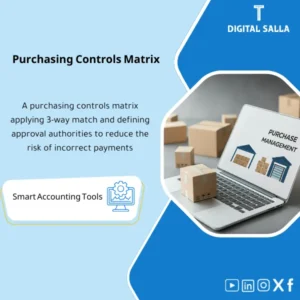
Purchasing Controls Template - Excel Template
| Area | Risk | Suggested control | Evidence |
|---|---|---|---|
| Procurement / AP | Unapproved or duplicate invoices | Block duplicate invoice numbers + approval workflow | Approval logs + exception report |
| Payments | Payments without authorization/evidence | Segregation of duties + approval limits | Role matrix + payment audit trail |
| GL / Journals | Manual entries without justification | Mandatory reason + required attachment | Attachments + change log |
| Documents | Missing evidence | Link documents to postings | Linked reference inside the transaction |
6) Integrations and document flow across systems
The challenge is not just “connecting an API,” but ensuring integrations don’t create variances across systems. Common cases: payment gateways/sales platforms, HR systems, document management, and reporting layers.
- HR / Payroll: validate cost centers and codes before connecting — integration details.
- Documents: make the document travel with the transaction (Invoice/PO/Receipt) — document management.
- Mobile apps: useful for expenses/invoices with an approval policy — mobile accounting apps.
7) Security & compliance: roles, logs, taxes
An accounting system holds sensitive data (vendors/customers/taxes/payments), so security is non-negotiable. From day one, implement: role-based access + MFA + logs + backups + a recovery plan. Key reference: Accounting data security in cloud systems.
7.1 Tax compliance inside the system
If the system issues/receives invoices, compliance becomes part of configuration—not a later step. See: Tax compliance via accounting systems.
8) Pre go-live testing (UAT / Parallel Run)
Testing is not “does the page open?” It’s: does the process produce correct postings, appear in the right report, and match management definitions? Best practice: UAT using real scenarios, then a short parallel run if possible.
If this is an ERP project or a major transition, you’ll benefit from: Safe ERP transition plan, because it ties testing to reconciliations and the cutover plan.
9) Post go-live: close, reporting, continuous improvement
After go-live, a new challenge appears: “stabilization.” Exceptions, change requests, and training gaps will show up. Make the first 30 days about: stabilizing the close, then improving reporting, then reducing manual work.
9.1 Improve reporting without bloated customization
- Start with a lightweight analytics layer: Financial data analysis (Excel & BI).
- Track why manual adjustments happen: data, permissions, integration, or unclear policy?
- After stabilization, add automation/AI gradually: AI in accounting.
10) Quick checklist + FAQs
- Scope approved (Must-Have) + formal change log for any additions.
- COA + cost centers + approval policies documented and implemented in the system.
- Two mock migrations + a trial balance match report.
- UAT on real scenarios + exceptions (return/discount/cancellation).
- Roles + MFA + logs + backup/restore tested.
- Cutover plan + rollback plan + a support team for the first month.
What’s the biggest reason accounting system projects fail?
Usually not the software—rather scope creep + dirty data + weak training + incomplete controls. Fix it with phased scope, tested migration, and clear change management.
Should I start with advanced customizations and reports from day one?
Not recommended. Start with correct operations (postings/approvals/documents/roles), then move to enhancements after stabilization. Helpful reference: advanced accounting software.
How do I ensure reports are audit-ready?
For each process: link evidence + approvals + change logs, and enforce segregation of duties and role-based access. This supports internal audit and reduces exceptions.