


Costs in Construction Companies: Materials, Labor, and Subcontractors

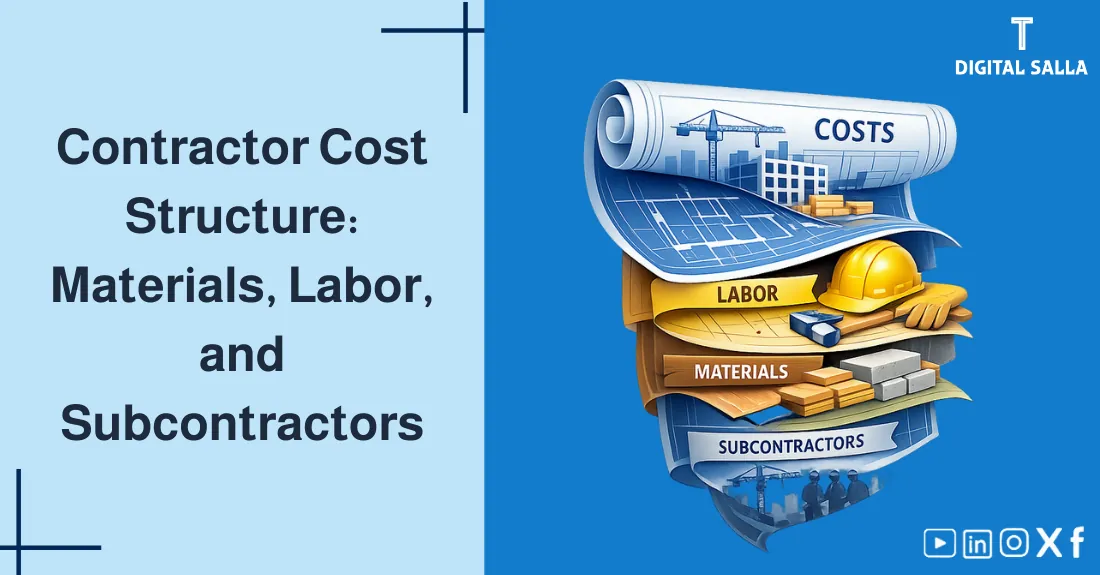
Costs in Construction Companies: Materials, Labor, and Subcontractors
Construction costs are not just “expenses” recorded at the end of the month, but a complete operating system starting from a purchase order, through receiving materials on site and issuing them, measuring labor productivity, and approving subcontractor billings— ending with daily decisions that prevent cost leakage and improve profit margin.
- Understanding the construction costs map: materials, labor, equipment, and subcontractors.
- A practical system for managing materials on site and reducing waste.
- Clear rules for monitoring labor costs and productivity.
- A method for tracking subcontractors without inflating costs or paying “on invoice” instead of execution.
- Monthly control Checklist + ready-to-use tools.
1) What are construction costs? (Difference between Cost and Expense)
Practically, construction costs are all resources consumed to execute a specific project: materials, labor, equipment, services, subcontractors… etc. The challenge is not just “recording” the cost, but determining where it was spent, why, and in what quantity.
- Cost: Directly linked to project execution and can be tracked or assigned to it.
- Expense: A cost not linked to a specific project or period-specific (like general administrative expenses).
In construction, the most common mistake is mixing the two: charging general expenses to a project (or vice-versa), distorting the profit margin and hindering management decisions.
2) Cost element map in construction companies
To adjust cost control, start with a clear Cost Breakdown Structure used in both pricing and monitoring. This is a brief table of the most common elements:
| Element | Examples | Control Documents | Quick Control Indicator |
|---|---|---|---|
| Site Materials | Concrete, steel, bricks, finishing | Receipt/Issue/Return/Inventory | Waste ratio + Unit cost |
| Direct Labor | Carpentry, blacksmithing, plastering… | Timesheet + Productivity + Eng. approval | Hours/meter + Labor hour cost |
| Subcontractors | Electrical/HVAC/Façade works | Contract + Billing + Variations | Approved execution value/Contract scope |
| Equipment & Supplies | Equipment rental, fuel, maintenance | Operating hours + Fuel issue note | Equipment operating hour cost |
| Project Indirects | Site management, security, labor camp | Cost center/Allocation base | Overhead % of direct cost |
3) Materials on Site: Receiving, Issuing, and Waste (Material Control)
The site materials item is usually the most sensitive in construction costs because it combines (procurement + transport + storage + issue + waste). Therefore, you need a material cycle understood by everyone.
3.1 What usually causes material cost leakage?
- Issuing materials without a note (Issue) or “estimated” issue without a clear item.
- Receiving quantities without inspection or difference between invoice and reality.
- Undocumented waste (breakage/theft/damage/poor storage).
- Mixing materials of multiple projects in one warehouse without analytical separation.
Bill of Materials (BOM) Template with Version Control
4) Labor: Wages, Productivity, and Unit Cost Measurement
Labor in construction is managed by answering two questions: How many work hours? and What did these hours accomplish? Without this link, labor turns into an “expense” instead of a “manageable cost”.
4.1 Practical Labor Indicators (No complex ERP needed)
| Indicator | How is it calculated? | When does it become a risk? |
|---|---|---|
| Work Hour Cost | Total period wages ÷ Approved work hours | Rise without improvement in execution |
| Productivity | Hours ÷ Unit (m²/meter/piece) | Hours per unit increase gradually |
| Lost Time Ratio | Idle hours ÷ Total hours | Frequent breakdowns/waiting for materials/approval delays |
| Overtime Ratio | Overtime hours ÷ Total hours | OT increases without actual delivery |
5) Subcontractors: How to Control Costs Without Paying “On Paper”?
The subcontractors item may represent a large percentage of construction costs. Control here depends on: clear contract + execution measurement + approved billings + documented variation orders.
5.1 Most Important Control Rules for Subcontractors
- Do not approve a billing without clear “outputs”: quantities/stages/tests.
- Separate: base scope execution and additional works (Variations).
- Make payments linked to approved execution and not just “invoices”.
- Track retentions and guarantees within the collection file so they don’t turn into a liquidity gap.
Project Claims and Variations Management Template
6) Indirect Costs and Allocation to Projects
Indirect costs are the “execution management costs” that serve several items/projects: site management, cars, communications, security… If not allocated fairly, you will get a project that seems “profitable” while reality is it’s consuming the company’s resources.
Production Cost Report - Excel File
6.1 Common Allocation Rules (Choose what suits the activity nature)
- Allocation by labor hours.
- Allocation by direct cost value.
- Allocation by area/units executed (in real estate development).
Important detail: Difference between Development and Real Estate Investment
7) Cost Control: Budget vs Actual and EAC
The essence of cost control in construction is comparing reality to the plan, then updating forecasts. Top 3 indispensable reports:
- Budget vs Actual for each item (materials/labor/subs/equipment).
- Committed Costs (contracted/requested costs) even before the invoice.
- EAC (Estimate at Completion) and its monthly change with reasons.
7.1 Brief Table for Interpreting Variances
| Variance Type | Example | Likely Diagnosis | Immediate Action |
|---|---|---|---|
| Price | Steel more expensive than pricing | Market change/weak negotiation/emergency supply | Renegotiation + alternatives + EAC update |
| Quantity | Issuing more cement than standard | Waste/poor storage/execution defects | Waste investigation + issue control |
| Productivity | Plastering hours higher than planned | Downtime/weak management/material shortage | Daily plan + removing obstacles |
8) Linking Costs to the Project File (WIP) without Complexity
Even if you don’t delve into completion percentage details today, remember that construction costs quality is the foundation of any project monitoring: if materials, labor, and subcontractors are not controlled, no profitability reading will be “trustworthy”.
Specialized Sectoral Chart of Accounts Library
9) Quick Numerical Example + Job Cost Sheet
Suppose a project with a Budget of 1,200,000 distributed as follows: materials 500k, labor 250k, subs 350k, equipment/other 100k. At the end of the first month, actual costs were:
| Item | Budget | Actual | Variance | Note |
|---|---|---|---|---|
| Materials | 500,000 | 210,000 | +290,000 | Check Committed PO |
| Labor | 250,000 | 120,000 | +130,000 | Compare productivity with plan |
| Subcontractors | 350,000 | 180,000 | +170,000 | Separate Base/Variations |
| Equipment/Other | 100,000 | 55,000 | +45,000 | Check operating hours |
| Total | 1,200,000 | 565,000 | +635,000 | Completed by EAC file |
10) Monthly Cost Control Checklist for Construction (Brief and Effective)
| Item | What are you reviewing? | Document/Impact |
|---|---|---|
| Site Materials | Matching receipt/issue/return + waste report | GRN + Issue/Return + Inventory |
| Labor | Timesheets + productivity + lost time | Eng. approval + daily reports |
| Subcontractors | Approved billings + variations + retentions | Contracts + notes + account statement |
| Indirects | Fixed allocation base + cost center verification | Cost Centers + Policy |
| Budget vs Actual | Price/Quantity/Productivity variances | Variance Report + Actions |
| EAC | Updating expected cost and reasons for change | Project management report |
11) Ready-made Tools and Templates for Applying Construction Cost Control
If you want to apply the above quickly, these templates are directly related to construction cost management (materials/subs/account structuring):
Specialized Sector Chart of Accounts Library (Sector COA Library) – Ready Excel Files
A ready-to-use chart of accounts by activity providing COA for trade, services, construction, and manufacturing with clear levels and classifications ready for migration. It produces an account structure that reduces reclassification in closing, for a finance manager establishing an accounting system or restructuring an existing COA.
Bill of Materials (BOM) Template with Version Control – Excel Template
The BOM template records item/unit components and quantities, with version control to fix the standard and compare it to actual issue. Useful for reducing quantity variances and material waste.
Material Issue, Return, and Waste Template (Material Issue/Return & Waste) – Excel Template
Material issue records Issue/Return for materials on items/sites, and produces waste reports and variance causes. Suitable for site warehouses and for those who want to control the material cycle quickly.
Subcontractor Management Tracker (Subcontractor Tracker) – Excel Template
Subcontractor monitoring via a Tracker that records subcontractor contracts, approved billings, payments, retentions, and variation orders. It gives you a clear picture of commitments and variances for each subcontractor.
Construction Claims and Variations Template (Claims & Variations) – Excel Template
Construction Claims records variation orders and claims, linking them to causes, documents, and approval status, with their impact on cost and time. Excellent for reducing “scope creep” resulting from undocumented additional works.
12) Frequently Asked Questions
What is meant by construction costs?
Construction costs are everything spent to execute a project/contract until delivery. They usually include: materials on site, direct labor, subcontractors, equipment, and indirect expenses allocated to projects.
How do I differentiate between direct and indirect costs in construction?
Direct costs can be tracked to a specific project (site materials/project labor), while indirect costs serve more than one project and need a fair allocation base (like labor hours or direct cost).
What are the most important site material control documents?
Goods Received Notes (GRN), warehouse addition notes, material issue notes, return notes, inventory sheets, and waste reports with reasons and approval.
How do I monitor subcontractors without inflating project costs?
With a clear contract and defined scope, approved billings, linking payments to completion percentage, documenting variation orders, and matching execution stages before approval.
Does retention money affect costs or only collection?
It mainly affects collection and liquidity and may cause a project funding gap, but it does not change the core execution cost. Therefore, it is monitored in the collection/receivables file within project management.
13) Conclusion
Managing construction costs is not just an “accountant’s” mission, but an operating system starting from the site. When you control site materials (receipt/issue/waste), monitor labor by productivity rather than just wages, and track subcontractors with contracts, billings, and variation orders—project cost will transform from a “recorded” figure into a “managed” figure, allowing you to build faster decisions and a more stable profit margin.