
The decision to correct accounting errors isn't just a "correcting entry"; it's a decision determining: Should we adjust prior years and restate statements, or record the effect in the current period? In this guide, you'll get a simplified practical rule for understanding Retrospective Application under IAS 8, with execution steps and disclosures to reduce risks during closing and audit.
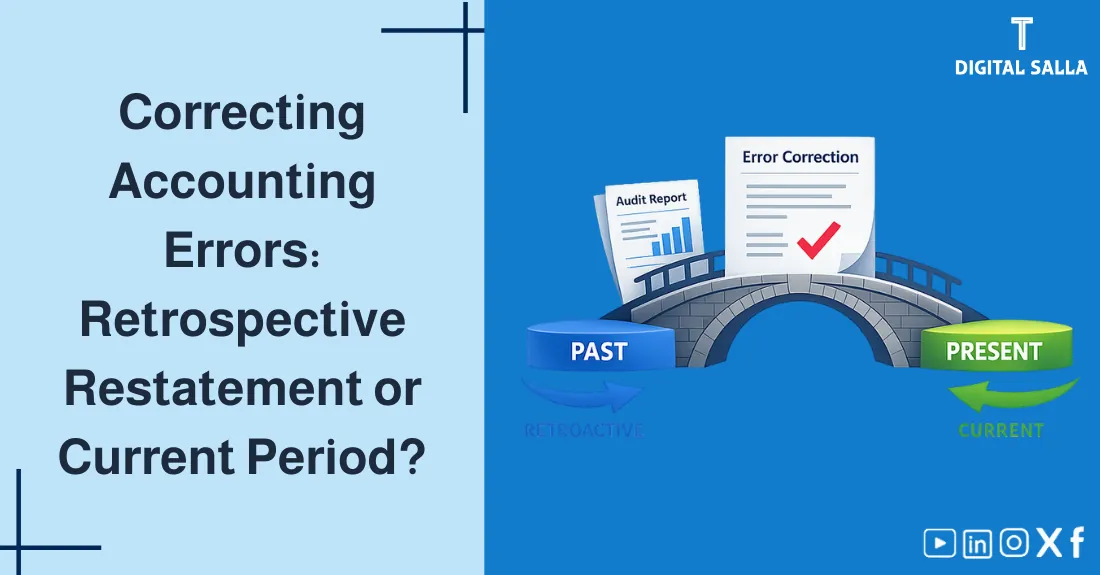
Golden Rule: Material Error is usually corrected retrospectively, and immaterial error is usually handled within the current period—with documented professional judgment.
What will you learn in this article?
- Definition of Accounting Error and what constitutes a "Prior Period Error" under IAS 8.
- How to determine Materiality quickly to know if Restatement is needed.
- Practical steps for Retrospective Application (Opening Balances + Comparatives).
- When Retrospective Application is "Impracticable" and what to do.
- Closing & Audit Checklist + FAQs to reduce confusion.
Your Core Reference: Accounting Policies This topic is part of the complete IAS 8 framework: Your Core Reference: Accounting Policies
Table of Contents Click to jump — Highlights automatically while scrolling
1) What is an Accounting Error per IAS 8? 2) Most Common Types of Accounting Errors 3) Materiality: The Decision Standard 4) When to adjust Retrospectively vs Currently? 5) Steps for Retrospective Application (Practical) 6) What if Retrospective Application is Impracticable? 7) Required Disclosures when correcting errors 8) Brief Practical Examples 9) Controls to Prevent Recurrence 10) Ready Checklist before Approval 11) FAQ 12) Conclusion
Go to Examples Go to Checklist
1) What is an Accounting Error per IAS 8?
In IAS 8, an accounting error is an omission from, or misstatement in, the entity's financial statements for one or more prior periods arising from a failure to use, or misuse of, reliable information that was available when those financial statements were authorized for issue, and could reasonably be expected to have been obtained and taken into account.
Important: Not every difference in figures is an "error". If the change is due to new information or changed circumstances (like updating useful life or default rates), this is often a Change in Estimate, not an error.
When is it called a "Prior Period Error"?
- When it relates to items recognized/measured/presented in prior period statements.
- And should have been treated differently according to information available at that time.
- And its effect appears in comparative figures or opening balances of current periods.
2) Most Common Types of Accounting Errors
Statement errors typically arise from one of these paths: mathematical mistakes, misapplication of accounting policies, misclassification, or oversight of facts. The following list helps you "diagnose the type" before deciding on the treatment.
Examples of common errors and how they appear in reality
| Error Type | Quick Example | Typical Impact |
|---|---|---|
| Mathematical Error | Wrong depreciation rate/formula or incorrect summation | Misstatement in Profits/Assets |
| Policy Misapplication | Capitalizing an expense that should have been expensed in the period | Overstating assets and understating expenses |
| Misclassification/Presentation | Presenting a long-term liability as current or vice versa | Distortion of Liquidity and Solvency ratios |
| Disclosure Oversight | Omitting material disclosure about liabilities/related parties | Compliance risks and user confidence |
Practical Tip: Before entering entries, write one sentence describing "what should have happened" versus "what actually happened". This will quickly determine if it is an error or just an estimate update.
3) Materiality: The Decision Standard
The question "Do we adjust retrospectively?" always starts with Materiality. A material error is one that could influence the economic decisions of users taken on the basis of the financial statements if not corrected or disclosed appropriately.
Quick Comparison: Materiality To understand how to judge Materiality practically: Quick Comparison: Materiality
How to assess Materiality quickly without complexity?
- Quantitative: Size of impact on Profit/Assets/Equity/Key Ratios (Thresholds may vary by industry).
- Qualitative: Even a small number might be material if it changes a profit trend, breaches bank covenants, or affects current/non-current classification.
- Cumulative: A set of small errors may become material when aggregated.
Important Closing Message: Do not assess the error in a "vacuum". Assess it in the context of the full statements, the users, and the indicators monitored by management and lenders.
4) When to adjust Retrospectively vs Currently?
Now we put the decision into an execution rule: Material Error → Often Retrospective Effect (Retrospective Restatement), and Immaterial Error → Often corrected within the Current Period (Current period correction) with documented judgment.
Simplified Decision Map: Retrospective or Current? Accounting Error Discovered Misstatement/Omission in prior period based on available info Is Error Material? (Materiality) Quantitative + Qualitative + Cumulative Material Retrospective: Restate Comparatives + Adjust Opening Balances Immaterial Current Period Correction + Document Judgment + Appropriate Disclosure Yes No
If the error is material, always think about Restating Financial Statements and Adjusting Prior Years to the extent practicable.
Crucial Point: Even if the error is "immaterial" quantitatively, it might become material qualitatively (bank covenants/turning profit to loss/liability classification/compliance).
5) Steps for Retrospective Application (Practical)
When judging that an error is material, the general framework is Retrospective Effect, which practically means: Restating comparatives (if presented) and adjusting opening balances for the earliest period presented. Below are concise execution steps suitable as an SOP for the closing team.
Step 1: Identify Affected Period(s)
- Did the error start in one year or across multiple years?
- Does its effect extend to opening balances (like accumulated assets/liabilities)?
Step 2: Measure Correction Impact for Each Item
- Measure correction impact on the Statement of Financial Position (Assets/Liabilities/Equity).
- Measure impact on the Statement of Profit or Loss for the comparative period(s).
- Determine impact on Cash Flows if classification/presentation is affected.
Step 3: Restate Comparatives and Adjust Opening Balances
The Goal Here: For the statements to appear as if the error never happened (as far as practicable), restoring comparability.
Practical Summary of Retrospective Outputs
| Element | What to do? | Execution Note |
|---|---|---|
| Comparatives | Restate figures for affected comparative periods | Includes related line items, notes, and schedules |
| Opening Balances | Adjust opening balance of earliest period presented | Usually via Retained Earnings/Appropriate Equity Component |
| Disclosure | Explain nature of error and correction amounts | Preferably a "Before/After" table for each affected item |
Complementary Point: Accounting Policies Manual To reduce error recurrence and standardize treatments: Complementary Point: Accounting Policies Manual
6) What if Retrospective Application is Impracticable?
Sometimes you cannot apply retrospective effect fully (e.g., loss of historical data or inability to distinguish error effect from other changes). In this case, it is permitted to apply treatment "as far as practicable", with disclosure of the reason for impracticability.
IFRS Transition Roadmap - Practical Workbook
Common Signs of Impracticability
- Absence of reliable data for the old period (at the required level of detail).
- Inability to determine the effect of the error separately and with reasonable confidence.
- Cost or effort disproportionate to the benefit of information (must be documented).
Execution Rule: If you cannot fully restate, focus on correcting the effect from the "earliest practicable date" with limitations explained. Transparency + Traceability of decision is key.
7) Required Disclosures when correcting errors
Disclosure makes the user understand why numbers changed, protecting comparability and trust. Practically, good disclosures look like a short report: What happened? Why? What is the impact? What did we do?
Practical Disclosure (Template) for Material Error Correction
| Disclosure Item | What to write? |
|---|---|
| Nature of Error | Clear description (omission/misapplication/classification/disclosure) and affected items |
| Correction Amounts | Correction amounts for each affected line item and each period presented (Before/After table preferred) |
| Opening Balances | Adjustment amount to opening balances of the earliest period presented |
| If Impracticable | Reason for impracticability and how correction was applied in the nearest possible way |
Best Practice: Add a short paragraph explaining the correction impact on key indicators (if impactful), to reduce questions from the Board/Lenders.
8) Brief Practical Examples
Example 1: Depreciation not recorded in a prior year
An asset was purchased and use began, but depreciation was not recorded for the previous year due to oversight. This is often a Prior Period Error because information was available and should have been applied. Decision: If impact is material → Restate comparative year and adjust opening balances.
Example 2: Capitalizing operational maintenance expense by mistake
Routine maintenance expense recorded as a fixed asset. If this violates company policy/standard and should have been expensed in the period, this is a Misapplication of Policy (Error). Reclassify/Correct impact based on materiality, potentially requiring Prior Year Adjustment.
Example 3: Material Disclosure omitted
Omission of disclosure regarding a significant commitment/obligation or related party. Even if it didn't change statement line items much, it might be qualitatively material, potentially requiring reissue/restatement per governance requirements.
Note: There is a difference between an internal "correcting entry" and "reissuing" published statements—the latter is also governed by regulatory requirements and internal governance policy.
9) Controls to Prevent Recurrence
The goal isn't just correcting the error, but preventing recurrence. These are simple but effective controls in most companies:
- Monthly Closing Checklist covering sensitive items (Depreciation/Provisions/Classifications).
- Independent Review of material entries before closing (4-eyes principle).
- Periodic Reconciliation between system and supporting reports (Aging/Fixed assets register/Inventory).
- Standardized Policies in an approved manual linked to SOPs.
- Error Log: Documents error, cause, and preventive action.
10) Ready Checklist before Approval
- Documented definition of error and why it constitutes a "Prior Period Error" not a change in estimate.
- Materiality assessed quantitatively, qualitatively, and cumulatively, with professional judgment documented.
- Affected periods identified, and impact measured for each affected item.
- If material: Restatement of comparatives and adjustment of opening balances for earliest period presented prepared.
- If impracticable: Reason documented and correction applied in nearest possible way.
- Clear disclosures prepared (Nature of Error + Correction Amounts + Periods + Constraints).
- Control implemented to prevent error recurrence (Procedure/Review/Policy Amendment).
Executive Summary: Before final closing, present a "One-Page Summary" to management: Error Type → Materiality → Treatment Method → Impact on Key Metrics → Disclosure.
11) Frequently Asked Questions (FAQ)
What is an Accounting Error according to IAS 8?
An accounting error is an omission from, or misstatement in, the entity's financial statements for one or more prior periods arising from a failure to use, or misuse of, reliable information that was available when those financial statements were authorized for issue and could reasonably be expected to have been obtained.
When do we adjust retrospectively?
When a material error exists in prior period financial statements, it is corrected retrospectively by restating comparative amounts and adjusting opening balances for the earliest period presented (where practicable).
When is the correction recorded in the current period without restatement?
If the error is immaterial, or if retrospective application is impracticable, the effect is corrected in the current period with appropriate disclosure regarding the nature of the error and the correction method.
What is the difference between correcting an error and a change in accounting estimate?
Correcting an error addresses an omission or misstatement that should have been avoided with available information previously, while a change in estimate is an adjustment due to new information or changed circumstances, and is typically handled prospectively.
What are the key disclosures when correcting a material error?
Disclosures include the nature of the error, the amount of correction for each financial statement line item and for each prior period presented, the impact on EPS, the amount of the adjustment to the opening balances of the earliest period presented, and an explanation if retrospective application is impracticable.
Does every error require reissuing financial statements?
Not necessarily. The decision depends on Materiality and on governance/regulatory requirements. An immaterial error might be corrected within the current period with documented professional judgment.
12) Conclusion
Accounting Error Correction under IAS 8 revolves around one question: Is the error material and does it affect user decisions? If so, the default is Retrospective Application via Restating Prior Years and Restating Statements as far as practicable. If immaterial, it is often corrected within the current period with judgment documentation and appropriate disclosure. Crucially: Make correction a "Process" within closing, then set controls to prevent the same cause from recurring.
© Digital Basket Articles — General educational content. Details may vary by locally applied standards, company policies, and industry nature. For real-world application or complex cases, consulting a specialist is preferred.