

COSO framework: The five components and how to apply them practically in your company?

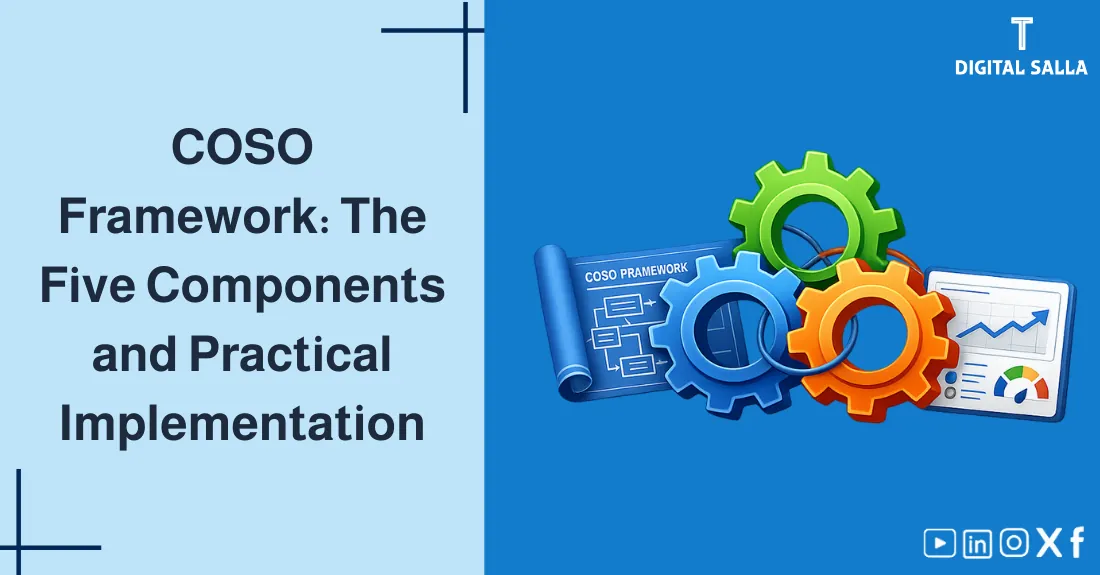
COSO Framework: The Five Components and How to Apply Them Practically?
COSO Framework: A detailed professional guide to the five COSO components (Control Environment, Risk Assessment, Control Activities…) and how to apply them practically to build a robust internal control system—Digital Salla.
- What is the COSO Framework and why is it considered the global standard for control?
- Detailed analysis of the 5 Components and their 17 supporting principles.
- How to build a strong Control Environment (Management Ethics).
- The methodology of Risk Assessment: Likelihood and Impact.
- How to choose the right Control Activities for your specific risks.
- Information, Communication, and Continuous Monitoring.
1) Why COSO is Essential?
The COSO Framework (Internal Control-Integrated Framework) provides companies with a roadmap to navigate risks. It ensures that “Everyone in the company” is working within a secure system, from the CEO down to the junior accountant.
2) Component 1: Control Environment (Tone at the Top)
This is the “Foundation” of the entire system. If management doesn’t respect the rules, no other control will matter.
- Key Principles: Integrity and ethical values, board oversight, and clear lines of authority.
- Practical Step: Implement a Conflict of Interest policy and an Employee Handbook that defines acceptable behavior.
3) Component 2: Risk Assessment (Knowing Your Enemy)
A company must identify events that could prevent it from achieving its goals.
| Risk Type | Example | Management Response |
|---|---|---|
| Operational Risk | System failure on production line | Prevent: Preventive maintenance |
| Financial Risk | Currency exchange volatility | Mitigate: Hedging contracts |
| Fraud Risk | Theft of high-value inventory | Control: Segregation of duties |
| Compliance Risk | Failure to pay Zakat/Tax on time | Monitor: Tax compliance calendar |
4) Component 3: Control Activities (Building the Barriers)
These are the actual policies and procedures that mitigate the risks identified in Step 2.
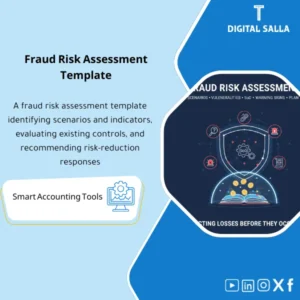
Fraud Risk Assessment - Excel Template
- Preventive Controls: Designed to stop an error Before it happens (e.g., dual approvals for bank transfers).
- Detective Controls: Designed to find an error After it happens (e.g., monthly bank reconciliations).
5) Component 4: Information & Communication
Relevant information must be identified and shared in a timeframe that allows people to perform their duties.
- Internal Communication: Sharing financial goals and performance results with department heads.
- External Communication: Reporting accurately to shareholders, ZATCA, and banks.
6) Component 5: Monitoring Activities (Closing the Loop)
Internal control systems need to be monitored—a process that assesses the quality of the system’s performance over time.
- Ongoing Evaluations: Built into day-to-day management activities.
- Separate Evaluations: Periodic audits performed by Internal Audit or external consultants.
7) Visualizing the COSO Cube
The COSO Cube shows the 3D relationship between: (1) Objectives (Operations, Reporting, Compliance). (2) Components (The 5 parts above). (3) Organizational Structure (Entity level, Department level).
8) Operational Controls & Readiness Checklist
To ensure your COSO implementation is effective:
Internal Audit Readiness Checklist
- Are the 17 principles of COSO mapped to existing company policies?
- Does every material GL Account have a specific detective control (Reconciliation)?
- Is there a formal Risk Register updated at least annually by the board?
- Are “System Privileges” (Read/Write/Delete) aligned with the Segregation of Duties?
- Is there a whistleblowing mechanism that ensures anonymity?
9) Common Errors and How to Prevent Them
- Paper-Only Controls: Having a policy that exists on a PDF but is never followed in practice.
- Ignoring IT Controls: Focusing only on manual approvals while ignoring risks related to database security and data integrity.
- Weak Information Flow: High-level risks are identified by the board but never communicated to the floor managers who handle the assets.
- One-Size-Fits-All: Trying to implement complex controls from a large multinational into a small entity (leads to operational paralysis).
10) Frequently Asked Questions
What is the main purpose of the COSO framework?
To provide a structured approach to internal control that helps organizations manage risks and ensure they reach their strategic, operational, and compliance objectives.
How many principles are in the COSO framework?
The 2013 framework consists of 5 components supported by 17 detailed principles that must be present and functioning.
Can COSO prevent all fraud?
No. Controls can be bypassed through Collusion (two people working together) or Management Override. COSO aims for “Reasonable Assurance,” not a 100% guarantee.
11) Conclusion
Applying the COSO Framework is the difference between an organization that “Guards itself” and one that “Leaves it to luck.” By mastering the five components and ensuring that Risk Assessment drives your Control Activities, you build an entity that is resilient to shocks, trusted by stakeholders, and capable of scaling without losing control over its most valuable assets.
Action Step Now (30 minutes)
- Select one department (e.g., Procurement).
- Identify the top risk (e.g., Kickbacks/Vendor favoritism).
- Check: Do you have a specific Control Activity to mitigate this? Is it being Monitored?