
Cost & Management Cost Accounting • Product Costing • Indirect Costs • Allocation • Variance Analysis
Cost Accounting Systems: How to Calculate Your Product Cost Accurately?
Cost Accounting: Learn how to calculate product costs accurately, cost control, cost allocation, and variance analysis to improve margins and reduce waste—a practical guide.
Your reference: Accounting Principles — Understanding the foundations before diving into the details of costing and management.
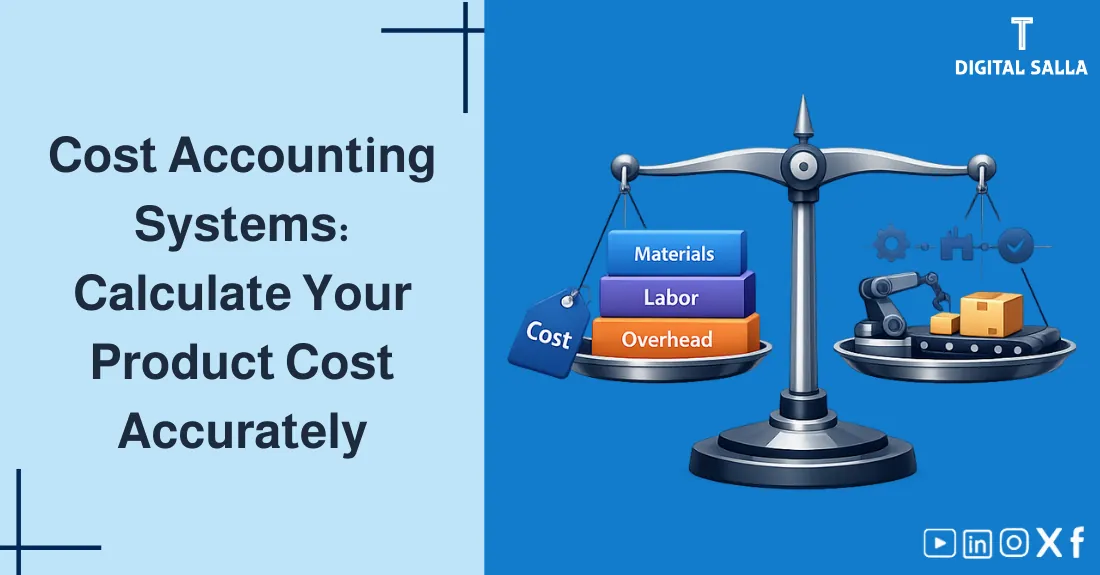
Core Principle: If you can't measure it, you can't manage it. Accurate costing is the only way to identify real profit and locate hidden waste in production.
What will you learn in this guide?
- What is Cost Accounting and how it differs from Financial Accounting?
- Classifying costs: Direct Costs vs. Indirect Costs (Overhead).
- Cost allocation methodologies and dealing with Manufacturing Overheads.
- Types of costing systems: Job Costing, Process Costing, and Standard Costing.
- Variance Analysis: How to compare actual performance with standards?
Practical Note: Accurate costing depends on "Data at Source." If production data (material consumption/man-hours) is undisciplined, even the best accounting system will produce misleading results.
Table of Contents Automatically determined while scrolling
1) The Concept of Cost Accounting 2) Fundamental Cost Classifications 3) Direct vs. Indirect Costs (The Core Challenge) 4) Manufacturing Overhead (MOH) Allocation 5) Main Costing Systems (Job vs. Process) 6) Standard Costing & Variance Analysis 7) Linking Cost to Pricing and Margin 8) Operational Controls & Readiness Checklist 9) Common Errors and How to Prevent Them 10) Frequently Asked Questions 11) Conclusion
1) The Concept of Cost Accounting
Cost Accounting is an internal management process aimed at identifying, measuring, and analyzing all costs associated with producing a product or providing a service. While Financial Accounting focuses on External Reporting, Cost Accounting focuses on Internal Decision Making.
Management Question: "Are we selling at the right price?" Accounting Answer: "You won't know until you accurately allocate the cost of the factory manager's salary and machinery electricity to every single unit produced."
2) Fundamental Cost Classifications
Understanding cost behavior is the first step in building a sound system. Costs are usually classified into:
2.1 Fixed Costs
Costs that remain constant regardless of production volume (e.g., factory rent, insurance).
2.2 Variable Costs
Costs that change in direct proportion to production volume (e.g., raw materials, direct labor per unit).
2.3 Mixed Costs
Costs that have both fixed and variable components (e.g., electricity bills with a minimum charge).
Manufacturing Costing BOM - Advanced Excel File
3) Direct vs. Indirect Costs (The Core Challenge)
This distinction is where most costing errors occur.
Comparison: Direct vs Indirect Costs
| Category | Definition | Example |
|---|---|---|
| Direct Costs | Can be easily and accurately traced to a specific unit. | Raw materials (Fabric for a shirt), Direct labor wages. |
| Indirect Costs (Overhead) | Necessary for production but cannot be directly linked to one unit. | Supervisors' salaries, factory cleaning, machine maintenance. |
Related topic: Inventory Valuation Methods — To understand how cost flows from materials to finished goods (FIFO vs Weighted Average).
4) Manufacturing Overhead (MOH) Allocation
Since Indirect Costs cannot be traced directly, we use Allocation Bases (Drivers). Common bases include:
- Direct Labor Hours: Best for labor-intensive industries.
- Machine Hours: Best for automated/heavy machinery environments.
- Direct Material Cost: Sometimes used as a simplified percentage.
Diagram showing the flow of Direct Materials, Direct Labor, and MOH into Work-in-Process (WIP) and then Finished Goods. From Resources to Finished Product Direct Materials Direct Labor Manufacturing Overhead Work-In-Process (WIP) Finished Goods (Unit Cost)
The unit cost = (DM + DL + MOH Allocation) / Total Units Produced.
5) Main Costing Systems (Job vs. Process)
Your production nature determines your accounting system:
5.1 Job Order Costing
Used for unique, custom products (e.g., custom furniture, construction projects). Costs are accumulated per Project/Job.
5.2 Process Costing
Used for mass production of identical items (e.g., beverages, chemicals). Costs are averaged over Departmental Periods.
5.3 Activity-Based Costing (ABC)
A modern system that allocates overhead based on Activities performed, providing much higher accuracy for complex products.
6) Standard Costing & Variance Analysis
Standard Costing is about setting targets. By comparing these targets with Actuals, we perform Variance Analysis:
Common Manufacturing Variances
| Variance | Logic | Diagnostic Question |
|---|---|---|
| Material Price Variance | (Actual Price − Standard Price) × Qty | Did purchasing fail to negotiate? |
| Material Usage Variance | (Actual Qty − Standard Qty) × Price | Is there excessive waste on the production line? |
| Labor Rate Variance | (Actual Rate − Standard Rate) × Hours | Did we use overtime or higher-skilled staff? |
| Labor Efficiency Variance | (Actual Hours − Standard Hours) × Rate | Is production slower than the standard benchmark? |
7) Linking Cost to Pricing and Margin
A major error in Product Costing is ignoring the Margin of Safety and the Break-Even Point.
- Variable Costing: Essential for short-term decisions (like accepting a special order).
- Absorption Costing: Mandatory for external reporting and inventory valuation.
Rule of Thumb: Your price must cover Total Absorption Cost to be profitable in the long run, but in the short run, any price above Variable Cost contributes to covering fixed overhead.
8) Operational Controls & Readiness Checklist
To ensure your cost data is "defensible" and accurate:
Cost Quality Gate Checklist
- Are direct materials linked to the Bill of Materials (BOM)?
- Is man-hour tracking matched with the Payroll Register?
- Is the MOH allocation base reviewed annually for relevance?
- Do we perform physical inventory counts to adjust for material waste?
- Are variances analyzed monthly and discussed with production heads?
Deep dive: Payroll Reconciliation — To ensure direct labor costs in your costing system match actual bank transfers.
9) Common Errors and How to Prevent Them
- Outdated Standards: Using last year's material prices as standards in a high-inflation environment.
- Ignoring Waste: Failing to include a standard percentage for "Normal Spoilage" in the unit cost.
- Wrong Allocation Base: Using labor hours in a fully automated factory (resulting in distorted overhead).
- Weak WIP Tracking: Underestimating the value of semi-finished goods at the end of the month.
10) Frequently Asked Questions
What is the goal of Cost Accounting?
The goal is to provide management with detailed data about costs to help in pricing, efficiency improvement, and locating waste.
Why do we separate Direct and Indirect costs?
Because Direct costs are factual and traced easily, while Indirect costs are estimated and allocated. Separation ensures the "Product Margin" is clear before overhead application.
Is Cost Accounting mandatory by law?
No, it is usually not mandatory for external reporting (though absorption costing is required for inventory valuation), but it is strategically mandatory for business survival.
11) Conclusion
Mastering Cost Accounting is the difference between "Guessing Profit" and "Knowing Profit." By implementing disciplined tracking of Direct and Indirect Costs, utilizing Variance Analysis, and maintaining a solid Bill of Materials (BOM), you will improve your pricing strategy and identify the real sources of efficiency within your entity.
Action Step Now (30 minutes)
- Pick your best-selling product.
- List its Direct Materials (BOM) and Direct Labor.
- Estimate its share of monthly overhead (Rent/Admin/Power).
- Compare this total cost with your current selling price—is your margin what you thought it was?
© Digital Salla Articles — General educational content for management accounting purposes.