
Cost & Management Cost Elements • Direct Materials • Direct Labor • Manufacturing Overhead (MOH)
Manufacturing cost elements: A practical guide to understanding Direct Materials, Direct Labor, and Manufacturing Overhead (MOH), how to calculate Prime Cost, and linking them to product pricing and performance control—Digital Salla.
First, establish the basics: Cost Accounting Guide — To understand how cost systems work and the difference between job and process costing.
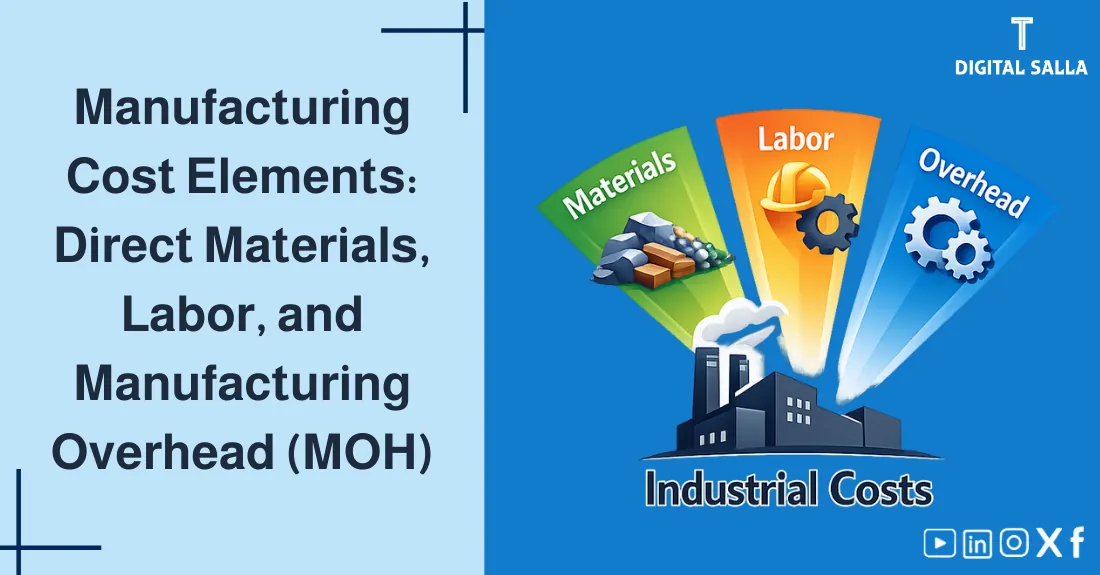
The objective of classifying cost elements is to separate "Traceable Costs" (Direct) from "Allocated Costs" (Indirect), enabling precise margin calculations.
What will you learn in this guide?
- What are the three fundamental elements of manufacturing costs?
- In-depth view of Direct Materials and Direct Labor.
- Breaking down Manufacturing Overhead (MOH): Indirect materials, labor, and services.
- The relationship between Prime Cost and Conversion Cost.
- How elements flow through the accounting cycle into the Balance Sheet and Income Statement.
Practical Note: Misclassifying a cost element (e.g., treating factory electricity as an administrative expense) leads to distorted product margins and wrong pricing decisions.
Table of Contents Updates automatically while scrolling
1) The Three Pillars of Product Cost 2) Element 1: Direct Materials (DM) 3) Element 2: Direct Labor (DL) 4) Element 3: Manufacturing Overhead (MOH) 5) Prime Cost vs. Conversion Cost 6) The Flow of Costs in the Accounting Cycle 7) Elements and Cost Behavior (Fixed vs. Variable) 8) Operational Controls & Readiness Checklist 9) Common Errors and How to Prevent Them 10) Frequently Asked Questions 11) Conclusion
1) The Three Pillars of Product Cost
In Cost Accounting, the cost of any tangible product is not a single number but a sum of three distinct elements. Each element requires a different management and measurement approach.
Diagram showing Product Cost = Direct Materials + Direct Labor + Manufacturing Overhead. Total Manufacturing Cost Components Direct Materials The "Raw" Ingredients Direct Labor The Hands-on Workers Overhead (MOH) The Factory Support Total Cost of Production
The sum of these three elements is what determines the value of inventory in your Balance Sheet and the COGS in your Income Statement.
2) Element 1: Direct Materials (DM)
Direct Materials are the raw materials that become an integral part of the finished product and can be economically and physically traced to the final unit.
- Example: Steel in a car, wood in a chair, fabric in clothing.
- Management Tip: Use a Bill of Materials (BOM) to lock the standard quantity for each unit. Any usage beyond the BOM is considered "Material Waste" and must be monitored.
Related topic: Inventory Valuation Methods — To learn how the cost of materials moves from the warehouse to production (FIFO vs WAC).
3) Element 2: Direct Labor (DL)
Direct Labor consists of the wages and benefits paid to workers who are physically involved in converting materials into the finished product.
- Example: Assembly line workers, machine operators, carpenters.
- Management Tip: Use "Time Cards" or digital logs to track the actual hours spent on each Job Order. Mismatch between payroll and production logs is a major source of costing variances.
Deep dive: Payroll Reconciliation — To ensure the total labor costs in your costing system match the actual bank transfers.
4) Element 3: Manufacturing Overhead (MOH)
Manufacturing Overhead (or Factory Overhead) includes all manufacturing costs except direct materials and direct labor. These are indirect costs that support the production process.
Cost Centers Guide - Practical Steps & Templates
MOH Breakdown
- Indirect Materials: Small items like glue, screws, cleaning supplies, or factory safety gear.
- Indirect Labor: Salaries of factory supervisors, maintenance teams, and security guards.
- Other Indirect Costs: Factory rent, utilities (electricity/water), depreciation on machinery, and insurance.
The challenge with MOH is Allocation. You must choose a "Cost Driver" (like machine hours) to distribute these total costs among the units produced.
5) Prime Cost vs. Conversion Cost
In management reporting, we often group these elements into two categories to understand the nature of the spending.
The Two Critical Cost Groups
| Category | Formula | Management Focus |
|---|---|---|
| Prime Cost | DM + DL | Focus on direct resources and basic efficiency. |
| Conversion Cost | DL + MOH | Focus on the cost of "converting" raw materials (Process efficiency). |
Notice that Direct Labor is part of both groups. It is a "Prime" cost because it is direct, and a "Conversion" cost because it is essential for the transformation process.
6) The Flow of Costs in the Accounting Cycle
Where do these elements go in your books?
- Raw Materials: Start as an Asset (Inventory).
- Work-In-Process (WIP): When DM + DL + MOH are applied to the floor.
- Finished Goods: When production is complete (Asset).
- COGS: When the product is sold (Expense on the Income Statement).
7) Elements and Cost Behavior (Fixed vs. Variable)
Understanding the element is not enough; you must know how it behaves when volume changes.
- DM & DL: Usually Variable (The more units you produce, the more you spend).
- MOH (Rent/Admin): Usually Fixed (Stays the same regardless of volume).
- MOH (Electricity/Supplies): Often Mixed or Variable.
Read Next: Cost Behavior (Fixed vs Variable) — To understand how these elements react to volume changes and affect your break-even point.
8) Operational Controls & Readiness Checklist
To ensure your cost elements are accurately captured:
Cost Element Quality Gate
- Does every product have an updated Bill of Materials (BOM)?
- Are factory supervisors' salaries separated from general office admin?
- Is there a system to record "Scrap" and "Spoilage" of direct materials?
- Is the MOH allocation rate reviewed at least quarterly?
- Are utilities (Power/Water) metered separately for the factory vs. the office?
9) Common Errors and How to Prevent Them
- Including Selling Expenses in MOH: Marketing and delivery costs are Period Costs, not product costs. They should not be in the product unit cost.
- Ignoring Labor Benefits: Direct labor is not just the basic wage; it includes social insurance, housing, and bonuses.
- Weak Material Requisition: Withdrawing materials from the warehouse without a formal "Material Requisition Note" linked to a job order.
- Fixed Allocation: Using the same overhead rate for years despite major changes in automation or rent.
10) Frequently Asked Questions
What are the main elements of manufacturing costs?
They are: Direct Materials, Direct Labor, and Manufacturing Overhead (MOH).
Is factory depreciation a direct or indirect cost?
It is an Indirect Cost (MOH) because the building supports all products and cannot be exclusively traced to a single unit produced.
Why do we calculate Conversion Cost?
To evaluate the efficiency of the production facility itself (Labor + Overhead), separate from the cost of the raw materials used.
What is the difference between Product Costs and Period Costs?
Product costs (DM/DL/MOH) stay with the product until it is sold. Period costs (Selling/Admin) are expensed in the period they are incurred.
11) Conclusion
Mastering Manufacturing Cost Elements is the foundation of any "Cost Control" strategy. By accurately separating Direct Materials and Labor from Overhead, and monitoring your Prime and Conversion costs, you will identify hidden waste, set more profitable prices, and gain full visibility over your production efficiency.
Action Step Now (30 minutes)
- Take a look at your Factory Ledger.
- Identify 3 items currently listed as "Overhead" and see if they can be traced "Directly" instead (to improve accuracy).
- Review your last utility bill—what percentage is allocated to production vs. administration?
© Digital Salla Articles — General educational content for management and cost accounting purposes.