
Evolution of Accounting Tools: From Abacus to AI
When we talk about the evolution of accounting tools, we are not just talking about "faster calculators," but about a radical shift in how an accountant thinks. From the abacus that solved the problem of counting, to paper ledgers that organized memory, reaching ERP systems and Artificial Intelligence that automate recording and open the door to deep data analysis. In this article, we trace the journey of the "Accountant's Companion" across the ages: How did technology change the profession from manual recording to real-time strategic decision support?
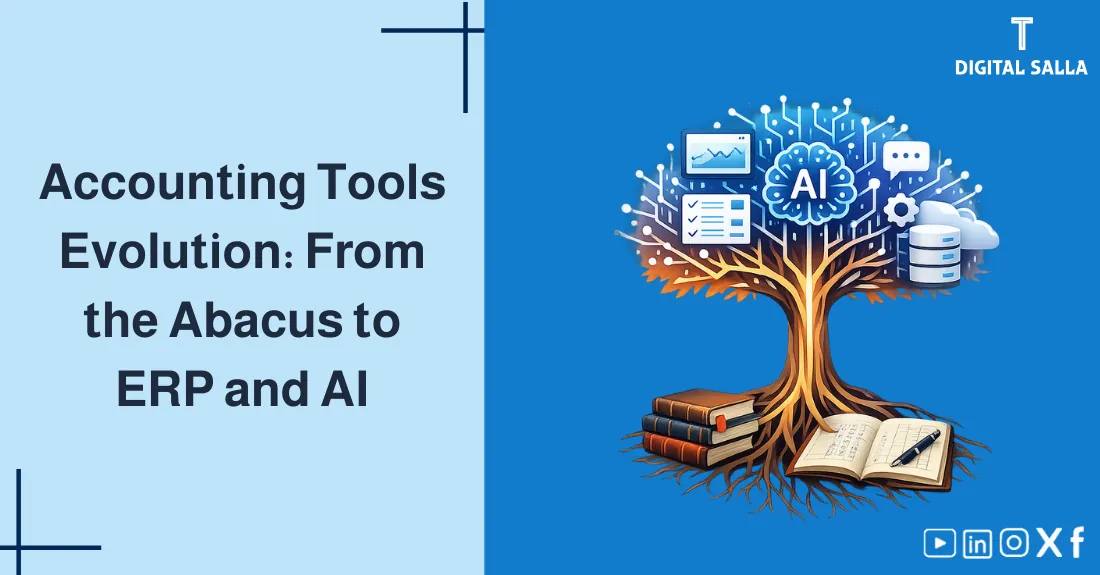
The evolution of tools is the story of humans seeking "Precision" and "Speed" while reducing "Routine Tasks."
What will you gain from this article?
- Trace the evolution of accounting tools across major historical eras.
- A visual timeline (SVG) from the Abacus to AI.
- The impact of the electronic spreadsheet (Excel) revolution on the profession's culture.
- A look at ERP and Cloud and why they are the current operational standard.
- Future prospects: How Artificial Intelligence turns data into "Informed Decisions."
To see the full context of the profession: Also read History of Accounting to understand how the science itself evolved before the tools exploded.
Table of Contents Auto-highlights on scroll
1) Why do tools change the profession? 2) The Abacus: The First Calculation Logic 3) Paper Ledgers: The Memory of Double-Entry 4) Mechanical Machines: The First Automation 5) The Spreadsheet Revolution (Excel) 6) ERP: The Era of Centralization 7) The Cloud: Real-time and Collaboration 8) The Age of AI: From Recording to Analytics 9) Visual Evolution Timeline (SVG) 10) Comparison Table of Tools 11) Frequently Asked Questions 12) Conclusion
1) Why do tools change the nature of the profession?
Tools are not "neutral." Every new tool allows the accountant to perform a larger task with less effort, shifting the focus from Execution (How to record?) to Analysis (What does this figure mean?).
Practical Rule: As the tool moves toward automation, the value of the "professional judgment" of the accountant increases, not decreases.
2) The Abacus: The First Calculation Logic
The Abacus was the world's first "calculator." It solved the problem of manual counting and symbols, providing a physical way to perform basic operations (Addition/Subtraction/Multiplication) quickly.
- Era: Ancient Civilizations.
- Value: Speeding up basic arithmetic and reducing counting errors.
3) Paper Ledgers: The Memory of Double-Entry
With the Double-Entry system (Pacioli), paper ledgers became a "Knowledge System." They were no longer just a list of items, but a balanced "journal" and "general ledger."
Excel Functions Practice Pack - Training Excel Files
The Impact of Paper: Paper taught accountants discipline: how to document, post, and reconcile. The manual ledger was the real lab for building accounting concepts.
To learn about the mind behind this era, see: Luca Pacioli: The Father of Accounting.
4) Mechanical Machines: The First Automation
In the 19th and early 20th centuries, adding machines and mechanical bookkeeping machines appeared. They reduced the burden of repetitive calculations and manual posting.
- Impact: Better handling of large transaction volumes in the industrial era.
5) The Spreadsheet Revolution (Excel)
The 1980s were the most critical turning point: Electronic Spreadsheets (like Excel). For the first time, a change in one cell could update an entire model in seconds.
Why did Excel change everything?
- Dynamic Modeling: Easily creating "What-If" scenarios.
- Analysis: Pivot tables turned thousands of rows into a single report.
- Democratization: Small businesses could now build complex systems at low cost.
6) ERP Systems: The Era of Centralization
Enterprise Resource Planning (ERP) systems moved accounting from an "Isolated Island" to the "Heart of the Company." In an ERP, the accounting entry is the result of an event (Purchase/Sale/Production), not an action on its own.
Digital Transformation Milestone: The ERP made the "Audit Trail" digital and unified, facilitating better Internal Control.
7) The Cloud: Real-time and Collaboration
Cloud Accounting (Cloud) removed geographical barriers. The accountant, client, and bank can all look at the same "Version of Truth" in real-time.
- Value: Remote work, automatic backups, and seamless bank integration.
8) The Era of AI: From Recording to Analytics
We are now in the Artificial Intelligence (AI) era. AI doesn't just "calculate"; it "identifies patterns."
What does AI do for the Accountant?
- Automatic Categorization: OCR technology reads invoices and enters data automatically.
- Fraud Detection: Identifying abnormal transactions that deviate from the pattern.
- Predictive Analytics: Forecasting cash flow and future trends based on historical data.
9) Visual Evolution Timeline (SVG)
Accounting Tool Evolution Journey Manual Era Abacus & Paper Ledgers Focus: Basic recording and physical storage of memory. Spreadsheet Era Excel & Individual Digital Systems Focus: Computational power, modeling, and speed in report creation. Intelligence Era ERP, Cloud, & AI Focus: Centralization, real-time data, and predictive analytics.
10) Comparison Table of Tools
Comparison: Eras | Core Value | Role of Accountant
| Era | Primary Tool | The Accountant's Primary Job | The "Magic" of the Era |
|---|---|---|---|
| Ancient | Abacus / Clay | Counting & Proof | Reducing arithmetic errors |
| Classical | Paper Ledgers | Recording & Classification | Organization (Double-Entry) |
| Modern | Excel / Local Software | Data Modeling & Reporting | Speed & Logic flexibility |
| Current/Future | ERP / Cloud / AI | Governance & Data Analytics | Real-time & Prediction |
11) Frequently Asked Questions
What is the most famous tool in accounting history?
Historically, the Abacus was the first. Modernly, Excel remains the most flexible, but ERP systems are the institutional backbone.
Will AI replace the accountant?
No. AI replaces routine tasks (recording/entry), but it increases the need for the accountant in interpreting results and strategic decisions.
12) Conclusion
The evolution of accounting tools is a journey from "Doing" to "Knowing." Every tool moved the accountant one step further from the ledgers and one step closer to the "Decision-making Board." Mastering the current tools (Cloud/ERP) and understanding the future (AI) is no longer a luxury, but the key to professional continuity.
Your Next Step: If you still rely only on Excel for everything, start exploring how Integration and Automation can save you hours of work every month.
© Digital Salla Articles — General educational content. For professional application or system selection, consult a technology specialist.