
Liability vs. Provision vs. Contingent Liability: Core Differences and Impact on Financial Statements
In the world of professional accounting, not every "debt" is recorded the same way. The core challenge lies in the degree of Certainty: Is the amount fixed? Is the timing known? Or is it just a "possibility"? Understanding the differences according to Standard IAS 37 is the key to mastering Provisions and protecting your balance sheet from sudden shocks. This guide provides the practical path for recognition, measurement, and disclosure—Digital Salla.
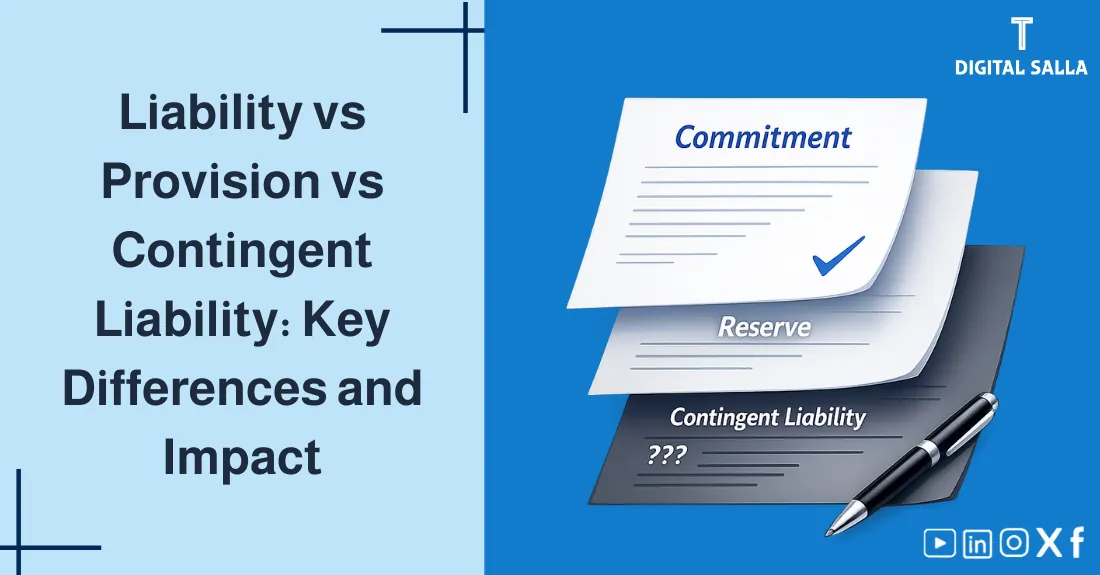
Provisions bridge the gap between fixed obligations and future risks.
What will you learn in this article?
- Clear definition of Liability (Fixed) vs. Provision (Estimated).
- The 3 Mandatory Criteria for recognizing a Provision in the accounts.
- Contingent Liabilities: When is disclosure enough without recording an entry?
- Degree of Certainty Scale (SVG): From "Virtually Certain" to "Remote".
- Practical comparison table between the three concepts.
- How to measure a Provision using the "Best Estimate" method.
- Interactive assessment to test your judgment in complex scenarios.
The Recognition Root: Your reference here: Payment vs. Expense (The Timing of Recognition)
Table of Contents Updates during scroll
1) Basic Definitions 2) Degree of Certainty (SVG) 3) Recognition Criteria for Provisions 4) Contingent Liabilities Explained 5) Detailed Comparison Table 6) How to Measure a Provision? 7) Interactive Quiz: Classify the Risk 8) Frequently Asked Questions 9) Conclusion & Summary
1) Basic Definitions: Fixed vs. Uncertain
To classify an obligation correctly, you must analyze its timing and amount:
- Liability: A present obligation with a certain timing and amount (e.g., Accounts Payable, Bank Loans).
- Provision: A present obligation of uncertain timing or amount (e.g., Legal Provisions, Product Warranties).
- Contingent Liability: A possible obligation arising from past events, whose existence will be confirmed only by the occurrence of uncertain future events.
The Essential Distinction: A Provision is recorded in the Ledger and Balance Sheet as a debt; a Contingent Liability is only mentioned in the Notes/Disclosures.
2) The Certainty Scale: When to Record? (SVG)
Accounting judgment depends on the probability of a cash outflow.
A horizontal scale showing the relationship between probability and accounting treatment: Liability, Provision, or Disclosure. 0% (Remote) 100% (Certain) Remote Do Nothing Possible Disclosure only Probable Record Provision Fixed/Certain Record Liability
The threshold for recording a "Provision" is typically when the probability is "More likely than not" (>50%).
3) The 3 Criteria for Recognizing a Provision (Mandatory)
According to IAS 37, you cannot record a provision unless all three conditions are met:
Vacation Accrual Rollforward - Excel Template
- Present Obligation: The company has a legal or constructive obligation as a result of a past event.
- Probable Outflow: It is "more likely than not" that a payment will be required to settle the obligation.
- Reliable Estimate: A reliable estimate can be made of the amount of the obligation.
Constructive Obligation: This exists when a company's past practices (e.g., a "no questions asked" return policy) create a valid expectation for customers, even if not required by law.
4) Contingent Liabilities: When Disclosure is Enough
A Contingent Liability is not recognized in the books because it doesn't meet the recognition criteria. However, it must be disclosed in the Notes to Financial Statements unless the possibility of a payment is "Remote" (very low).
- Example: An ongoing lawsuit where lawyers say the company's chance of losing is 30% (Possible, but not Probable).
- Treatment: Do not record an expense or liability. Describe the case and estimate the potential financial impact in the notes.
5) Detailed Comparison Table
Provision vs. Liability vs. Contingency
| Feature | Liability | Provision | Contingent Liability |
|---|---|---|---|
| Amount & Timing | Certain | Estimated/Uncertain | Uncertain/Potential |
| Accounting Treatment | Record Entry | Record Entry | Disclosure Only |
| Reporting | Balance Sheet | Balance Sheet | Notes to Financials |
| Standard | IAS 1 / IAS 32 | IAS 37 | IAS 37 |
6) How to Measure a Provision? (The Best Estimate)
The amount recognized as a provision should be the best estimate of the expenditure required to settle the obligation at the end of the reporting period.
- Single Obligation: (e.g., one lawsuit) The "Most Likely Outcome" is used.
- Large Population: (e.g., product warranties) The "Expected Value" is used (weighting all possible outcomes by their probabilities).
7) Interactive Quiz: Classify the Risk
Scenario: A company is facing a lawsuit. Lawyers state there is a 70% chance of losing $100,000. How should this be treated according to IAS 37?
Record a Provision of $100,000 in the Balance Sheet
Disclose as a Contingent Liability in the Notes only
Do nothing because the case isn't over
8) Frequently Asked Questions
Can we record a provision for "Future Maintenance"?
No. You cannot record a provision for future costs unless there is a past event and an obligation to a third party. Future maintenance can be avoided by selling the asset, so there is no present obligation.
What is a 'Contingent Asset'?
It is a possible asset that arises from past events. It is never recognized in the accounts to follow the 'Prudence' principle, but it is disclosed if the inflow of money is Probable.
When do we remove a provision from the books?
When the obligation is settled, or when it becomes no longer probable that an outflow of resources will be required.
9) Conclusion & Summary
Mastering the difference between Liabilities, Provisions, and Contingencies is the hallmark of a high-level accountant. By strictly applying IAS 37 criteria, you ensure that the company's financial statements provide a "True and Fair view" of its risks and obligations—Digital Salla. Always prioritize professional judgment and remember: when in doubt, use the Prudence principle.
© Digital Salla Articles — General educational content. For specific legal provisions or complex restructuring cases, always consult a certified public accountant or legal advisor.