
Double-Entry System Explained: The Foundation of Financial Balance
The double-entry system is the invisible scale that keeps the financial world balanced. Every time a riyal moves, it has a source and a destination; this system ensures that for every Debit, there is a corresponding Credit. Without it, companies would not be able to detect errors or build reliable financial statements. This guide provides a simplified explanation for accountants and business owners—Digital Salla.
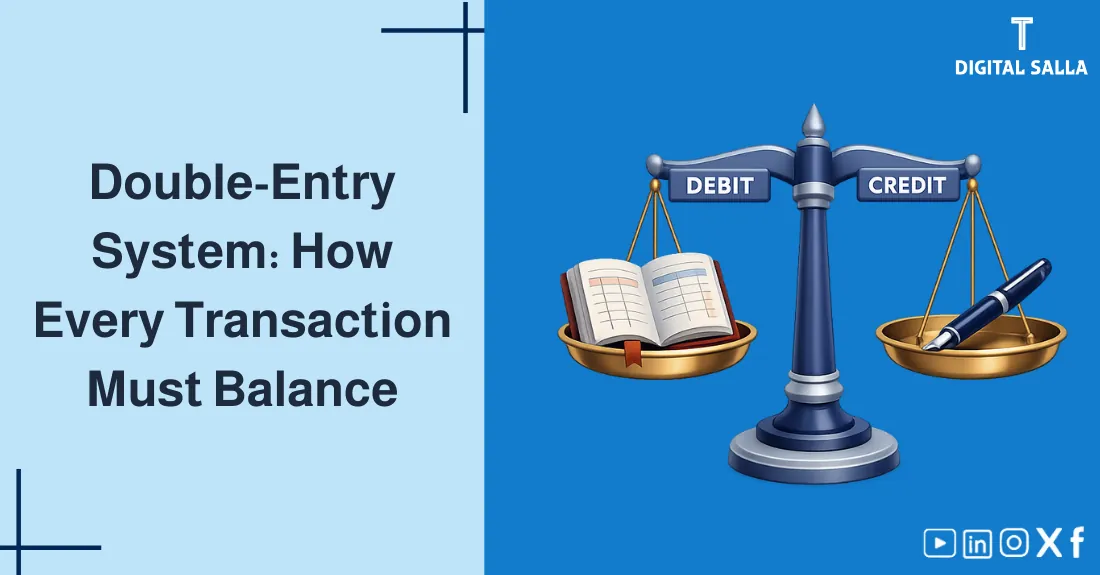
The double-entry system ensures that the accounting equation ($Assets = Liabilities + Equity$) remains in constant equilibrium.
What will you learn in this article?
- Precise definition of the double-entry system and why we need it.
- The relationship between the system and the Accounting Equation.
- The 3 golden rules for any journal entry to be correct.
- Practical example: Recording a service sale on credit.
- System workflow (SVG) from transaction to Trial Balance.
- Interactive Tool: Verify the balance of your journal entries instantly.
Step-by-Step Practical Application: Your reference here: Debit vs. Credit (How to understand without memorizing)
Table of Contents Updates during scroll
1) What is the Double-Entry System? 2) The Mathematical Foundation 3) Double-Entry Flow (SVG Diagram) 4) The 3 Rules of a Correct Entry 5) Practical Example: Sales Entry 6) Interactive Tool: Entry Balancer 7) Benefits of the System 8) Frequently Asked Questions 9) Conclusion & Summary
1) What is the Double-Entry System? (The Duality Logic)
In accounting, every financial event is a "Duality." If you buy a laptop for cash, you have gained an asset (the laptop) and lost an asset (the cash). The double-entry system records both sides of this movement to ensure that every transaction is fully documented.
The Rule of Two: Every transaction must affect at least two accounts. One account is debited, and the other is credited.
2) The Foundation: Balancing the Equation
The double-entry system is the mechanism that keeps the Accounting Equation in balance. Because $Assets = Liabilities + Equity$, any change on one side must be offset by an equal change on either the same side or the opposite side.
3) Double-Entry Flow: From Event to Ledger (SVG)
This diagram shows how the system translates a real-world event into balanced data.
Smart Journal Entries System - Excel File
Diagram showing: 1) Financial Event. 2) Journal Entry (Dr = Cr). 3) Posting to Ledger. 4) Balanced Trial Balance. 1) Event Invoice/Payment 2) Entry Debit = Credit 3) Posting T-Accounts 4) Balance Trial Balance Result: Error-Free Reporting
The system ensures that errors are caught early at the Trial Balance stage.
4) The 3 Rules of a Correct Journal Entry
For any entry to be valid under the double-entry system, it must follow these rules:
- Balance: Total Debits must always equal Total Credits ($Dr = Cr$).
- Dual Impact: At least two accounts must be affected.
- Correct Nature: The accounts must increase or decrease according to their Normal Balance.
5) Practical Example: Selling a Service on Credit
Suppose you sell a consulting service for $5,000 to be paid next month:
Journal Entry: Credit Sale
| Account | Debit ($) | Credit ($) |
|---|---|---|
| Accounts Receivable (Asset ↑) | 5,000 | — |
| Consulting Revenue (Revenue ↑) | — | 5,000 |
Observation: Assets increased (on the left), and Revenue increased (on the right). The equation remains balanced.
6) Interactive Tool: Entry Balance Checker
Enter your entry totals below to verify the mathematical balance.
Total Debits ($)
Total Credits ($)
Entry Description (Optional)
Enter values and click check...
7) Benefits of the Double-Entry System
- Error Detection: If your Trial Balance doesn't balance, you know an entry is missing or wrong.
- Complete Picture: Tracks assets, liabilities, and equity, not just cash.
- Audit Ready: Provides a clear trail for auditors to follow.
- Performance Measurement: Allows for accurate profit and loss calculation per period.
8) Frequently Asked Questions
Can an entry have more than two accounts?
Yes. This is called a "Compound Entry," but the total debits must still equal total credits.
Is the double-entry system used by small businesses?
While very small businesses might use single-entry, any business aiming for growth, loans, or accurate taxes should use the double-entry system.
Does balancing mean the entry is 100% correct?
No. An entry could be balanced but use the wrong account or have the wrong amount on both sides. Balancing is the first step, not the final one.
9) Conclusion & Summary
The double-entry system is the cornerstone of professional accounting. By mastering the logic that every Debit must have an equal Credit, you ensure the integrity of your financial data and the sustainability of your business—Digital Salla. Always check your totals, verify your account natures, and let the system catch your errors before they reach the reports.
© Digital Salla Articles — General educational content. For complex accounting system implementation or forensic audits, please consult a certified public accountant.