
Audit & Compliance Audit Report • Audit Opinions • Clean vs Modified • Materiality • Accounting Standards
Independent Auditor's Report: Types of Opinion (Unqualified, Qualified, Adverse, Disclaimer) and How to Read It?
External Auditor's Report: A professional guide explaining the 4 types of audit opinions—Unqualified, Qualified, Adverse, and Disclaimer—what they mean for each user, and clarifying the Emphasis of Matter paragraph—Digital Salla.
Read First: International Auditing Standards (ISA) — To understand the professional requirements the auditor must follow before issuing their final opinion.
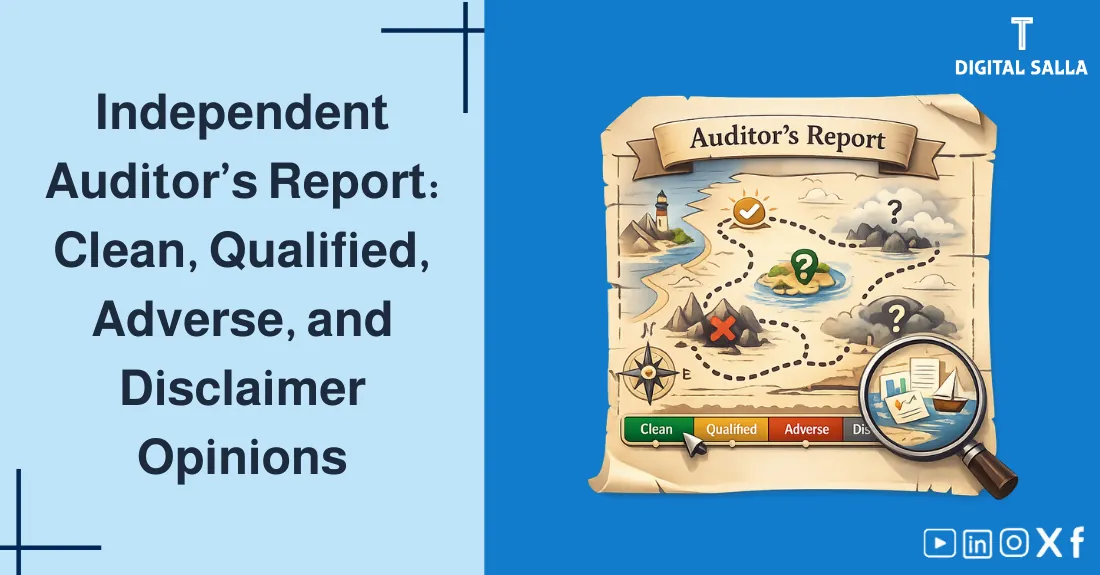
Core Principle: The Auditor's Report is the "Quality Certificate" of financial data. For a bank or investor, the type of opinion is the most critical factor in deciding whether to trust the company.
What will you learn in this guide?
- What is the Independent Auditor's Report and its strategic importance?
- Detailed analysis of the 4 Opinion Types (Clean vs. Modified).
- When is a report "Qualified" and what does "Except For" mean?
- The danger of Adverse Opinions and Disclaimer of Opinion.
- Understanding the Emphasis of Matter and Key Audit Matters (KAMs).
- Checklist: How to prepare your company for an Unqualified Opinion.
Practical Note: An Unqualified Opinion does not mean the company is profitable; it only means the Financial Statements are a fair representation of its reality (whether that reality is good or bad).
Table of Contents Updates as you scroll
1) The Concept of the Audit Report 2) Unqualified Opinion (The "Clean" Report) 3) Qualified Opinion (The "Except For" Report) 4) Adverse Opinion (The Negative Report) 5) Disclaimer of Opinion (No Conclusion) 6) The Auditor's Logic Path (Visual Matrix) 7) Emphasis of Matter and Other Paragraphs 8) Operational Controls & Readiness Checklist 9) Common Errors and How to Prevent Them 10) Frequently Asked Questions 11) Conclusion
1) The Concept of the Independent Auditor's Report
The Auditor's Report is a formal document issued by an external CPA following an audit of an entity's financial statements. It expresses the auditor's conclusion on whether the statements are prepared, in all Material respects, in accordance with an applicable financial reporting framework (like IFRS).
Key Insight: The report is addressed to the Shareholders, not the management, ensuring the auditor's accountability to the owners of the capital.
2) Unqualified Opinion (The "Clean" Report)
This is the most common and the desired type of report.
- Meaning: The auditor has no reservations. The financial statements fairly represent the company's position.
- Market Impact: Increases investor confidence and makes it easier for the company to secure loans.
3) Qualified Opinion (The "Except For" Report)
This is the first type of Modified Opinion.
Audit-Ready Guide - Word/PDF File
- Meaning: The financial statements are fair Except For a specific matter.
- Causes: (1) A disagreement with management about an accounting policy (e.g., depreciation method), or (2) A limitation on the scope of the audit (e.g., unable to count inventory at one branch).
- Nature: The issue is material but not Pervasive (it doesn't destroy the whole report).
4) Adverse Opinion (The Negative Report)
This is a rare and severe warning.
- Meaning: The auditor believes the financial statements do not present fairly. They are misleading.
- Nature: Misstatements are both Material and Pervasive (affecting many parts of the P&L and Balance Sheet).
- Consequence: Legal trouble, possible delisting from stock markets, and total loss of bank trust.
5) Disclaimer of Opinion (No Conclusion)
The auditor chooses not to express an opinion at all.
- Cause: A massive limitation on scope. Management refused to provide data, or major fires destroyed all records.
- Nature: The auditor cannot gather enough evidence to even begin form an opinion.
- Risk: Often a huge red flag for Fraud or impending bankruptcy.
6) The Auditor's Logic Path (Visual Matrix)
How an auditor chooses the type of opinion based on Materiality and Pervasiveness?
Diagram showing how materiality and pervasiveness determine the type of audit report.
Insight: As long as a mistake is Immaterial (small), the auditor still issues a Clean Opinion.
7) Emphasis of Matter and Key Audit Matters (KAMs)
Sometimes an auditor issues a "Clean" opinion but adds extra info:
- Emphasis of Matter: Used to point out something already disclosed that is vital (e.g., a major lawsuit that could bankrupt the company if lost). It does not change the opinion to qualified.
- Key Audit Matters (KAMs): Required for listed companies. These are the "Hardest things" the auditor had to check during the audit.
Deep dive: Corporate Governance — To see how the Audit Committee discusses these Key Audit Matters with the auditor before the report is published.
8) Operational Controls & Readiness Checklist
To ensure your company earns an Unqualified (Clean) Opinion:
Year-End Audit Quality Gate
- Are Accounting Estimates (like bad debt reserves) backed by a formal logic memo?
- Is there a Discontinued Operations or Assets Held for Sale note if applicable?
- Are Subsequent Events (occurring after Dec 31st) documented for disclosure?
- Have all Related Party transactions been declared and audited?
- Is the Going Concern assumption verified (Does the company have cash for 12 months)?
Related topic: Tax Invoice Data — To ensure your revenue assertions (Completeness and Accuracy) are backed by legally compliant documentation.
9) Common Errors and How to Prevent Them
- Treating 'Emphasis of Matter' as a Failure: It is not a bad thing; it is a Transparency Tool. Don't fight the auditor to remove it if the risk is real.
- Missing the 'Going Concern' warning: Management sometimes ignores the auditor's doubts about the company's ability to survive. Fix: Prepare a 12-month Cash Flow Forecast.
- Late Adjustments: Finding a huge error on the day of report signing. Fix: Perform a Pre-Audit review 30 days before year-end.
- Blocking Scope: Refusing to let auditors visit a warehouse. Fix: The Internal Audit Charter should guarantee full access.
10) Frequently Asked Questions
What is a 'Clean' audit opinion?
It is an Unqualified Opinion. It means the auditor is satisfied that the financial statements are fair and comply with standards.
What is 'Pervasiveness' in auditing?
It describes errors that are not just in one line item but are so widespread they represent a substantial portion of the financial statements, or are fundamental to the users' understanding.
Who pays for the audit?
The company pays the fee, but the auditor must remain Independent. If the fee is so large it creates "Self-interest risk," the auditor's independence is compromised.
11) Conclusion
The Independent Auditor's Report is the ultimate verdict on a company's financial health. By understanding the nuances between Unqualified, Qualified, and Adverse opinions, you gain the ability to read between the lines of any annual report. For management, achieving a "Clean" opinion is the reward for a year of disciplined internal control, ethical accounting, and transparent governance. It is the foundation of institutional credibility in the global market.
Action Step Now (30 minutes)
- Find a competitor's latest Annual Report.
- Skip to the "Auditor's Report" section.
- Check the "Opinion" and "Key Audit Matters." What was the auditor most worried about in their business?
© Digital Salla Articles — General educational content for audit, accounting, and institutional transparency purposes.