


Feasibility Studies: Using NPV and IRR to make investment decisions

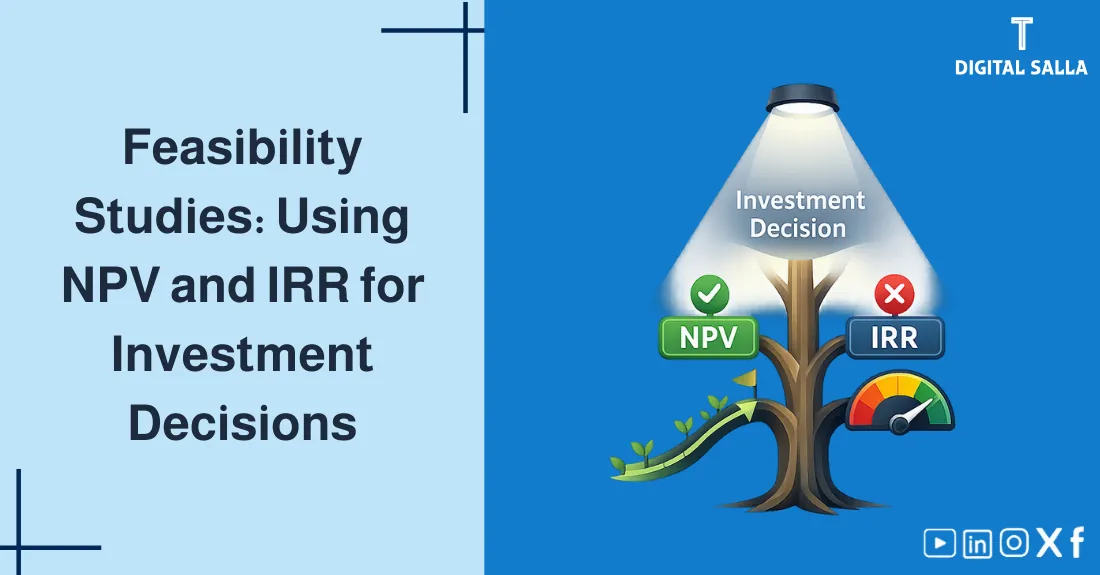
Feasibility Studies: Using NPV and IRR for Investment
Making an investment decision isn’t based on “feeling” but on numbers. Financial Feasibility Studies answer: Is the project profitable? When will I recover my money? And what is the return? This guide explains NPV and IRR with a practical calculator.
- The concept of Time Value of Money and why a dollar today is better than tomorrow.
- Net Present Value (NPV): The most accurate standard for profitability.
- Internal Rate of Return (IRR): The project’s breakeven interest rate.
- Payback Period: When does the capital return?
- Interactive Calculator to test your numbers and make a decision (Accept/Reject).
1) What is a Financial Feasibility Study?
It is a systematic analysis to determine the economic viability of a proposed project. It answers one question: “Should we invest?”. It relies on estimating costs (Capex/Opex) and revenues, then calculating indicators like NPV and IRR.
2) Time Value of Money: The Base of Everything
$1,000 today is better than $1,000 a year from now. Why? Because you can invest today’s amount to earn a return (Opportunity Cost), and because inflation reduces purchasing power. Therefore, we must discount future flows to know their value today.
3) Net Present Value (NPV)
NPV is the sum of the present values of all cash inflows and outflows.
Rule:
- NPV > 0: Accept (Project adds value).
- NPV < 0: Reject (Project destroys value).
4) Internal Rate of Return (IRR)
IRR is the discount rate that makes NPV equal to zero. It represents the expected annual return percentage.
Rule: Accept if IRR > Cost of Capital (WACC).

Rolling Forecast 12-Month Model - Excel File
5) Payback Period
How long until I get my money back? Simple Payback ignores the time value of money, while Discounted Payback accounts for it. It is a risk measure, not value.
6) Comparison: Which Metric is Better?
| Metric | Pros | Cons |
|---|---|---|
| NPV | Gives absolute value in dollars (Real Wealth) | Hard to explain to non-finance people compared to % |
| IRR | Easy percentage to understand (e.g., 20% return) | May give misleading results in unconventional projects |
| Payback | Simple measure of liquidity risk | Ignores profit after payback period |
7) Sensitivity Analysis (What If?)
Never rely on a single scenario. What if sales drop by 10%? What if costs rise? Change assumptions (Sensitivity Analysis) to see if NPV remains positive.
8) Feasibility Calculator (NPV & IRR)
Enter the initial investment (as a negative number or positive and we’ll handle it) and expected annual cash flows.
9) Common Mistakes in Feasibility Studies
- Optimism Bias: Overestimating revenue and underestimating time/cost.
- Ignoring Working Capital: Forgetting that you need cash for inventory and receivables.
- Wrong Discount Rate: Using a rate too low for the risk level.
- Focusing on Profit not Cash: Accounting profit implies nothing about liquidity.
10) Frequently Asked Questions (FAQ)
What is the difference between NPV and IRR?
NPV gives value in currency (Dollar Wealth), while IRR gives a percentage return. NPV is scientifically preferred for decision making.
When should I accept a project?
When NPV is positive, meaning the project covers its costs and the required cost of capital.
What is the Payback Period?
The time needed to recover the initial capital. It measures liquidity risk, not total profitability.
11) Conclusion
Feasibility Study is your map before paying a single dollar. Use NPV to measure value creation, IRR to measure return efficiency, and Payback to measure risk. Don’t just calculate; analyze scenarios and ensure your assumptions are realistic.