


Financial fraud: Fraud triangle, red flags, and prevention methods

Financial Fraud: The Fraud Triangle, Red Flags, and Prevention Methods
Financial Fraud: A practical guide explaining the Fraud Triangle and the most critical Red Flags, how to detect embezzlement and financial statement manipulation, and implementing preventative controls—Digital Salla.
- The fundamental definition of Financial Fraud and its three main types.
- Detailed analysis of the Fraud Triangle (Cressey’s Model).
- Identifying behavioral and financial Red Flags in employees.
- Fraud in the books: Common methods of Financial Statement Manipulation.
- Strategic prevention: Hotlines, audit culture, and the “Tone at the Top.”
1) The Concept of Financial Fraud
Financial Fraud is any intentional act of deception designed to achieve unlawful gain or deprive the organization of its assets. Unlike “Errors” (which are accidental), fraud involves deliberate Concealment.
2) The Fraud Triangle (Cressey’s Model)
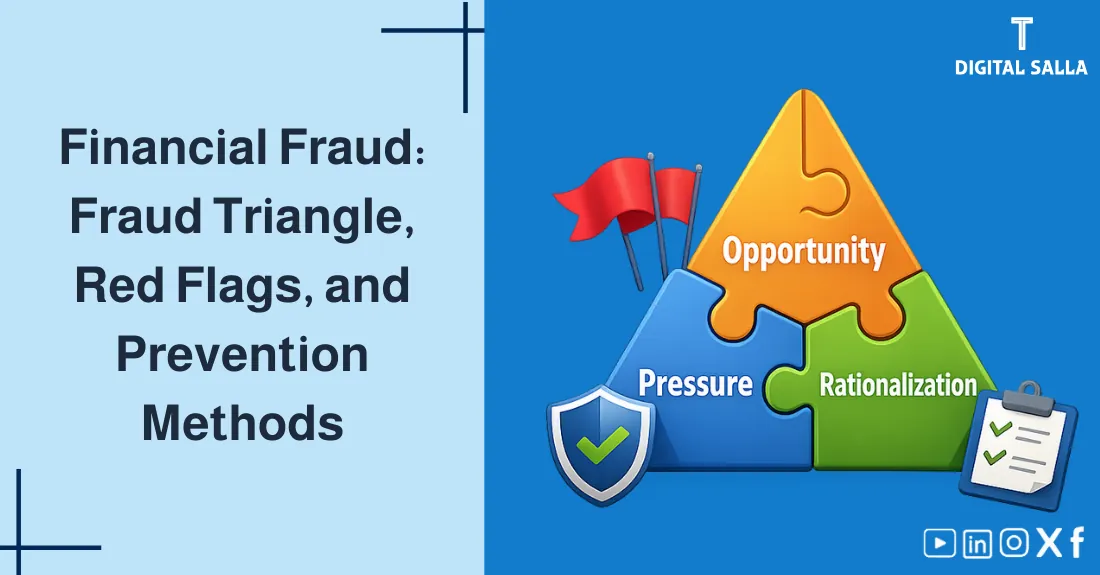
According to criminologist Donald Cressey, three elements must be present simultaneously for fraud to occur:
- Pressure (Motive): A financial problem the person cannot solve legally (e.g., debt, addiction, or unrealistic performance targets).
- Opportunity: A weakness in Internal Control that allows the person to commit the act with low risk of being caught.
- Rationalization: The self-justification (e.g., “I’m only borrowing the money” or “The company underpays me”).
3) The Triangle Logic (Visual Analysis)
Why management can only truly control one side of the triangle?
4) Types of Occupational Fraud
The Association of Certified Fraud Examiners (ACFE) divides fraud into three categories:
- Asset Misappropriation: Stealing cash, inventory, or using company assets for personal use (Most common).
- Corruption: Bribery, kickbacks, and illegal gratuities.
- Financial Statement Fraud: Falsifying records to inflate profit or hide debt (Highest dollar impact).
5) Red Flags: Spotting the Danger Early
Look for these behavioral patterns in staff, especially those in finance or procurement:
JE Correction Workflow - Excel Template
- Living beyond means: Expensive cars or lifestyle that doesn’t match the salary.
- Refusal to take vacations: Fear that someone will discover the fraud while they are away.
- Unusually close relationship with vendors: Frequent private meetings or accepting gifts.
- Excessive control: Refusing to let others see their work or share responsibilities.
6) Financial Statement Fraud (The Numbers Game)
Executives may commit “Cooking the Books” to meet quarterly targets or secure loans:
- Channel Stuffing: Sending more goods to customers than they ordered to record immediate revenue.
- Capitalizing Expenses: Recording a repair (expense) as an asset to hide it from the P&L.
- Off-balance-sheet debt: Hiding liabilities in special entities.
7) Designing a Fraud Prevention System
A robust defense requires multiple layers:
7.1 The Tone at the Top
Management must lead by example. If the CEO ignores the rules, the employees will too.
7.2 Whistleblower Hotlines
Over 40% of fraud is caught via tips. Ensure the channel is anonymous and protected.
7.3 Mandatory Job Rotation
Force employees to move roles or take mandatory 2-week vacations to break the concealment cycle.
8) Operational Controls & Readiness Checklist
To evaluate your Fraud Resilience today:
Anti-Fraud Quality Gate
- Is there a formal Code of Ethics signed by all employees?
- Do we perform background checks (Criminal/Credit) on new finance hires?
- Are Segregation of Duties strictly enforced in the ERP?
- Is there an “Active Whistleblower Hotline” advertised to staff?
- Do we perform Surprise audits on cash and inventory?
9) Common Errors and How to Prevent Them
- The “Trusted Employee” Myth: Bypassing controls because “He’s like family.” Most fraud is committed by long-tenured employees.
- Focusing only on Cash: Ignoring the theft of Proprietary Data or Time.
- Weak IT Permissions: Allowing an accountant to have “Admin” rights to the system.
- Retaliation: Failing to protect whistleblowers, which stops future tips.
10) Frequently Asked Questions
What is the main cause of financial fraud?
The combination of Pressure (financial need) and Opportunity (weak controls). Management can only control the Opportunity.
What is Forensic Accounting?
It is a specialized branch of accounting that uses investigative skills to uncover fraud for use in legal proceedings.
Can an external audit catch all fraud?
No. External audits are designed to find “Material Misstatements,” not necessarily every small embezzlement. Internal control is much more effective at detection.
11) Conclusion
Financial Fraud is a silent predator that can destroy decades of hard work in a matter of months. By understanding the Fraud Triangle and actively monitoring Red Flags, you move from being a “Victim” to being a “Guardian” of the company’s wealth. A strong culture of ethics, supported by rigid Internal Controls and anonymous reporting, ensures that your entity remains a safe environment for growth, investment, and sustainable success.
Action Step Now (30 minutes)
- Check if your company has an anonymous “Ethics Hotline.”
- Identify the employee with the most “Unsupervised” control over cash.
- Implement a Dual Authorization requirement for that person’s bank transfers today.