


The Role of Financial Planning & Analysis (FP&A): How does an accountant become a strategic partner?

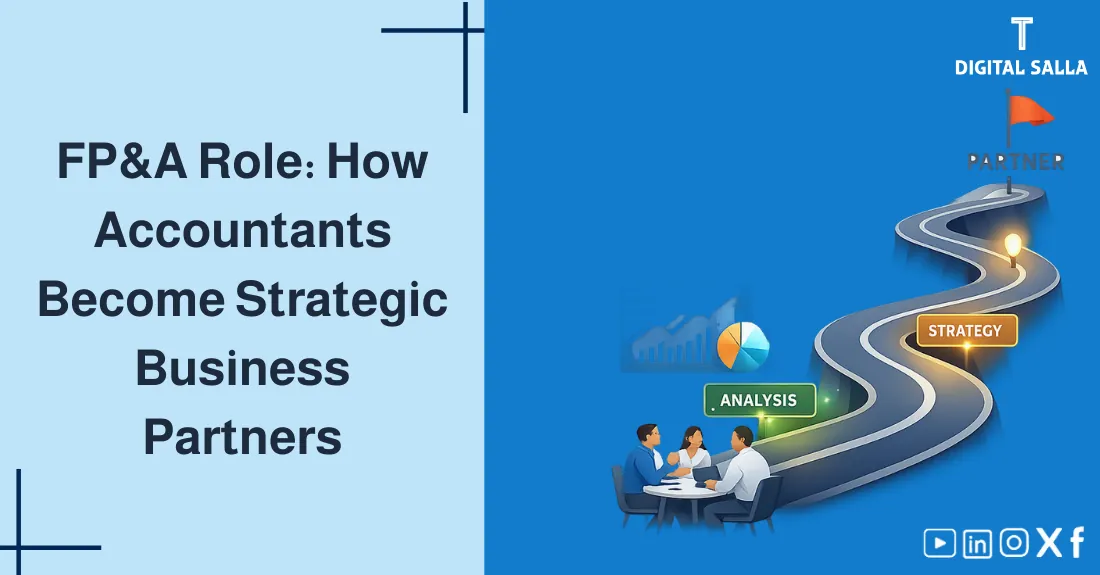
The Role of Financial Planning and Analysis (FP&A): How Does an Accountant Become a Strategic Partner?
Financial Planning and Analysis (FP&A): What is the FP&A function and how does an accountant transform into a strategic partner supporting senior management through modeling, forecasting, and data-driven insights—Digital Salla.
- The fundamental definition of FP&A and its place in the organizational structure.
- Accounting vs. FP&A: From “Trial Balance” to “Strategic Roadmap.”
- The four pillars of FP&A: Planning, Budgeting, Forecasting, and Analysis.
- Decision Support: How FP&A helps in pricing, investment, and risk management.
- Skills required to transition from a traditional accountant to an FP&A Analyst.
1) What is FP&A? (The Definition)
Financial Planning and Analysis (FP&A) is a set of activities that support a company’s financial health by providing senior management with an accurate picture of future performance. FP&A professionals act as “Internal Consultants” to the business.
2) Accounting vs. FP&A (Past vs. Future)
Many people confuse the two, but their focus is entirely different.
| Aspect | Traditional Accounting | Strategic FP&A |
|---|---|---|
| Time Focus | The Past (Last Month/Year) | The Future (Next 1-5 Years) |
| Objective | Accuracy, Compliance, Tax | Growth, Efficiency, Strategy |
| Primary Output | Financial Statements (P&L, BS) | Forecasts, Scenarios, Insights |
| Standard | IFRS / GAAP Rules | Relevance to Business Decisions |
3) The Four Pillars of the FP&A Function
FP&A work is usually structured around these four recurring cycles:
4) Decision Support: Real-world Applications
FP&A is the department management calls when they have a difficult choice:
Asset Revaluation Model - Excel Template
- Investment Decisions: “Should we buy a new machine or outsource production?” (Net Present Value – NPV analysis).
- Pricing Strategy: “If we drop prices by 5%, how much volume do we need to gain to maintain current profit?” (Break-even analysis).
- Resource Allocation: “Which department’s budget should we cut to fund the new marketing campaign?”
5) Financial Modeling: The Analyst’s Engine
An FP&A Analyst must be a master of Financial Modeling. A model is a dynamic simulation of the business in Excel or an FP&A tool.
Attributes of a Professional Model
- Assumptions-Driven: Changing a “Sales Growth Rate” updates the entire P&L and Balance Sheet.
- Scenario Analysis: Capability to toggle between “Base Case,” “Upside,” and “Downside.”
- Error-Checked: Built-in balance checks to ensure assets always equal liabilities + equity.
6) Data Storytelling: Beyond the Numbers
Management doesn’t want to see a Trial Balance. They want to hear a Story.
- Bad Reporting: “Revenue is up 10%.”
- Good FP&A Storytelling: “Revenue is up 10% because of a surge in the Western region, but our material cost rose by 15%, meaning our actual cash margin is tighter than last year. We need to renegotiate vendor contracts by Q3.”
7) Essential Skills for FP&A Success
- Technical: Advanced Excel (modeling), SQL/Power BI (data handling), and deep knowledge of financial statements.
- Analytical: Ability to spot trends, outliers, and “Anomalies” in thousands of data rows.
- Communication: Presenting complex financial concepts to Sales, HR, or Marketing managers in simple business terms.
- Business Acumen: Understanding how the product is made, sold, and delivered—beyond the ledger.
8) Operational Controls & Readiness Checklist
To ensure your FP&A Function is delivering strategic value:
FP&A Quality Gate Checklist
- Is the FP&A team involved in strategic meetings with the CEO?
- Do we use Rolling Forecasts instead of just static annual budgets?
- Is the KPI Dashboard updated and reviewed by business owners monthly?
- Are we tracking “Leading Indicators” (Future) not just “Lagging Indicators” (Past)?
- Is there a formal process to analyze Variances and document corrective actions?
9) Common Errors and How to Prevent Them
- Operating in a Vacuum: Building a budget without talking to the sales or production teams.
- Focusing on Cents: Worrying about a $10 variance when there’s a $10,000 strategy gap (Lack of Materiality).
- Static Assumptions: Using the same exchange rate or fuel price for a 5-year plan in a volatile market.
- Messy Data Sources: Building high-level models on top of unreliable or un-reconciled accounting data.
10) Frequently Asked Questions
What is FP&A?
It is the strategic function of finance responsible for planning, budgeting, forecasting, and providing insights to support management decisions.
How can I move from Accounting to FP&A?
Start by analyzing the “Why” behind the variances in your monthly reports, master financial modeling in Excel, and learn how to present data visually.
What is a Strategic Partner in finance?
A finance professional who doesn’t just “Report” but actively helps other department heads find ways to increase revenue or decrease costs.
11) Conclusion
The transition from traditional accounting to Strategic FP&A is the path to becoming a true business leader. By mastering the Four Pillars of Planning, building robust Financial Models, and focusing on Decision Support, you move from “Counting Value” to “Creating Value.” This role ensures that your entity is not just surviving day-to-day, but navigating toward a profitable and sustainable future.
Action Step Now (30 minutes)
- Find one non-financial manager (e.g., Marketing Head).
- Ask them: “What is the biggest financial question you struggle with when making a decision?”.
- Try to build a small 1-page “Financial Insight” or model to help them answer that specific question.