


Forensic Accounting: How to Uncover Fraud with Law and Numbers?

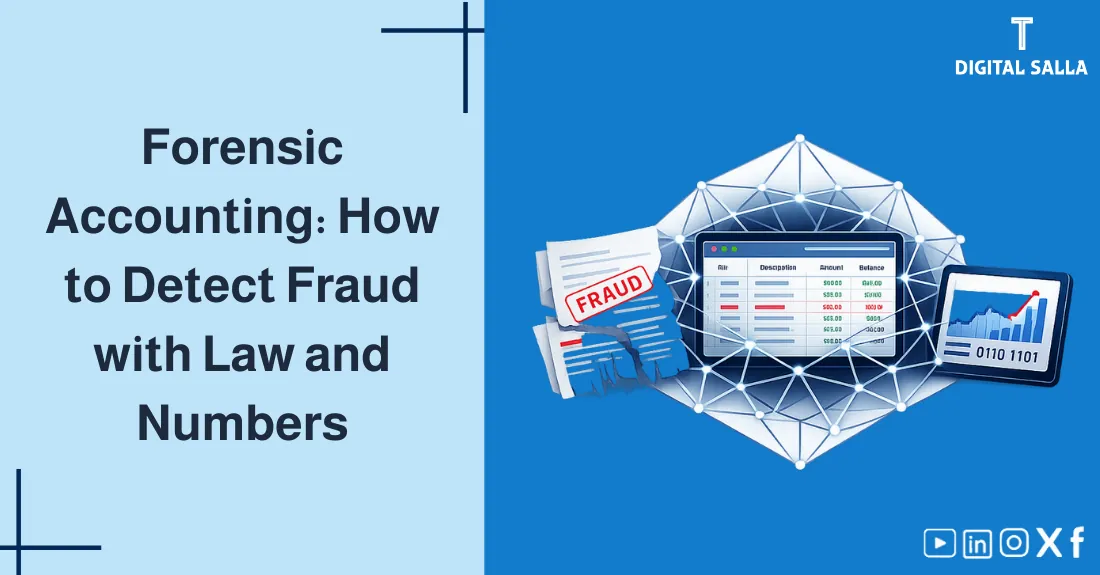
Forensic Accounting: How to Uncover Fraud with Law and Numbers?
In many companies, fraud or manipulation starts small: a “minor increase” invoice, an unjustified discount, a vendor appearing out of nowhere, or returns higher than normal. The problem isn’t the error itself… it’s that small errors recur until they turn into a hemorrhage. This is where Forensic Accounting emerges as a practical solution: a blend of financial investigation, digital analysis, and legal understanding to gather defensible evidence, interpret patterns, and draft a clear report suitable for management—and sometimes for the court.
- A clear understanding of Forensic Accounting and the practical role of a forensic accountant.
- A quick distinction between forensic investigation, traditional auditing, and internal control.
- A step-by-step methodology: from the first “red flag” to a usable evidence report.
- Checklists and “Red Flags” tables to immediately reduce risks in your company.
1) What is Forensic Accounting?
Forensic Accounting is a specialty that combines accounting, auditing, and financial analysis—with a legal understanding of how to collect, document, and interpret evidence. The word “Forensic” doesn’t always mean “court,” but it means the work is done in a disciplined and documented manner so results can be relied upon during a dispute, formal investigation, or sensitive management decision.
Simply put: A forensic accountant doesn’t just ask “Is the entry correct?” but asks: Is what happened logical? Who benefits? Is there a pattern? What is the money trail? Can we prove it?
2) Audit vs Forensic Accounting vs Internal Control
Confusion often arises because everyone deals with “numbers.” However, each role has a different goal and output.
| Element | External Audit | Internal Control | Forensic Accounting |
|---|---|---|---|
| Goal | Opinion on fairness of statements | Evaluate controls & compliance | Detect/Prove fraud or dispute |
| Scope | Samples + Standard procedures | Risks + Control tests | Deep focus on specific files/persons |
| Output | Opinion report | Recommendations & Risk maps | Forensic report + Timeline + Loss valuation |
3) When do you need a forensic accountant? (Practical Indicators)
Don’t wait for “full proof” before acting. In real investigations, early action reduces losses.
Practical IFRS Applications - PDF File
| Indicator | Practical Example | Immediate Action |
|---|---|---|
| Recurring Discrepancies | Cash shortages or inventory gaps that “appear and disappear” | Freeze entry adjustments + Begin matching data sources |
| Illogical Vendor/Client | New vendor without a clear file or contract | Verify bank registration, address, and tax IDs |
| Closing Period Transactions | Large invoices on the last day of the month | Review receiving documents and actual service proof |
4) Most common types of fraud detected
“Fraud” is a broad term. Forensic accounting usually deals with recurring patterns:
First: Billing and Procurement Fraud
- Ghost Vendor: Creating a vendor name/bank account linked to an employee.
- Inflated Invoices: Prices higher than market or doubled quantities.
- Duplicate Invoices: Paying the same invoice twice by changing the number/description.
Second: Revenue Fraud
- Early Revenue Recognition: “Inflating” revenue to improve results.
- Hidden Returns: Delaying the recording of returns to the next month.
5) Financial Investigation Methodology step-by-step
Investigation success depends on methodology. A forensic accountant follows these stages:
(1) Defining the Hypothesis and Scope
- What is the incident? When did it start? What systems are affected?
- What is the required output: Administrative report? Legal file? Dispute support?
(2) Preserving Evidence before analysis
- Copying databases/servers or Audit Logs.
- Securing original documents (Invoices, POs, Delivery notes).
(3) Building a Analyzable “Data Picture”
- Gathering data from multiple sources: ERP, Bank, POS, Inventory, Email…
6) Fraud Detection Tools (Data Analysis + Logic Tests)
Tools are “tests” that put a possibility under pressure.
A) Pattern / Anomaly Analysis
- Bank Account Duplication: Same IBAN appearing for multiple vendors.
- Duplicate Invoices: Same amount/date/vendor with a different invoice number.
- Round Numbers: Excessive amounts ending in 00/50/99 might indicate abnormal estimates.
B) Matching
- 3-Way Match: Purchase Order + Receipt + Invoice.
- Bank Reconciliation: Linking bank movements to system movements.
7) Evidence and Chain of Custody
The biggest mistake in internal investigations is handling evidence haphazardly. Chain of Custody simply means documenting how you got the evidence, where it was stored, and who handled it.
What does a forensic accountant usually document?
- Source: System name/Bank/Email/Original file.
- Date & Time: When the data was extracted and when the event occurred.
- Digital Fingerprint: Hash/Checksum for sensitive files.
8) Forensic Report & Expert Witnessing
A good report builds a “provable story”: What happened? How was it detected? What is the evidence?
Practical Structure for a Forensic Report
- Executive Summary: 10-15 lines for management.
- Methodology: How was data collected? What were the tests?
- Facts and Evidence: Numbered tables + Appendices + Clear trail.
- Loss Valuation: Net impact and calculation assumptions.
9) Anti-Fraud Program (Prevention before Cure)
A effective anti-fraud program consists of 4 layers: Prevent → Detect → Respond → Learn.
Prevention Layer
- Segregation of Duties: Creator ≠ Approver ≠ Payer.
- Document Policy: No payment without PO/Receipt/Invoice/Approval.
10) Checklist for Employers: 30-Day Plan to Reduce Risk
| Week | Execution Task | Expected Result |
|---|---|---|
| 1 | Map document cycle + Define approvers + Audit permissions | Clarity of responsibilities; closing the “no one knows” gap |
| 2 | Basic segregation of duties (Vendor/Payment) + Review top 20 vendors | Reduced risk of ghost vendors or bank account manipulation |
| 3 | Activate weekly bank reconciliation + Audit returns/discounts sample | Early detection of recurring manipulation patterns |
11) Frequently Asked Questions
What is Forensic Accounting simply?
It’s using accounting and audit with law to gather financial evidence to uncover fraud or support disputes.
When do I need a forensic accountant?
When you see indicators of fraud, partnership disputes, large insurance claims, or before/after an acquisition.
12) Conclusion
Forensic Accounting is a practical method to turn numbers into evidence. If you apply the minimum prevention (Segregation of duties + Reconciliations + Permissions), you will prevent most fraud cases before they start.
- Start with the “30-Day Plan” above to reduce risks quickly.
- Make reconciliations a fixed habit, not a delayed task.
- When an abnormal pattern appears, act early: Save evidence first, then analyze.