
History of Accounting and Profession Pioneers: A Journey from Clay Tablets to AI
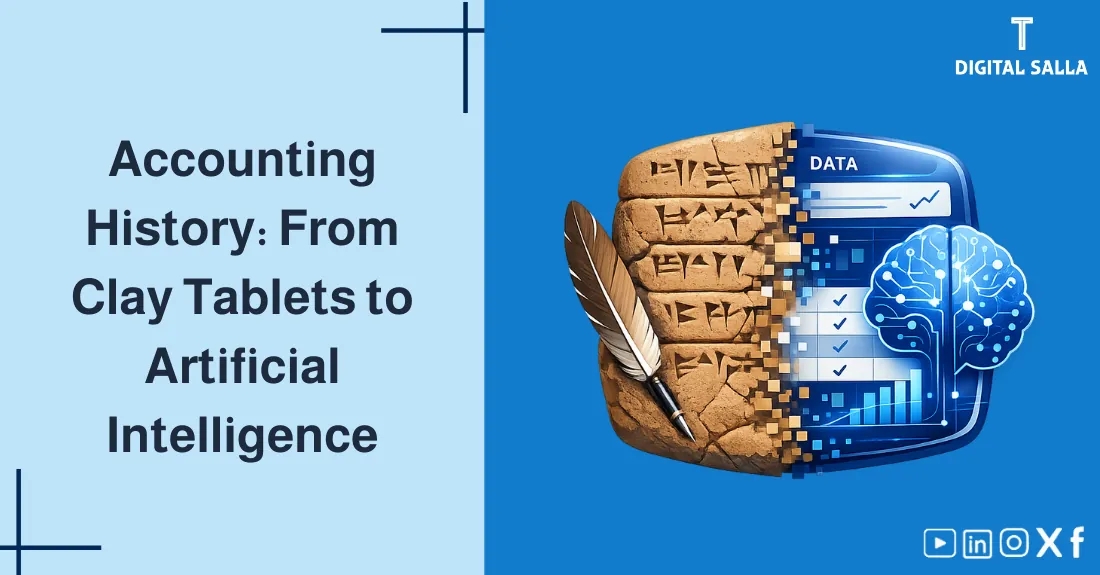
History of Accounting is not just a story of "ledgers and numbers," but the story of society's evolution: trade, taxes, companies, markets... then data and AI.
When we read about the origins of accounting and see how humans recorded transactions on clay tablets, we understand that accounting has always been the "language of trust" between people: Who paid? Who received? What is the inventory? What is the debt? Over time, the history of bookkeeping moved from symbols and counting to double-entry, then to standards, auditing, and digital systems, reaching the era of Artificial Intelligence. In this article, you will get a clear map: Accounting in Ancient Civilizations → The Age of Global Trade → The Industrial Revolution → Standards → Digitalization → Future of the profession.
What will you gain from this article?
- A simplified understanding of the evolution of accounting science through major stages.
- A visual timeline linking eras to changes in tools and methodology.
- Why did double-entry appear? And how did it pave the way for modern financial statements?
- How did technical evolution (ledgers → Excel → ERP → AI) reflect on the accountant's role?
Table of Contents Auto-highlights on scroll
1) Why care about accounting history? 2) Accounting in Ancient Civilizations 3) Double-Entry: The Turning Point (SVG) 4) Industrial Revolution & Specializations 5) From Ledgers to Standards 6) Timeline of Accounting Evolution (SVG) 7) Evolution of Tools: Ledger → AI 8) Auditing and Governance 9) Accountant Skills in 2026+ 10) Practical Resources 11) Frequently Asked Questions 12) Conclusion
1) Why care about accounting history?
The history of accounting might seem "theoretical," but it is very practical for simple reasons: Every historical stage added something to the methodology we use today. Understanding why a certain idea appeared helps you know when it fits and when it doesn't.
- Understanding the logic of rules: Many policies were born to solve recurring problems.
- Improving professional judgment: Tools change, but the core remains: documentation, fairness, and consistency.
- Preparing for the future: AI changes the way of working, but not the goal: reliable information for decision-making.
Quick Thought: Accounting history = the history of building trust in money. The more complex the economy, the more accurate accounting we need.
2) Accounting in Ancient Civilizations: From Counting to Documentation
The origins of accounting start from the simplest need: "How do I guarantee my right?" then turn into "How do I manage a state?". In Accounting in Ancient Civilizations, we see three recurring pillars: Inventory (grains/livestock), Taxes (state share), and Debts (who owes whom).
2.1 Clay Tablets and First Records
In early agricultural and trading societies, storage and bartering needed records. Methods emerged: symbols, counting, then writing. The goal was simple: proving quantities, ownership, and entitlement. This is the first seed of history of bookkeeping.
2.2 Administration, Taxes, and Public Spending
With the rise of states, documentation was not just for trade but for managing taxes, salaries, state stores, and public spending. Here, roles like "Scribe," "Storekeeper," and "Financial Officer" appeared as early precursors to accountants, treasurers, and controllers.
3) Double-Entry: The Turning Point that Changed Everything (SVG)
If there is one invention considered the "heart of modern accounting," it is Double-Entry Bookkeeping. The idea is not just two columns (debit/credit); it is a concept of balance: Every transaction affects at least two elements, making the system capable of detecting errors and building linked statements.
Financial Statements Builder - Excel File
Double-Entry: Simple Practical Example Example: Purchasing inventory on credit for 10,000 Debit Side Debit: Inventory • Increases Asset (Inventory) • Shown on Balance Sheet Value: 10,000 Credit Side Credit: Accounts Payable • Increases Liability (Debt) • Shown on Balance Sheet Value: 10,000 Balance ✅
The essence of Double-Entry: Every transaction has two balanced effects. This link allowed accounting to scale from a small merchant to a global corporation.
4) Industrial Revolution and Accounting Specializations
With mass production, new questions emerged: How much does a unit cost? Where is waste occurring? This led to Cost Accounting taking shape, followed by concepts like budgeting and control.
4.1 Cost and Managerial Accounting
Companies needed a system that goes beyond recording what happened, to helping plan and control. This was a major step in the evolution of accounting science from "recording" to "management."
4.2 Public Companies and Increased Reporting
When investors (shareholders) entered, the question of trust became critical. External reports grew in importance, the role of external auditors evolved, and modern auditing features began to emerge.
5) From Ledgers to Standards: How Modern Frameworks Appeared?
With global companies, comparability became a requirement: How can you compare two companies if their policies are vastly different? From here, the idea of "Frameworks" and "Standards" expanded: not just how we record, but how we measure and disclose.
6) Timeline of Accounting Evolution (SVG)
Simplified Timeline: From Ledgers to AI Ancient Times Counting & Records Global Trade Double-Entry Ind. Revolution Cost & Budgeting Standards & Audit Governance & Trust Digital & AI ERP / Analytics
Evolution has always been driven by one question: How do we increase trust and reduce ambiguity as the economy scales?
7) Evolution of Accounting Tools: Ledger → Excel → ERP → Cloud → AI
Part of the history of bookkeeping is the history of the "Tool." From paper ledgers relying on manual discipline to electronic spreadsheets, ERP systems, cloud platforms, and finally AI tools.
7.1 Paper Ledgers: Discipline First
Paper ledgers taught the profession the most important lesson: "If there is no document, there is no number." But they were slow and prone to errors.
7.2 Excel: Flexible Power... with Risk
Spreadsheets provided flexibility but also risks if not managed: multiple versions, undocumented edits, and hidden formulas.
7.3 ERP: Accounting "Inside the Process"
With ERP, recording became part of the process itself: Purchase → Inventory → Payment → Automatic entries. This increased the value of controls and chart of accounts design.
8) Auditing and Governance: Why "Trust" became a standalone profession?
With the expansion of markets, it was no longer enough for management to say: "These numbers are correct." A professional independent party was needed to evaluate report quality and controls. This is where accounting history intersects with auditing history: the higher the risk, the higher the need for auditing.
9) What does this mean for you today? Accountant Skills in 2026+
From "Bookkeeper" to "Financial Trust Engineer"
| Stage | Key Skill | Tool | Value Provided |
|---|---|---|---|
| Paper Ledger | Accuracy & Discipline | Ledgers & Docs | Traceable Record |
| Excel | Modeling & Analysis | Spreadsheets | Faster Reporting |
| ERP | Control Design | Enterprise System | In-process Reporting |
| Cloud/AI | Data Governance | Automation/AI | Better Decisions |
11) Frequently Asked Questions
What is the history of accounting?
It is the evolution of recording and reporting transactions from ancient records to AI-driven systems.
Why is double-entry important?
Because it links every transaction with two balanced effects (debit/credit), which is the basis of modern accounting.
12) Conclusion
Ultimately, accounting history is not just an "old tale"; it is a roadmap to understanding why we work the way we do today. From clay tablets to AI, every stage solved a problem: raising trust and reducing ambiguity. Understanding this story helps you adapt to changing tools while keeping the core objective clear.
© Digital Salla — General educational content. Details and dates may vary by source; the goal is to provide a "map of understanding" for the profession's evolution.