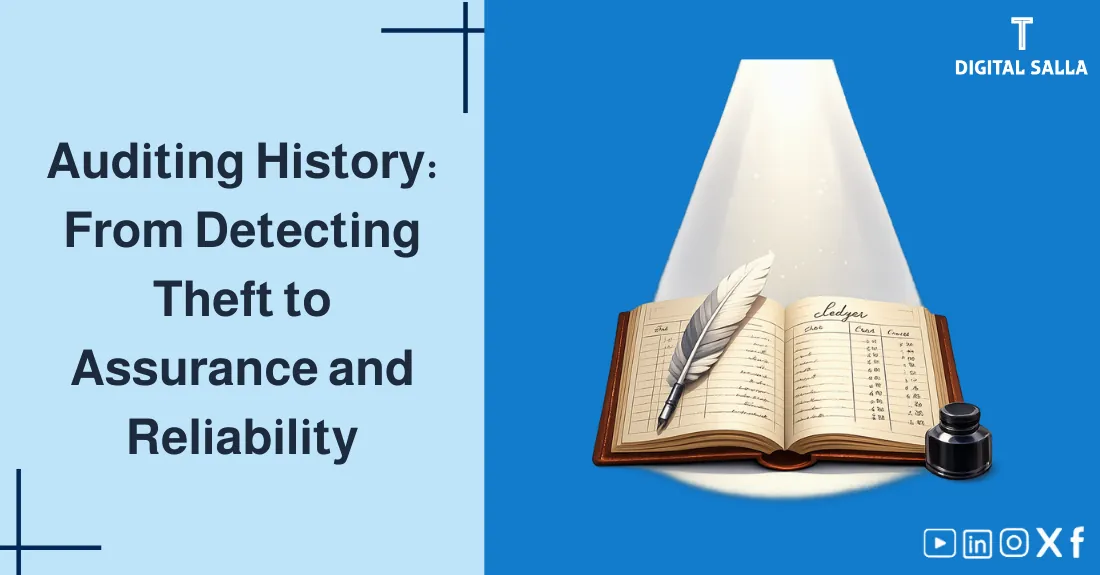
History of Auditing (Auditing History): From Embezzlement Detection to Ensuring Reliability
When you hear the word auditing, you might imagine an "inspection" looking for a mistake or embezzlement. However, auditing history tells us that the profession evolved radically: from focusing on detecting embezzlement within paper ledgers, to a broader role aimed at enhancing report reliability and increasing trust between management, owners, banks, and markets.
What will you gain from this article?
- Understanding the evolution of auditing: how and why the goal and methodology changed through the ages.
- A mental map linking financial scandals to the development of standards and governance.
- A clear look at the emergence of audit firms and the role of independence and audit quality.
- How digital transformation changed audit tools: from paper samples to data analytics.
Back to the general framework: Also read History of Accounting and Profession Pioneers to understand the full evolution of the "language of money" before branching into auditing.
Table of Contents Auto-highlights on scroll
1) What is Auditing? And what has changed? 2) Why study the history of auditing? 3) The Beginnings: Control before "Auditing" 4) Trade and Ledgers: From Inventory to Review 5) The Industrial Revolution: The Birth of External Auditing 6) Emergence of Audit Firms and Independence 7) From Inspection to Standards: Why did rules appear? 8) Financial Scandals that Changed the Profession 9) Digital Transformation: Computer-Assisted Auditing 10) Where is Auditing Heading? 11) Frequently Asked Questions 12) Conclusion
1) What is Auditing? And what has changed over time?
Auditing is a systematic process of examining evidence to form an independent professional opinion about financial (and sometimes non-financial) information, such as financial statements, controls, or compliance. The core idea: reducing the trust gap between those who prepare information (management) and those who rely on it (owners, banks, investors...).
The biggest historical change: Auditing moved from a "full inspection of every transaction" to a "risk-based approach using evidence, samples, and controls." This shift occurred because business volume exploded, making literal examination of everything impractical.
How did the goal of auditing change? (Historical simplification)
| Stage | Dominant Goal | Why did it change? |
|---|---|---|
| Early | Detecting embezzlement/obvious errors | Control over storekeepers, collectors, and agents |
| Joint-Stock Era | Protecting owners and boosting trust in management | Separation of ownership and management + funding expansion |
| Standards Era | Independent opinion on fair presentation | Standardizing practice + comparability + market protection |
| Digital Age | Testing controls/systems + data analytics | ERP systems, big data, and technical risks |
2) Why study the history of the auditing profession?
Because history explains the "reason for existence" of many professional rules today: independence, documentation, planning, risk assessment, and quality control. You will understand that every rule typically appeared after a recurring problem: conflict of interest, misleading reports, or gaps in controls.
Policies & Procedures - Editable Word File
Practical Application: When explaining to a client why we request documents or why we test system controls instead of every invoice— this isn't a "luxury" but the result of a long evolution to protect the reliance on information.
3) The Beginnings: Control before "Auditing"
Before the profession was known by its modern name, there was always a need for verification mechanisms: inventory counting, reconciling tax proceeds, reviewing receipts, and holding agents accountable on behalf of authorities or owners. "Control" in its infancy was closer to direct inspection and documentation.
The core idea remains constant: Whenever an agent manages money they do not own, an independent verification mechanism is needed to reduce deviations or errors.
4) Trade and Ledgers: From Inventory to Reviewing Entries
As trade expanded and organized ledgers appeared, control moved from "counting things" to "reviewing records." A new question emerged: Do the records reflect reality? Are the adjustments logical? Is there consistency?
Important Milestone: Organized Ledgers and the "Trace" Concept
- Every transaction leaves a trace: Document → Entry → Ledger → Report.
- This chain is the basis of what we call today the "Audit Trail".
Detail: For more context on ledger evolution, read Evolution of Accounting through the Ages.
5) The Industrial Revolution: The Birth of External Auditing
With the Industrial Revolution, companies expanded massively, and joint-stock companies appeared with many shareholders who did not participate in daily management. External auditing became essential: an independent party to reassure owners and lenders that reports are not just "management's narrative."
Why did independence become a central element? Because if the auditor is "subordinate" to those being audited, trust collapses. Therefore, the profession is built on independence (in fact and in appearance) and managing conflicts of interest.
6) The Emergence of Audit Firms and Independence
With growing market demand for an "independent opinion," audit firms specialized in providing the service emerged, gradually evolving into large networks offering diverse services (audit, tax, consulting...). Continuous challenges also began: How do we balance business growth with maintaining independence?
Professional principles formed through history
| Principle | Why did it appear? | Real Example |
|---|---|---|
| Independence | Conflict of interest kills trust | Separating the audit team from management rewards/interests |
| Documentation | So the auditor's work itself can be reviewed | Working papers showing evidence and logic |
| Professional Skepticism | Blind reliance opens the door to misleading | Don't just accept explanation—search for supporting evidence |
| Quality Control | Reducing quality variance between teams | Internal file review before issuing the opinion |
7) From Inspection to Standards: Why did auditing rules appear?
When financial reports became widely used in funding and investment, it was no longer acceptable for auditing practices to vary radically from person to person. The need for standards emerged to define: What is a "good audit"? How do we plan? How do we assess risk? What evidence is sufficient?
Useful Rule: Standards are not written to restrict professionals; they are to unify a minimum quality so audit outputs become reliable and comparable.
What changed in the audit methodology?
- Better planning: understanding the activity, environment, and governance.
- Risk assessment: where could material misstatement occur?
- Tests based on controls and samples instead of examining 100% of transactions.
- Stronger evidence: third-party confirmation, reconciliations, analytics.
Quick Comparison: To understand how technology affected the nature of evidence, see Evolution of Accounting Tools.
8) Financial Scandals that Changed the Profession
Auditing history cannot be understood without "shocking milestones" that pushed markets and regulators to tighten rules. Every major scandal usually produces: stronger governance requirements, stricter independence, deeper documentation, and higher quality control.
Milestones: What happens after a scandal?
| Milestone | What was exposed? | Impact on Auditing |
|---|---|---|
| Decades of misleading cases | Fake revenue, hiding liabilities, estimate manipulation | Tightening fraud assessment procedures and enhancing tests |
| Major corporate collapses | Weak governance + conflict of interest + oversight failure | Raising independence requirements and firm quality control |
| Market trust crises | Questions about the "opinion" utility and limits | Developing audit reports and stakeholder communication |
A 4-stage ladder showing audit evolution from detecting embezzlement to ensuring reliability, then systems and data auditing. Audit Goal Evolution Ladder (Simplification) Detect Fraud Direct Inspection Verify Ledgers Document → Entry Independent Opinion Fair Presentation Data Analytics Concept: As business scales and systems complexify, auditing shifts from inspection to evidence/risk/tech methodology.
This diagram is simplified, but helps explain "why" modern auditing cannot just be about counting invoices.
Important: Auditing is not an absolute guarantee against all fraud; rather, it provides reasonable assurance within scope, evidence, and risk assessment limits.
9) Digital Transformation: Computer-Assisted Auditing
With ERP systems and increasing data volume, the "location" of evidence changed. Evidence is no longer just in paper files—it is in system logs, user permissions, approval paths, and automatic entries. Therefore, Computer-Assisted Audit Tools (CAATs) and analytics emerged to detect exceptions and abnormal patterns.
The real transformation here: Instead of asking "Is this invoice correct?", the question is now also "Does your system prevent an incorrect invoice from existing in the first place?" (Controls, permissions, segregation of duties, audit logs...)
Examples of digital evidence in modern auditing
| Evidence Type | Example | What it Proves? |
|---|---|---|
| System Logs | Changing vendor data / price edit / document deletion | Who did what and when (Traceability) |
| Permissions | Who has rights to approve discounts or cash disbursement | Segregation of duties and reducing manipulation risks |
| Analytics | Duplicate invoices / out-of-range figures / end-of-day entries | Risk areas for targeted testing |
Auditor's Practical Rule: The higher the processing automation, the more important it is to understand controls, because an error entering the system can repeat "automatically" very quickly.
10) Where is Auditing Heading?
The general trend is clear: expanding the scope of trust. The world no longer only cares about financial statement figures but also governance, risk, compliance, and sometimes non-financial information (like sustainability)— but always within one question: Can this information be relied upon to make a decision?
3 Expected Paths (Simplified)
- More Technical: broader analytics + automated testing + exception monitoring.
- More Governance-Focused: greater emphasis on audit committees, independence, and execution quality.
- More Integrated: understanding operational and technical risks alongside financial ones.
11) Frequently Asked Questions
What is meant by the history of auditing?
Tracking how auditing originated and changed its goals, tools, and standards—from embezzlement detection to providing a professional opinion that enhances market trust.
When did modern external auditing emerge?
It crystallized with the expansion of joint-stock companies and the need for owners and banks for an independent opinion, strengthened by professional regulations and standards.
Is auditing's goal only to detect fraud?
No. The modern goal is to provide reasonable assurance about the fair presentation of statements, considering fraud/error risks within a methodological scope.
How has digital transformation changed auditing methods?
It moved auditing from paper samples to digital evidence, analytics, and ERP control testing, reaching toward continuous auditing concepts.
12) Conclusion
The summary of auditing history is simple: the profession exists to bridge the trust gap. As trade, funding, and systems became more complex, auditing transitioned from inspection to an evidence, risk, standards, and technology methodology. Understanding this evolution makes you stronger in explanation and execution—whether you are an auditor or a business owner seeking reports that can be "relied upon."
Your Next Step: Note 5 common risks in an activity you know (revenue, purchases, inventory, system permissions...), then ask: What evidence reassures me? Is it better to examine transactions or test controls that prevent the error?
© Digital Salla Articles — General educational content. Details may vary by laws and standards in your country. Consult a specialist for actual professional application or regulatory/legal decisions.