
Clearing Accounts (Clearing Accounts) and Suspense Accounts: How to Manage and Close Them?
In any accounting system, there are amounts that represent "transit points" rather than final destinations. Clearing Accounts help organize the matching between different sources, while Suspense Accounts act as a temporary "parking spot" for unknown transactions. However, if these accounts are not managed with a "Zero-Balance" strategy, your Trial Balance will become cluttered with old, ambiguous figures. In this guide, we provide a practical framework for managing and clearing these accounts professionally.
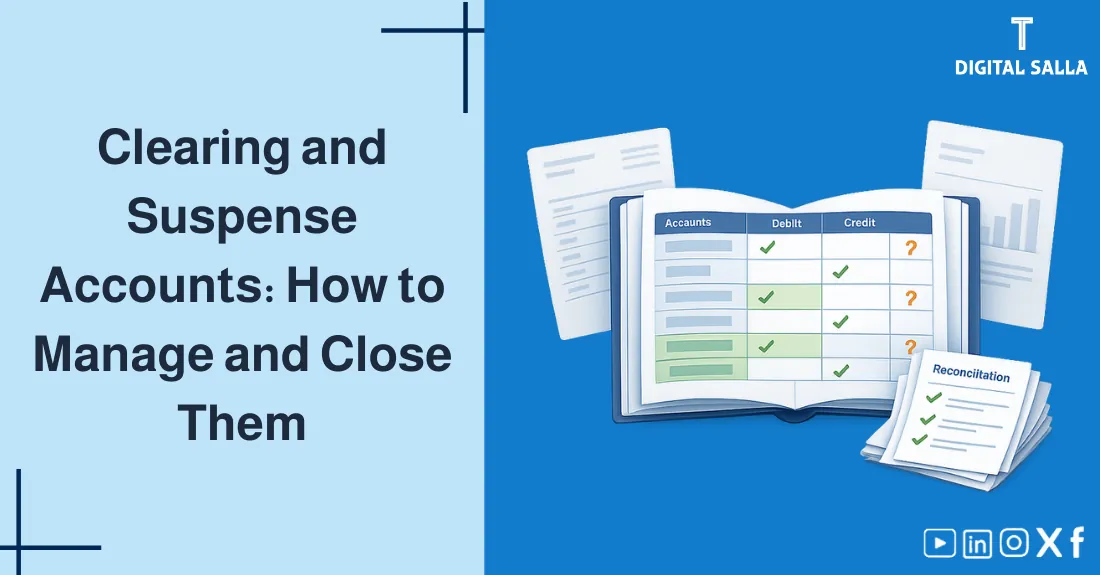
Transit accounts are bridges, not permanent residences. Their natural state is to be empty.
What will you learn in this guide?
- A clear definition of Clearing Accounts and their planned roles.
- What are Suspense Accounts and why do they appear?
- A quick comparison table between the two types.
- Visual model (SVG) explaining the clearing journey from bank to ledger.
- Strategies for Trial Balance Cleanup and handling unallocated payments.
- How to use Aging Reports for transit accounts.
- A checklist for month-end and year-end closing.
Contextual Link: To understand the foundation of these accounts, read Account Classification Guide to see where they fit in your hierarchy.
Table of Contents Auto-highlights on scroll
1) Defining Clearing vs. Suspense Accounts 2) Summary Comparison Table 3) Clearing Accounts: The Planned Buffer 4) Suspense Accounts: Investigating Ambiguity 5) Visual Journey: The Transit Point (SVG) 6) Aging Reports for Transit Accounts 7) Strategies for Zero-Balance Closing 8) Common Management Mistakes 9) Frequently Asked Questions 10) Conclusion
1) Defining Clearing vs. Suspense Accounts
Both are Temporary Accounts used to record amounts until they can be posted to their permanent accounts. However, the reason for their existence is different:
- Clearing Account: A planned account used to facilitate the matching of two sides of a transaction that don't happen simultaneously (e.g., Bank Clearing).
- Suspense Account: An unplanned account used to "park" an amount when you don't know where it belongs (e.g., an incoming transfer with no customer name).
2) Summary Comparison Table
| Feature | Clearing Account | Suspense Account |
|---|---|---|
| Purpose | Internal Matching & Control | Investigating Unknown Entries |
| Origin | Planned in the system design | Created to solve an immediate mystery |
| Example | Payroll Clearing, POS Clearing | Unidentified Bank Inflow |
| Ideal Balance | Zero (at the end of process) | Zero (as soon as resolved) |
3) Clearing Accounts: The Planned Buffer
In modern ERP systems, clearing accounts are essential for Internal Control.
Accounting Templates Library - Excel & Word Files
Real Scenario (Payroll): Instead of recording 100 individual entries from the bank directly to salaries, the total is recorded to a "Payroll Clearing" account, which is then "Cleared" against the individual salary expenses recorded in the system.
4) Suspense Accounts: Investigating Ambiguity
A suspense account is your "Waiting Room." It is used when an accountant is under pressure to close a day or a month but lacks complete info for a specific entry.
The Risk: If left unattended, these accounts become a "Dustbin" for unsolved errors, leading to Material Misstatements in your financial statements.
5) Visual Journey: The Transit Point
Workflow: The Journey of a Clearing Account Bank Side Total cash received Clearing Account The Matching Point Ledger Side Allocated to Customers Net Balance = 0 ✅
The clearing account proves that the bank totals match the individual system records.
6) Aging Reports for Transit Accounts
Just like you track Accounts Receivable Aging, you must track the aging of clearing/suspense accounts.
- 0-7 Days: Normal operational delay.
- 7-30 Days: Warning (Needs follow-up).
- +30 Days: High Risk (Indicates a lost document or a breakdown in the cycle).
7) Strategies for Zero-Balance Closing
- Weekly Reconciliation: Don't wait for month-end to clear transit accounts.
- Responsibility Assignment: Assign one person to be the "investigator" for the suspense account.
- Threshold Rule: If an amount remains in suspense for more than 90 days despite investigation, escalate to management for write-off or special adjustment.
8) Common Management Mistakes
- Hiding Losses: Recording a deficit as a "debit balance" in a suspense account instead of an expense.
- Ignoring Credits: Leaving unknown cash inflows in suspense without attempting to identify the customer (Lost Revenue).
- Reporting as Assets: Listing a large clearing balance as an "Asset" on the Balance Sheet without disclosure.
9) Frequently Asked Questions
How often should I clear the suspense account?
Daily or weekly is best. It should never have a balance by the time you issue your monthly financial statements.
Is "Cash in Transit" a clearing account?
Yes, it is a classic example of a clearing account used to track money that has left the safe but hasn't reached the bank yet.
10) Conclusion
Clearing and Suspense accounts are powerful tools for organization, but only if they remain temporary. By adopting a "Zero-Balance" culture and using aging reports to track transit items, you ensure that your financial statements remain accurate, transparent, and ready for audit at any time.
Your Next Step: Open your Trial Balance and look for any account with the word "Clearing," "Suspense," or "Transit." Is the balance zero? If not, how old are the entries inside?
© Digital Salla Articles — General educational content. For professional account reconciliation services or system cleanup, consult a certified public accountant.