
Cost & Management Job Order Costing • Job Cost Sheet • Project Profitability • Custom Production
Job Order Costing: How to Calculate the Profitability of Each Project or Order Individually?
Job Order Costing: How to calculate the cost of an order and the profitability of each project separately using a Job Cost Sheet, with steps for accurate aggregation of materials, labor, and overhead—Digital Salla.
Establish correctly: Cost Allocation Guide — To understand how to calculate overhead rates before assigning them to a specific job order.
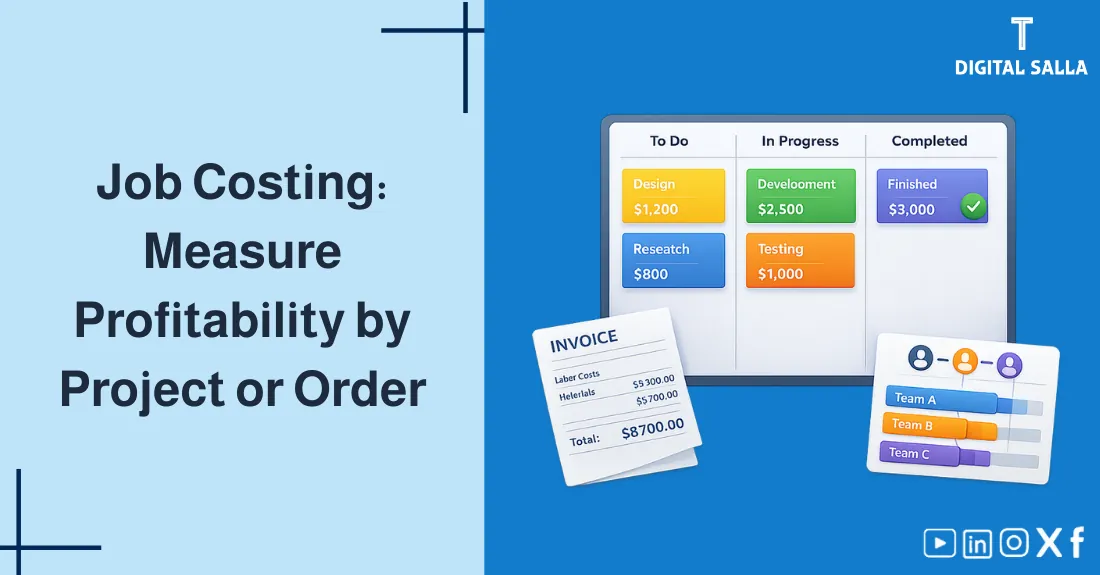
Core Principle: In Job Costing, the "Cost Object" is a specific project or order. Success depends on isolating the costs of Job A from Job B to identify which one is truly profitable.
What will you learn in this guide?
- What is Job Order Costing and which industries use it?
- The Job Cost Sheet: The ultimate document for project control.
- Steps to accumulate costs: Direct Materials, Direct Labor, and Applied Overhead.
- Accounting flow from Work-in-Process (WIP) to Finished Goods.
- How to calculate Project Profitability and analyze variances per order.
Practical Note: The biggest risk in Job Costing is "Cost Leakage," where materials used for Job A are recorded against Job B, leading to distorted profitability reports.
Table of Contents Updates automatically while scrolling
1) The Concept of Job Order Costing 2) The Job Cost Sheet: Anatomy & Components 3) Recording Direct Materials (DM) 4) Recording Direct Labor (DL) 5) Applying Manufacturing Overhead (MOH) 6) The Flow of Costs through Jobs 7) Calculating Individual Order Profitability 8) Operational Controls & Readiness Checklist 9) Common Errors and How to Prevent Them 10) Frequently Asked Questions 11) Conclusion
View Job Sheet Profit Analysis
1) The Concept of Job Order Costing
Job Order Costing is a costing system used by companies that produce unique, custom products or distinct batches of items. Unlike mass production, where costs are averaged, Job Costing treats every order as an independent financial entity.
- Target Industries: Construction, custom furniture, printing shops, legal firms, advertising agencies, and aircraft manufacturing.
Key Insight: In this system, you don't ask "How much does a unit cost?", you ask "How much did this specific order cost us?".
2) The Job Cost Sheet: Anatomy & Components
The Job Cost Sheet is the "Master Ledger" for a single project. It accumulates costs as the work progresses through departments.
Diagram showing a Job Cost Sheet aggregating Direct Materials, Direct Labor, and Applied Overhead to reach the Total Cost.
The Job Cost Sheet serves as a subsidiary ledger for the Work-in-Process (WIP) account in the General Ledger.
3) Recording Direct Materials (DM)
Materials are charged to a job via a Materials Requisition Note.
Manufacturing Costing BOM - Advanced Excel File
- Source: Warehouse requests.
- Verification: Ensure the "Job ID" is clearly written on the request to prevent material cross-contamination between orders.
Related topic: Inventory Valuation — To ensure the unit price of materials charged to the job follows the FIFO or WAC method accurately.
4) Recording Direct Labor (DL)
Labor costs are assigned using Time Tickets or digital activity logs.
- Rule: Only Direct Labor (hands-on time) is recorded on the sheet. Factory supervisors and cleaners are handled via Overhead.
- Accuracy Check: Total hours on job sheets must reconcile with the Payroll Register for the period.
Deep dive: Payroll Reconciliation — To ensure that total labor spent on jobs matches actual bank transfers to employees.
5) Applying Manufacturing Overhead (MOH)
Since actual overhead (rent, utilities) isn't known until the end of the month/year, we use a Predetermined Overhead Rate to "Apply" costs to jobs in real-time.
- Formula: Applied Overhead = POHR × Actual Activity (e.g., Labor Hours).
Crucial Step: At the end of the period, you must compare Actual Overhead with Applied Overhead and record an adjustment for under/overapplied overhead.
6) The Flow of Costs through Jobs
Costs move through the system as the job physically moves through the factory:
- WIP Inventory: Accumulates costs while the job is "Active."
- Finished Goods: When the job is "Completed."
- COGS: When the job is "Delivered/Sold" to the customer.
7) Calculating Individual Order Profitability
The ultimate goal of Job Order Costing is the Profitability Report per Order.
Example: Job #105 Profit Analysis
| Element | Value | Management Insight |
|---|---|---|
| Selling Price | $20,000 | Agreed contract value. |
| Direct Manufacturing Cost | ($13,300) | Sum of DM, DL, and Applied MOH. |
| Gross Profit | $6,700 | Project Margin (33.5%). |
| Estimated Period Costs | ($2,000) | Selling & Admin share (allocated). |
| Net Project Profit | $4,700 | Final profitability for this client. |
8) Operational Controls & Readiness Checklist
To ensure your project costing is reliable:
Job Costing Quality Gate
- Are materials withdrawn only with a Job ID?
- Do workers record time as they work (Real-time logs)?
- Is the overhead rate reviewed whenever a major cost changes (e.g., new lease)?
- Do we perform "Post-Job Reviews" to compare actual costs with the original estimate?
- Are Job Sheets locked once the order is delivered to prevent retroactive edits?
9) Common Errors and How to Prevent Them
- Material Transfers: Taking left-over materials from Job A to use on Job B without a "Transfer Note."
- Idle Time: Charging "Machine downtime" to a specific job (it should be an indirect overhead cost).
- Outdated Rates: Using a 2023 overhead rate for 2025 projects.
- Incomplete Costing: Forgetting to include specialized freight or subcontracting costs specific to a job.
10) Frequently Asked Questions
What is Job Order Costing?
It is a system that accumulate costs for each individual order or project separately, suitable for custom or batch-based businesses.
Why use "Applied" overhead instead of "Actual"?
Because managers need to know the cost immediately to price the job and invoice the client, they cannot wait for the monthly utility bill to arrive.
Is Job Costing used in service businesses?
Yes. Law firms, audit firms, and consultancies use "Engagement Costing," which is a variation of Job Costing where the primary cost is "Billable Hours."
11) Conclusion
Mastering Job Order Costing is the key to identifying your "Winning" and "Losing" projects. By maintaining disciplined Job Cost Sheets, accurately tracing Direct Costs, and applying Overhead consistently, you move from "Global Profitability" to "Granular Visibility." This allows you to refine your bidding process and focus your resources on the most profitable segments of your business.
Action Step Now (30 minutes)
- Open your Work-in-Process (WIP) ledger.
- Select one active job and check if all material requisitions are attached.
- Compare the actual labor hours spent on that job so far with your initial budget.
© Digital Salla Articles — General educational content for management and cost accounting purposes.