
Payroll & HR Accounting: The Complete Guide to Salaries and Compliance
Payroll is more than just transferring money; it is a complex cycle of calculating entitlements, deducting social insurance and taxes, and ensuring compliance with labor laws. Errors here affect both employee morale and the company's legal standing. This guide details the payroll cycle from preparation to the accounting entry—Digital Salla.
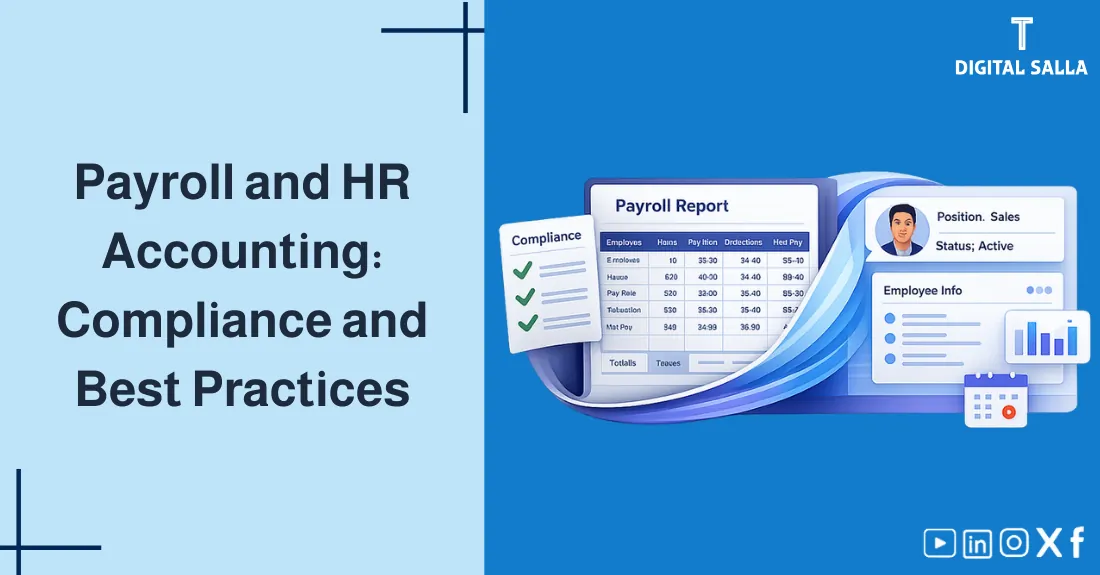
The "Payroll Sheet" is the primary document supporting the salary journal entry.
What will you learn in this article?
- Components of the Salary Package: Basic, Housing, Transport, and others.
- How to calculate Gross Salary vs Net Salary.
- Understanding Social Insurance (GOSI): Employee share vs Employer share.
- The standard Payroll Journal Entry (Accrual and Payment).
- Interactive Tool: Net Salary Calculator (with deductions).
Related Reference: Accrued Expenses
Unpaid salaries at month-end are treated as Accrued Expenses.
Table of Contents Updates automatically during scroll
1) Salary Components 2) Payroll Calculation Flow (SVG) 3) Social Insurance (GOSI) Rules 4) The Payroll Journal Entry 5) Vacations and End of Service 6) Interactive Tool: Salary Calculator 7) Frequently Asked Questions 8) Conclusion
1) Salary Components: Anatomy of a Paycheck
The employment contract defines the compensation structure:
- Basic Salary: The core amount used for calculating overtime and often EOS benefits.
- Allowances: Add-ons like Housing (often 25% of basic), Transport (often 10%), or Phone allowance.
- Gross Salary: Basic + All Allowances. This is the Expense to the company.
- Net Salary: The cash the employee takes home after deductions.
2) Payroll Calculation Flow (SVG Diagram)
Visualizing the journey from Contract to Bank Transfer.
Diagram showing Basic + Allowances = Total Gross, minus Deductions (GOSI/Tax/Advances) = Net Pay. GROSS SALARY Basic + Allowances DEDUCTIONS GOSI + Tax + Loans NET PAY Bank Transfer Note: Company GOSI Share is an EXTRA expense, not deducted from employee.
The company bears the Gross Salary PLUS its share of insurance/taxes.
3) Social Insurance (GOSI) Rules
Social Insurance is a shared responsibility. It usually consists of two parts:
- Employee Share: Deducted from the employee's salary (e.g., 9.75% in KSA, 11% in Egypt - verify local rates). This reduces Net Pay.
- Employer Share: Paid by the company on top of the salary. This is an additional expense for the company.
4) The Payroll Journal Entry (The Standard)
The entry is usually recorded at the end of the month as an accrual, then paid.
Debit: Salaries Expense (Gross Basic + Allowances)
Debit: Social Insurance Expense (Company Share)
Credit: Social Insurance Payable (Total: Employee + Company Share)
Credit: Employee Advances (if any)
Credit: Salaries Payable (Net Amount)
5) Vacations and End of Service (Provisions)
According to the matching principle, you must accrue the cost of vacations and End of Service Benefits (EOSB) monthly, even if no one resigned or took leave. Entry: Dr. Vacation Expense / Cr. Vacation Provision.
EOSB Accrual Rollforward - Excel Template
6) Interactive Tool: Salary Calculator
Calculate the Net Salary and Total Company Cost.
Basic Salary ($):
Housing Allowance ($):
Transport Allowance ($):
Other Allowances ($):
Employee GOSI %:
Company GOSI %:
Enter values to see breakdown...
7) Frequently Asked Questions
What if an employee has unpaid absence?
Unpaid days are deducted from the Gross Salary before calculating taxes/insurance (depending on local law), effectively reducing the daily rate pay.
Are overtime payments subject to GOSI?
In many jurisdictions, GOSI is calculated on the "Fixed" salary (Basic + Housing) and not on variable overtime. Check your local labor law.
How to treat employee loans?
Loans are assets (Receivables from Employees). When deducted from salary, you credit this asset account, reducing the Net Pay.
8) Conclusion
Payroll Accounting requires precision because it touches the most sensitive part of the business: its people. By distinguishing between Gross and Net, and correctly accruing for hidden liabilities like EOSB, you protect the company from legal risks and financial surprises—Digital Salla.
© Digital Salla Articles — General educational content. Labor laws and tax rates vary by country. Consult a HR/Legal specialist for compliance.