
Strategy & Management Pricing Strategies • Cost-Plus • Market Value • Pricing Policies • Discounts
Pricing Strategies: Cost-Plus Pricing vs. Market Value (The Strategic Choice)
Pricing Strategies: A practical guide on how to compare Cost-Plus Pricing with Market-Based pricing, set effective pricing policies, and manage discounts to achieve sustainable profitability—Digital Salla.
Establish correctly: Relevant Costs Guide — To understand which costs are "Relevant" to pricing decisions before applying a markup.
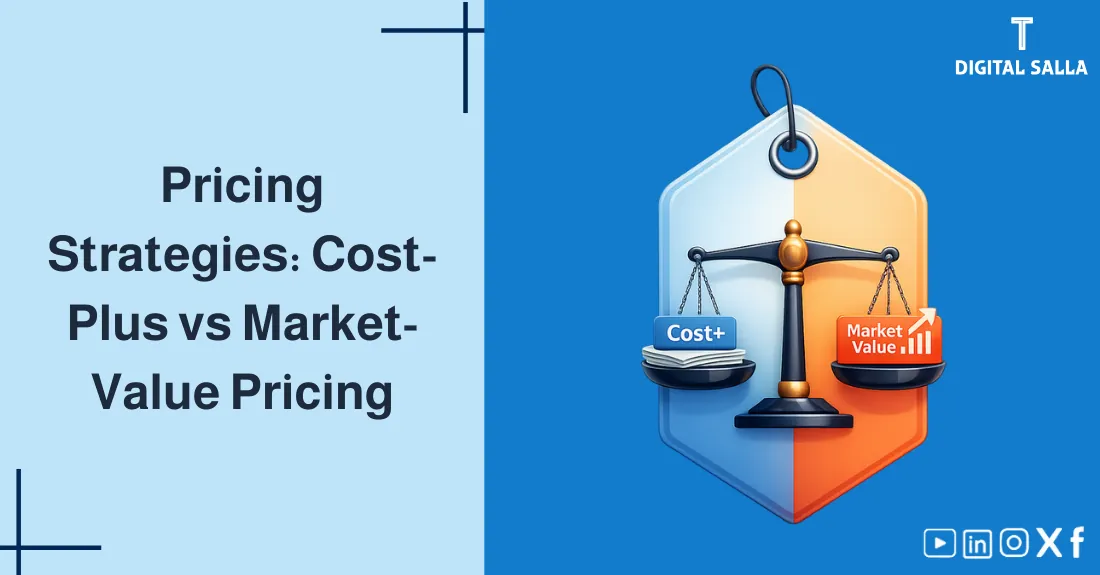
Core Principle: Price is the only element of the marketing mix that generates revenue. Choosing between "Covering Costs" and "Capturing Value" is a strategic crossroads.
What will you learn in this guide?
- Fundamental methodology of Cost-Plus Pricing.
- In-depth view of Target Costing (The Market-Driven approach).
- Value-Based Pricing: How to price based on customer perception.
- Pricing Policies: Skimming vs. Penetration strategies.
- Discount Management: Protecting your margins from excessive erosion.
Practical Note: Setting a price too high loses customers; setting it too low loses profit. Strategic pricing requires a deep understanding of your Competitive Advantage and cost structure.
Table of Contents Automatically determined while scrolling
1) Cost-Plus Pricing Strategy 2) Target Costing (Market-In) 3) Value-Based Pricing Strategy 4) Strategic Pricing Policies (Skimming & Penetration) 5) Summary Comparison Table 6) Managing Discounts & Price Erosion 7) Operational Controls & Readiness Checklist 8) Common Errors and How to Prevent Them 9) Frequently Asked Questions 10) Conclusion
1) Cost-Plus Pricing Strategy
This is the "Inside-Out" approach. You calculate the Total Cost of the product and add a Markup to reach the final price.
- Formula: Unit Cost + (Unit Cost × Markup %) = Selling Price.
- Pros: Simple to calculate and ensures all costs are covered if sales volume is hit.
- Cons: Ignores what competitors are doing and what customers are willing to pay.
Related topic: Manufacturing Cost Elements — To ensure you are including all materials, labor, and overhead in your "Base Cost."
2) Target Costing (The Market-Driven Strategy)
In highly competitive markets, you don't "Set" the price; the market does. You must then work backward to find the allowable cost.
Diagram showing Market Price minus Desired Profit equals Target Cost.
Target Costing is widely used in the automotive and electronics industries where market prices are pre-determined by competition.
3) Value-Based Pricing Strategy
This is the most profitable but difficult strategy. You set the price based on the Value Delivered to the customer rather than the cost of production.
Manufacturing Costing BOM - Advanced Excel File
- Example: A software that saves a company $1,000,000 in labor costs could be priced at $100,000, even if it only costs $1,000 to maintain.
- Requirement: You must have a strong Unique Selling Proposition (USP) and deep customer insights.
4) Strategic Pricing Policies (Skimming & Penetration)
When launching a new product, management usually chooses between two extremes:
4.1 Price Skimming
Setting a High Price initially to "Skim" the early adopters who are less price-sensitive. Common in high-end tech (e.g., new smartphones).
4.2 Penetration Pricing
Setting a Low Price initially to gain market share quickly and discourage competitors. Common in consumer goods and digital subscriptions.
5) Summary Comparison Table
Which Pricing Strategy fits your market?
| Strategy | Drivers | Best Used For | Profit Margin |
|---|---|---|---|
| Cost-Plus | Internal Books | Govt Contracts / Specialized Services | Predictable |
| Target Costing | Competition | Consumer Goods / Retail | Tight Control |
| Value-Based | Customer Perception | Luxury / Software / Consultancy | Highest Potential |
6) Managing Discounts & Price Erosion
A 10% discount doesn't just reduce revenue by 10%; it hits Net Profit much harder.
Example: If your net margin is 20%, a 10% price discount actually cuts your total profit by 50%. You would need to double your volume just to stay even.
- Trade Discounts: Used for bulk buyers to reduce administrative costs.
- Cash Discounts: Used to speed up the cash cycle (e.g., 2/10, n/30).
Read Next: Break-Even Analysis — To calculate exactly how much extra volume you need to sell to offset a price discount.
7) Operational Controls & Readiness Checklist
To ensure your Pricing Policy is effective:
Pricing Quality Gate Checklist
- Are prices reviewed at least quarterly against current material inflation?
- Is the Contribution Margin monitored per product line?
- Do sales teams have a "Maximum Discount" threshold before requiring approval?
- Is the Sales Mix analyzed to ensure you're not just selling low-margin items?
- Have competitors' prices been benchmarked in the last 30 days?
Deep dive: Payroll Reconciliation — To ensure the Direct Labor costs included in your pricing models match actual payments.
8) Common Errors and How to Prevent Them
- Death Spiral: Continually raising prices to cover fixed costs as volume drops (leads to faster volume loss).
- Static Costing: Pricing based on a budget made 12 months ago without considering supply chain shocks.
- Ignoring Overhead: Using only "Material + Labor" as the base for cost-plus pricing and failing to cover rent/salaries.
- Discounting for Cash: Giving a 5% cash discount when your short-term borrowing cost is only 1% (Giving away 4% unnecessarily).
9) Frequently Asked Questions
What is Markup vs. Margin?
Markup is the percentage added to the cost (Profit/Cost). Margin is the percentage of the selling price that is profit (Profit/Price).
When should I use Price Skimming?
Use it when you have a unique product with no immediate competition and a strong brand that can attract "Early Adopters."
Why is Target Costing considered superior for electronics?
Because consumer electronics prices drop rapidly due to competition. A company must design the product to be profitable at the future market price.
10) Conclusion
Strategic Pricing is the bridge between your cost structure and your market position. By understanding the discipline of Cost-Plus Pricing, the market focus of Target Costing, and the profit potential of Value-Based Pricing, you gain the power to steer your entity's profitability with precision. Remember, price is not just a number—it is a signal to your customers and the primary engine of your sustainable growth.
Action Step Now (30 minutes)
- Take your top 3 products and calculate their Markup % over total variable cost.
- Compare this with a competitor's price for a similar product.
- Ask: Are we pricing based on our In-house Costs or the Market Reality?
© Digital Salla Articles — General educational content for management accounting and strategic pricing purposes.