Taxes, Salaries, and Sectors

Retail Accounting: Managing POS and cash and inventory control

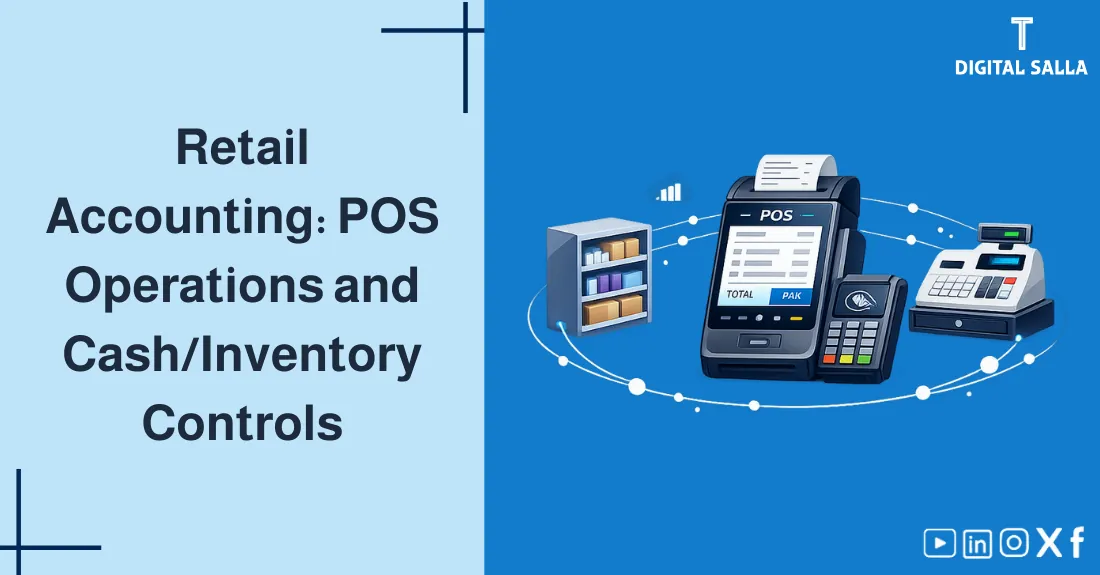
Illustration for Retail Store Accounting
Skip to content
Retail Sector POS • Inventory • E-commerce • Reconciliations

Retail Accounting: Managing POS and Controlling Cash and Inventory

Retail accounting (Retail) is not just about recording sales, but a specialized system for managing thousands of transactions, controlling inventory, and reconciling daily cash and digital payments. Whether you manage a traditional store or an e-commerce platform—or both—accurate accounting is your shield against shrinkage, errors, and loss.

Retail accounting design with a cash register and digital payment icons.
Summary: From the barcode at the POS to the profit margin in the ledger—how to control every step?
What will you gain from this article?
  • Understanding the retail accounting cycle: from sale to settlement.
  • Comparing Periodic vs. Perpetual Inventory and choosing what fits your activity.
  • Practical methods for POS control and reducing cash discrepancies.
  • Managing E-commerce and payment gateway reconciliations.
  • Calculating COGS and key indicators like Gross Margin and Turnover.

1) What is Retail Accounting?

Retail accounting is specialized in tracking goods sold directly to the final consumer. It is characterized by a high volume of small transactions, sensitive inventory control, and a diversity of payment methods (Cash, Card, Wallets, Buy-Now-Pay-Later).

Core Accounting Logic: Success in retail isn’t just “selling more,” but selling with the lowest shrinkage and highest turnover.

2) Traditional Store vs. E-commerce: Accounting Differences

In the modern era, many retailers operate as “Omnichannel.” Here are the differences to consider:

Traditional Store vs. E-commerce
Item Traditional Store (POS) E-commerce Store
Primary Risk Cash shrinkage / Store theft Shipping errors / Returns / Gateway fees
Inventory Point Display floor / Backroom Fulfillment center / Logistics partner
Reconciliation End-of-shift cash count Payment gateway settlement match
Tax (VAT) Based on POS location Based on customer location / Export rules

3) Retail Accounting Cycle: From POS to Ledger (SVG)

The retail accounting cycle must be automated as much as possible to handle the scale.

The Retail Accounting Cycle Flowchart showing: Sale at POS, Inventory update, Payment Reconciliation, and Financial Reporting. 1) POS Sale Invoice + Barcode 2) Inventory Auto-Update (Perpetual) 3) Payments Cash & Gateway Match 4) Ledger Profit & COGS Report
Automation is the heartbeat of retail: Barcode -> Inventory -> Cashier -> Ledger.

4) Inventory Control: Periodic vs. Perpetual

Which method should you use for your inventory control?

Recommended for you

Inter-Warehouse Transfers Tracker - Excel Template

Stock Transfer Template: Manages transfer orders from dispatch to receipt, including in-transit stat...

4.1 Perpetual Inventory (Highly Recommended): Inventory is updated in real-time with every sale or purchase. Advantage: Constant visibility of stock, easier to detect shrinkage, supports e-commerce.
4.2 Periodic Inventory (Traditional): Cost of goods is determined only after a physical count at the end of a period. Advantage: Simpler for very small businesses with no POS system.
Important for e-commerce: Learn more about FinTech Integrations — To automate the link between your store and your ledger.

5) Cash and POS Control: Eliminating Discrepancies

"Cash is King" in retail, but it's also the hardest to control. POS control requires discipline:

  • Blind Counts: Cashiers should count cash without knowing what the system says.
  • Dual Sign-off: Shift closes must be signed by both the cashier and a supervisor.
  • Petty Cash Separation: Never use the cash register for "store expenses" without a separate voucher system.
Pro Tip: Reconcile digital payments separately from cash. Often, "missing money" is just a payment recorded as cash but paid by card.

6) Payment Gateways and Digital Wallets: Reconciliations

When a customer pays via Apple Pay or a credit card, you don't receive the cash immediately. You receive a settlement minus fees.

Example of Gateway Reconciliation
Item Amount Accounting Treatment
Customer Payment 1,000.00 Debit Gateway Receivable
Gateway Fees (e.g. 2%) (20.00) Debit Bank Fees (Expense)
Net Bank Deposit 980.00 Debit Cash at Bank

7) COGS and Profitability Indicators

Calculating the Cost of Goods Sold (COGS) is the foundation of your income statement.

COGS = Beginning Inventory + Purchases - Ending Inventory

Key Retail KPIs:

  • Gross Profit Margin %: (Sales - COGS) / Sales.
  • Inventory Turnover: COGS / Average Inventory. (How many times do you "sell out" your stock per year?)
  • Shrinkage Ratio: (System Inventory - Physical Inventory) / Sales.

8) Common Pitfalls in Retail

  1. Ignoring Shipping Costs: In e-commerce, not adding shipping to the cost model can kill margins.
  2. Poor Return Management: Returns should reverse the sale and return the item to inventory.
  3. Manual Inventory Entry: Increases the probability of human error significantly.

9) Daily/Monthly Control Checklist

Checklist

  • Daily: Match POS Z-Report with actual Cash/Card receipts.
  • Daily: Verify all digital payments were batch-submitted.
  • Weekly: Cycle counting for high-value inventory items.
  • Monthly: Reconcile gateway settlements with bank statements.
  • Monthly: Full physical inventory count vs. Perpetual system balance.

10) Tools and Ready Templates for Retailers

Daily POS and Cash Reconciliation - Excel Template

An easy-to-use template to record daily POS reports, cash counts, and digital settlements, highlighting any over/under discrepancies instantly.

Inventory Shrinkage and Waste Tracker

Track items lost to damage, theft, or expiration. Links directly to your COGS adjustments.

11) Frequently Asked Questions

What is meant by Retail Accounting?

Specialized accounting for selling goods directly to consumers, focusing on high volume, inventory, and payment reconciliations.

What is the difference between Periodic and Perpetual Inventory?

Perpetual is real-time; Periodic is count-based at the end of the term.

How is COGS calculated in retail?

Beginning Inventory + Purchases - Ending Inventory.

12) Conclusion

Retail accounting is the bridge between operational speed and financial control. By automating your inventory, disciplining your POS control, and diligently reconciling gateways, you transform your store from a "sales machine" into a sustainable, profitable business.

© Digital Salla Articles — General educational content. Applications vary by local tax laws and specific store policies.