
Operating Revenue vs. Gains: Why Should They Be Separated in the Income Statement?
Profit is not just one number; its source determines the future value of the company. Distinguishing between Revenue (income from core operations) and Gains (incidental profit) is essential for transparent financial reporting. Without this separation, a company might look healthy because it sold its building, while its actual sales are collapsing. This guide provides the practical path to analyzing income types correctly—Digital Salla.
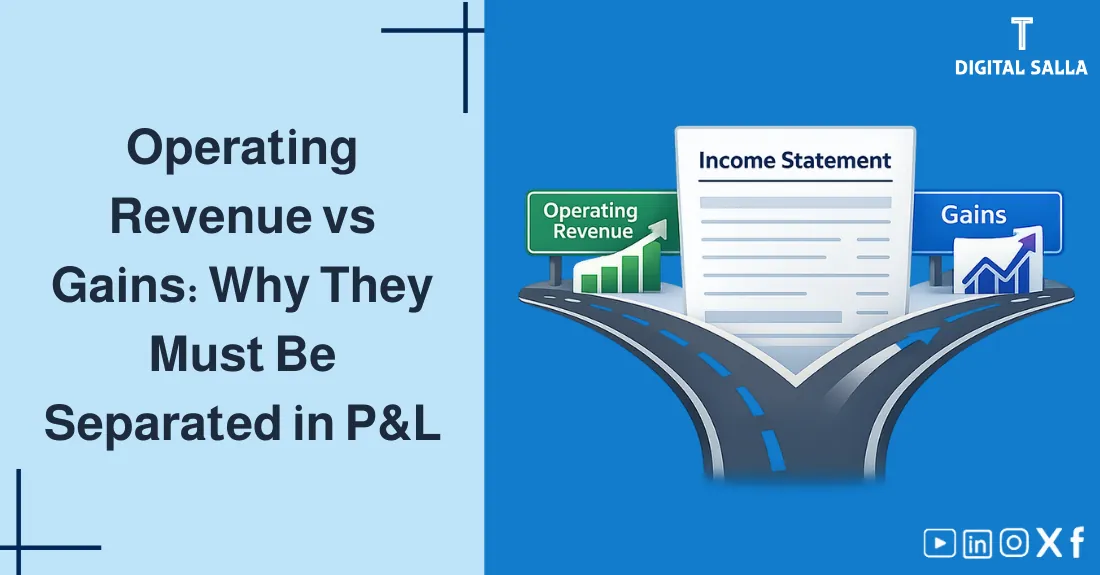
Revenue shows the power of the business model; Gains show the result of peripheral events.
What will you learn in this article?
- Detailed definition of Revenue (Operating) vs. Gains (Non-operating).
- Why Revenue is reported as Gross while Gains are reported as Net.
- The concept of "Profit Sustainability" and its importance for investors.
- Operational Flow Map (SVG): Separating core from incidental activities.
- Practical examples: Selling products vs. selling fixed assets.
- Interactive quiz to test your classification of income.
The Performance Engine: Your reference here: Accrual Basis & Matching Principle (How income is timed)
Table of Contents Updates during scroll
1) Definitions: Core vs. Peripheral 2) Source of Income Map (SVG) 3) Why Gross vs. Net Reporting? 4) Profit Sustainability for Investors 5) Detailed Comparison Table 6) Real-world Scenarios (Analysis) 7) Interactive Quiz: Revenue or Gain? 8) Frequently Asked Questions 9) Conclusion & Summary
1) Definitions: Core Operations vs. Peripheral Events
To classify income correctly, you must ask: "Does this come from our daily business goal?"
- Revenue (Operating): The gross inflow of economic benefits arising from the company's ordinary activities (e.g., selling cars for a car dealer).
- Gains (Non-operating): Increases in equity from incidental or peripheral transactions (e.g., selling a used car for a supermarket).
The Ordinary Activity Rule: Revenue is recurring and predictable; Gains are often one-time "surprises" in the financial period.
2) Source of Income Map: The Profit Split (SVG)
This diagram summarizes how a company generates value from different levels of activity.
A diagram showing the company at the center with two output paths: Core Activities leading to Revenue, and Peripheral Events leading to Gains. The Company Income Sources Core Activities REVENUE (Gross) Peripheral Events GAINS (Net) Accounting Goal: Profit Transparency
Correct classification prevents "masking" poor operational performance with one-time lucky events.
3) Why Gross vs. Net Reporting? (The Accountant's Logic)
In the Income Statement, we treat these two figures very differently:
- Revenue is Gross: We report the full sales amount (e.g., $1 Million) to show the "Top Line" volume of business.
- Gains are Net: We only report the profit (e.g., $10,000 profit on a machine sale) because the machine's cost isn't a "Cost of Goods Sold".
4) Profit Sustainability for Investors
Investors and banks look for Recurring Income. If a company has $500,000 profit, but $400,000 of it came from a "Gain" (selling land), that company is risky because it cannot "sell land" every year to pay its bills. Revenue is what pays for future expansion and dividends.
5) Detailed Comparison Table
Key Differences Summary
| Feature | Revenue (Operating) | Gain (Non-operating) |
|---|---|---|
| Source | Core business purpose. | Incidental/Secondary events. |
| Frequency | Regular and recurring. | Occasional/One-time. |
| Presentation | Gross (Total Sales). | Net (Profit only). |
| Analytical Value | Shows Market Share & Demand. | Shows Resource Efficiency. |
6) Real-world Scenarios: Which is which?
- A Tech Company: Sells software licenses → REVENUE.
- The same Tech Company: Sells its old office furniture at a profit → GAIN.
- A Real Estate Firm: Sells apartments (its product) → REVENUE.
- A Supermarket: Sells its stock portfolio at a profit → GAIN.
7) Interactive Quiz: Revenue or Gain?
If a Bakery sells a used delivery van for $15,000, and its book value was $12,000, how is the $3,000 difference classified?
Classification: Gain
Classification: Revenue
8) Frequently Asked Questions
Do Revenue and Gains appear in the same section?
No. Revenue appears at the very top (Gross Profit section). Gains usually appear under "Other Income" or after the Operating Profit line.
Can a 'Gain' be negative?
Yes, but then it is called a Loss (e.g., selling an asset for less than its book value).
What is 'Comprehensive Income'?
It is a broader category that includes both operating results and unrealized gains/losses from items like foreign exchange or investments.
9) Conclusion & Summary
Separating Revenue from Gains is the hallmark of honest and professional accounting. By highlighting the income from core operations, you provide stakeholders with the clarity needed to judge the company's true health and future potential—Digital Salla. Always prioritize the "Top Line" for sustainability and the "Gains" for incidental highlights.
© Digital Salla Articles — General educational content. For complex revenue recognition policies (IFRS 15) or detailed tax treatments of gains, please consult a certified public accountant.